

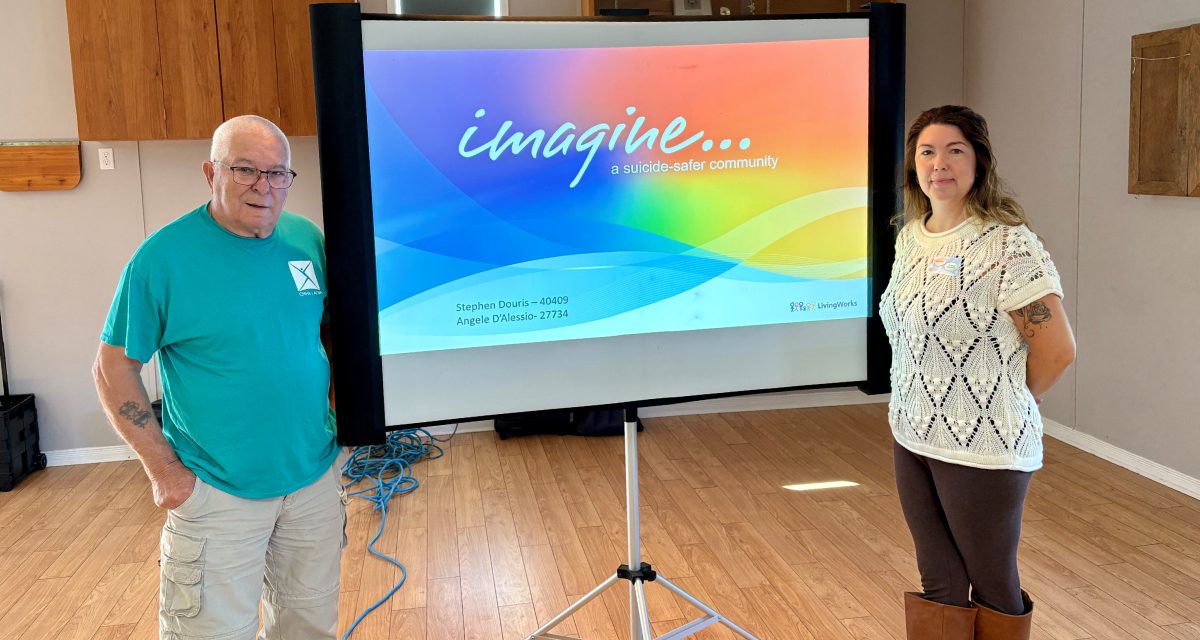
Approximately a dozen people took part in a free safeTALK training session at Treadwell Community Hall in the Township of Alfred and Plantagenet on Thursday, September 10, learning how to recognize when someone may be thinking about suicide and how to connect them with further help. Training was organized by the Canadian Mental Health Association (CMHA) – Champlain East.
safeTALK, which stands for Suicide Alertness For Everyone, is a three- to four-hour training program developed by LivingWorks. It is designed for people aged 15 and older and does not require previous suicide-prevention experience.
The training was led by Stephen Douris and Angele D’Alessio, who began the session by discussing the difficulty many people have talking openly about suicide. Douris also shared his own experience as a survivor of suicide attempts, explaining that his experiences eventually led him to become involved in suicide-prevention training.
He said that during his first attempt, he had told people he was going to kill himself, but nobody recognized what was happening.
“That’s become my passion,” Douris told participants, explaining his desire to help prevent others from going through similar experiences.
Douris said he wants people to become more comfortable using the word “suicide” rather than avoiding the subject or using more general terms such as someone being “in distress.”
The safeTALK program teaches participants to move beyond the tendency to miss, dismiss, or avoid signs that someone may be thinking about suicide. Participants learn to recognize invitations for help and use the TALK steps—Tell, Ask, Listen, and KeepSafe—to help connect the person with someone who can provide further support.
The training emphasizes that participants do not have to be a mental-health professional to play a role in suicide prevention. Instead, safeTALK participants serve as a connection between someone who may be thinking about suicide and people or services equipped to provide further intervention.
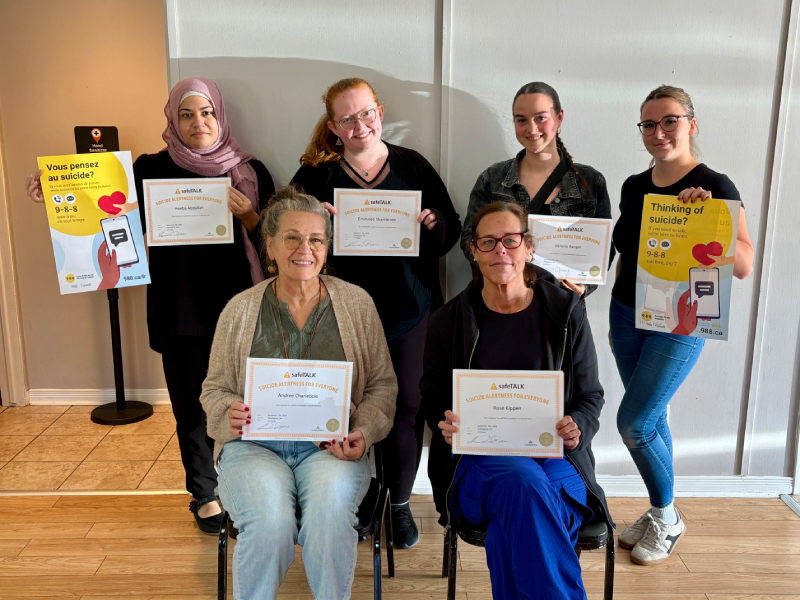
The program is designed to complement more intensive suicide-intervention training, such as LivingWorks’ two-day ASIST program.
D’Alessio told participants that open, direct, and honest conversations can make it easier for people experiencing suicidal thoughts to seek help.
The training also addressed the relationship between suicide and mental health, noting that while mental-health disorders can increase vulnerability to suicide for some people, the absence of a diagnosed mental-health disorder does not eliminate suicide risk.
For Douris, teaching the subject remains personal. He said that even after conducting numerous training sessions, the material can still be difficult because of his own experiences.
But he continues to lead the sessions because he believes more people should be prepared to recognize when someone may need help.
The message throughout the training was that suicide prevention is not limited to professionals. Friends, family members, co-workers, and other people in the community may be among the first to notice something is wrong, and learning how to respond can help connect someone to further support.
For suicide prevention and crisis support in Canada, readers can call or text 9-8-8, the Suicide Crisis Helpline, 24 hours a day, seven days a week. Additional information and resources are available at 988.ca, while Talk Suicide Canada can be reached at 1-833-456-4566.
