

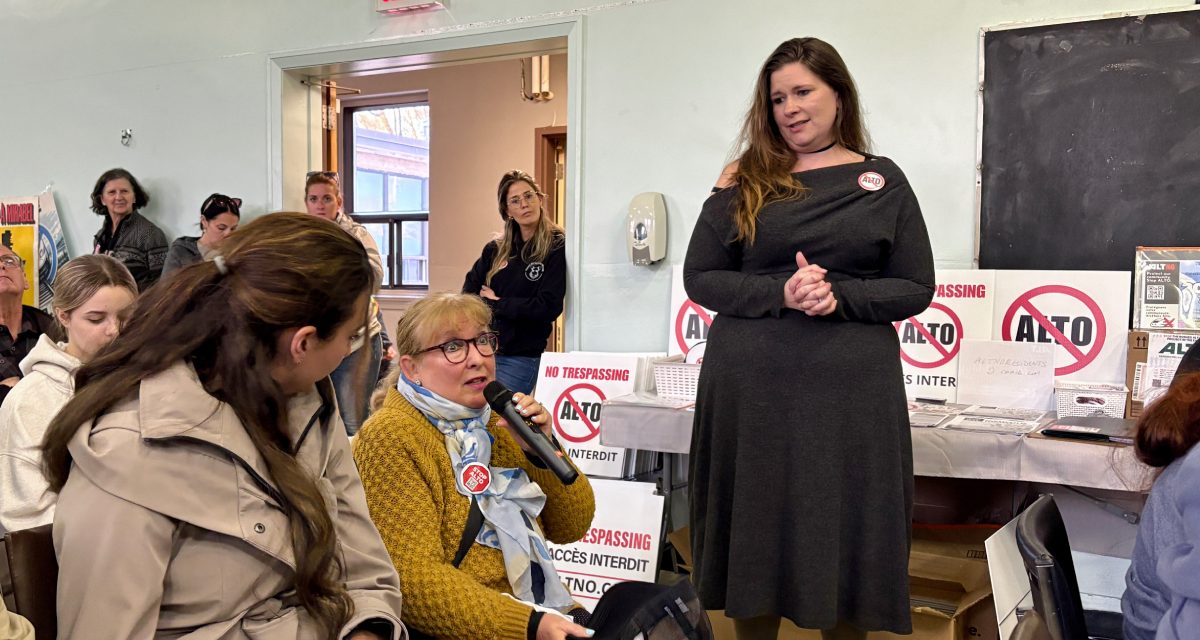
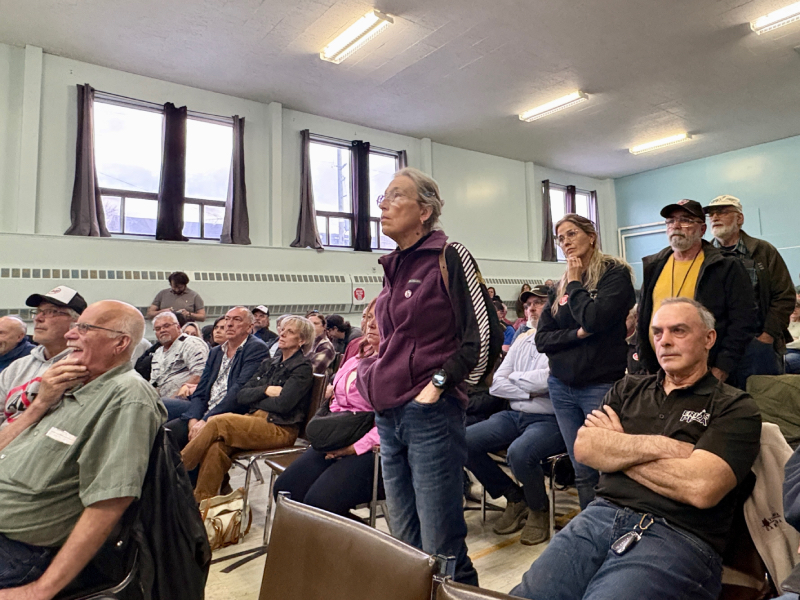
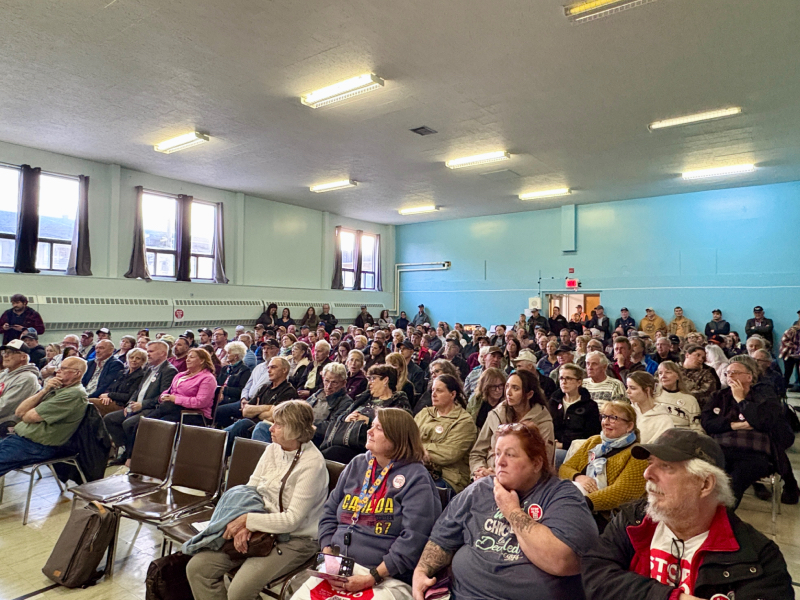
On Wednesday, May 6, concerns over property expropriation, cost, and the long-term viability of the proposed Alto high-speed rail project dominated a town hall meeting in Casselman, where speakers and attendees repeatedly raised objections to the planned rail corridor. The event drew a large and at times animated crowd, with remarks from the stage and the floor met with applause and cheers from the audience.
Approximately 200 individuals attended the town hall organized by the Prescott-Russell-Cumberland Federal Conservative Riding Association.
Rather than a traditional question-and-answer format following the speakers, much of the time at the microphone was used for statements of concern, with multiple attendees sharing similar criticisms about the project’s potential impact on communities along the proposed route.
Mirabel municipal councillor Robert Charron was one of the guest speakers at the event and said the scale of potential land acquisition remains a significant issue for residents along the corridor.
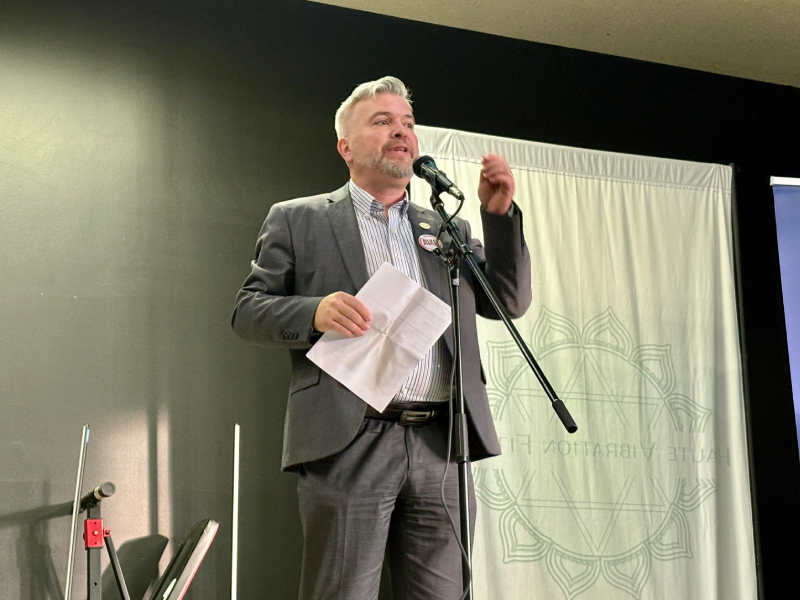
“We’re going to have at least 2000 families or so that will be expropriated,” Charron said, adding that he was citing reporting and discussions he attributed to Alto leadership.
He said that the impact would extend across the broader region.
“That’s a lot between Montréal and Ottawa,” Charron said, noting additional effects could extend further into Ontario.
Charron said people living outside the corridor may not fully grasp what the project’s construction would mean for affected communities. His remarks were met with applause from the audience at several points.
He then encouraged attendees to continue spreading information within their own networks.
“The rule of seven is when you have an idea, like we’re having tonight, is to speak with at least seven people in your surroundings. What’s going to happen is like a pyramid. The seven people you’re going to talk to about opposing the high-speed train will then speak to seven others,” he said.
He described the effort as ongoing and long-term, saying, “This is a marathon, not a sprint. This must not be the first and last meeting we do together. We have to do it again and again.”
Charron also urged sustained engagement beyond the town hall itself.
“We need to stay together. At the end of the day, remember the challenge to speak to seven people you know. If you’re on social media, share the maximum amount of information, French, English, whatever the language, and continue to stick together,” he said.
The second speaker, Lanark-Frontenac Member of Parliament (MP) Scott Reid, centred his remarks on what he described as the financial risks and assumptions underlying the Alto proposal. His comments were presented as analysis and opinion based on publicly available projections and external studies.
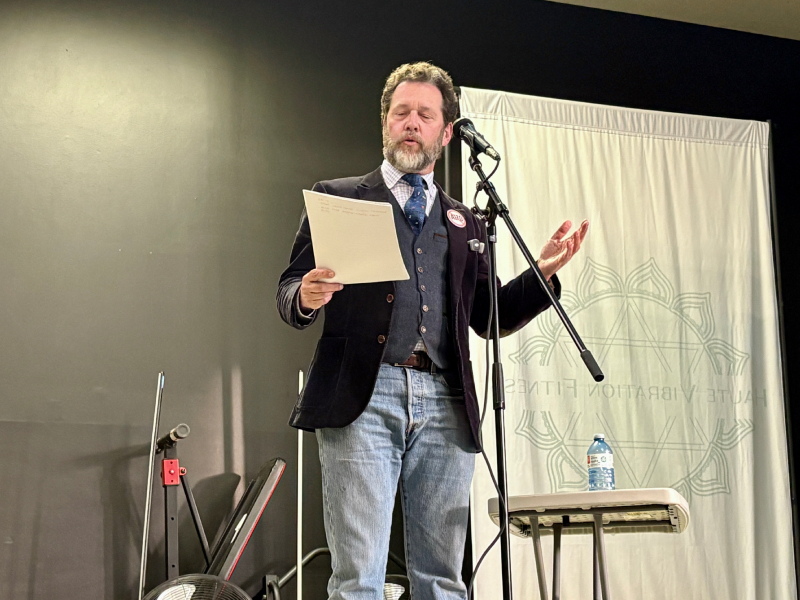
“What will stop Alto is the financial case,” Reid said.
He argued that Canadians are effectively being asked to bear the costs of the project in multiple ways over time.
“There are 40 million Canadians who are, in effect, being asked to invest twice in this project. First, as the bondholders, who will finance the construction of the rail line in the years before its projected completion in the year 2037. And second, as the shareholders who will own the high-speed rail after that date,” Reid said.
Reid also questioned the long-term investment horizon, tying his remarks to ridership and pricing assumptions used in feasibility modelling, including estimates from a McGill University Transportation Research Centre study on what current VIA Rail passengers would be willing to pay for faster service.
He said, “I doubt very much there would be any investment advisor on Earth who would counsel his clients to tie up their money today for a project that won’t likely pay off until 2093.”
A significant portion of Reid’s speech focused on projected passenger numbers contained in Alto’s business case modelling, which he said were not grounded in realistic assumptions.
“Alto’s own projected passenger number, based on its business case modelling, of 24 million passengers a year is pure fantasy,” he said.
Reid said that reaching such levels would require near-total conversion of existing air, rail, and car travel demand, under the modelling scenario he was referencing.
“They need to get 100 per cent of all passengers taking air, rail, and car today, plus another 38 per cent,” he said, under the scenario he described.
He then outlined what he described as key factors influencing intercity travel decisions into three main factors: cost, comfort, and total door-to-door travel time.
“What every intercity traveller thinks about when they are deciding which mode of transport to select is some combination of the following three factors: comfort, cost, and the total time it takes to get from the traveller’s starting address to their destination in another city.”
While acknowledging high-speed rail would be competitive on comfort, Reid argued it would struggle against air travel on speed.
“Planes are just faster,” he said, “even taking into account the time spent at the airport for security screening.”
Reid also said car travel would remain competitive for many trips due to flexibility and door-to-door convenience.
“Car travellers who are heading from a western part of Montréal or Ottawa to an eastern or northern part of Toronto will not be tempted by a train trip that starts by travelling half an hour or more in the wrong direction to get to the train station by subway or Uber to get to their final destination,” he said.
Reid pointed to a range of estimates for construction costs as another key uncertainty in the project.
“The official estimated construction cost for Alto is $60 to $90 billion,” he said, referring to figures contained in project planning data.
He also referenced external academic analysis that produced a broader range of potential outcomes.
“A defensible cost projection for the Alto corridor is $142 billion, with a 95 per cent prediction interval of $76 to $264 billion,” he said, referencing a study of comparable high-speed rail projects across the G7.
Reid said such uncertainty would be difficult for any investor to accept, noting, “That, in itself, would cause any rational investor to conclude that the Alto project is just too risky.”
He warned that financing scenarios could translate into long-term public costs, based on his projections.
“Every such family will therefore have to shoulder $6,000 in additional taxes between now and 2093,” he said.
Under higher-cost scenarios, he said that burden could increase substantially.
“If the highest estimate is used, it rises to over $26,000 per family,” he said.
Reid also emphasized the extended timeline for repayment under the financing scenario he described.
“A baby born this year will be 67 years old in the year the investment in Alto finally pays off,” he said.
Throughout the evening, audience reaction reflected strong opposition from many attendees, with applause punctuating several remarks. At the microphone, multiple speakers did not pose direct questions but instead used their time to reiterate concerns about displacement, cost, and the project’s broader impact on rural communities in Eastern Ontario.
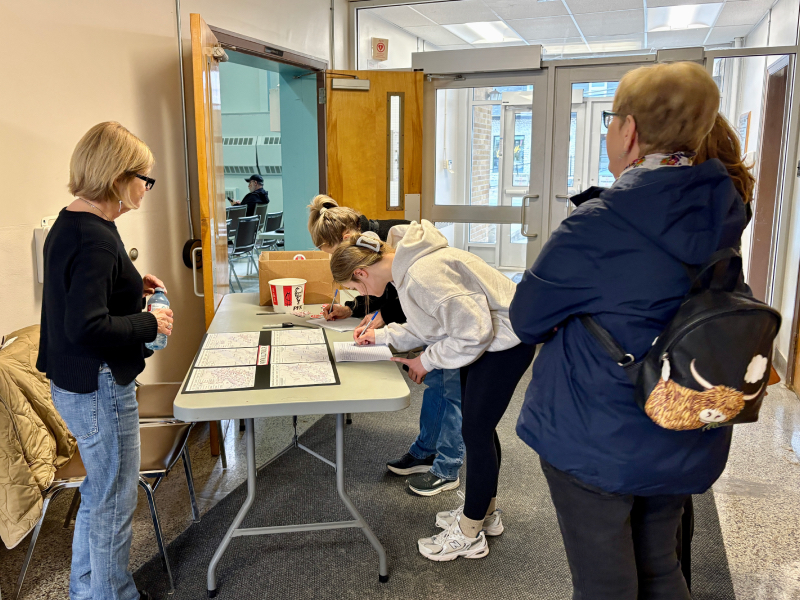
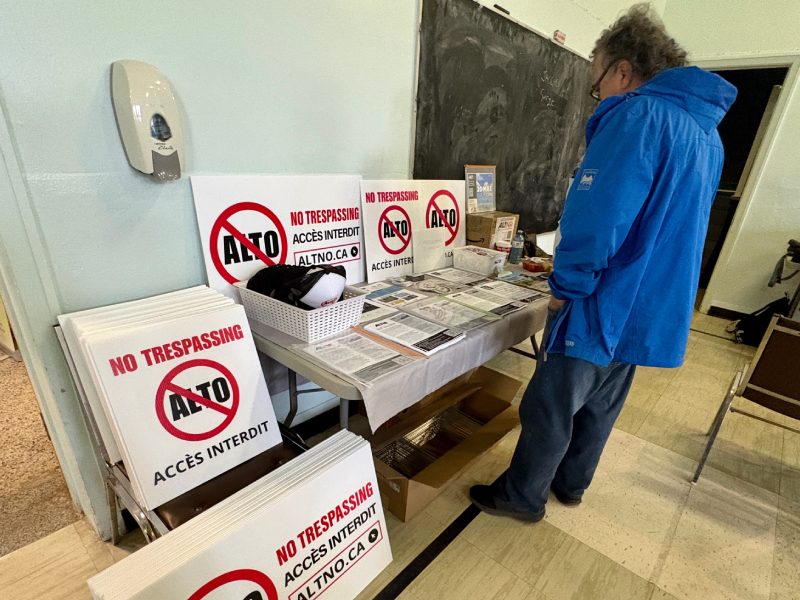
Others asked what more they could do to share their concerns with other Canadians outside of sharing petitions.
The tone of the meeting suggested a divided public conversation as the Alto proposal continues to move through planning stages, with opponents saying they intend to maintain pressure on elected officials and project planners.
Reid concluded his remarks by saying the objective should be to force an early reassessment of the project’s viability.
“The goal is to avoid as much of this pain of these billions of dollars in expenditures as possible by bringing the government to the inevitable decision point that Alto is unworkable as soon as possible,” he said.
