

“Those who sleep in Flanders,” The Vankleek Hill-ers of the 2nd Company, 11 Platoon, 87th Battalion, Canadian Grenadier Guards
By Jean-François Born
When preparing for a trip to Scotland and the Northumberland region of northern England with my family, I decided to consult the website of the Commonwealth War Graves Commission (CWGC) to see if any Canadian military personnel were buried in Alnwick, where we were planning to visit my wife’s relatives. I found Private Mike Laviolette buried in Alnwick Cemetery, the lone Canadian among 2000 civilian graves including over a dozen other CWGC war graves. Although the vast CWGC cemeteries of France, the Netherlands, Italy, or Germany are well known, there are war graves scattered in many countries and these are sometimes isolated among civilian graves. I wanted to expose my sons to historical research and to the veneration of these war graves. I wondered how a Vankleek Hill boy ended up buried in Alnwick, so far from the front in France and from comrades of his 87th Battalion, Canadian Grenadier Guards.
My research revealed not only the story of one soldier, but of four from Vankleek Hill who joined the 87th Battalion November 17, 1915 in Montreal: Mike Laviolette, his younger brother Albert Laviolette, Gusty Villeneuve and Aldaige Crevier. They had sequential serial numbers and served in the 2nd Company, 11 Platoon. The regiment had held a recruitment drive two days earlier in Vankleek Hill.
Those in attendance at the recruitment drive listened to speeches and a “direct appeal” by Sir Clifford Sifton “to the young men to come forward, and maintain the liberties for which their fathers had bled and died.” About a year later, The Review (then known as The Eastern Ontario Review), stated that “Vankleek Hill is paying its full share of the blood sacrifices required in the fight for civilization.” With the war explained to the public in these terms, the call for recruitment must have been persuasive. The experiences of these four men represent a sample of the potential fate of thousands who fought with the Canadian Corps during the First World War.
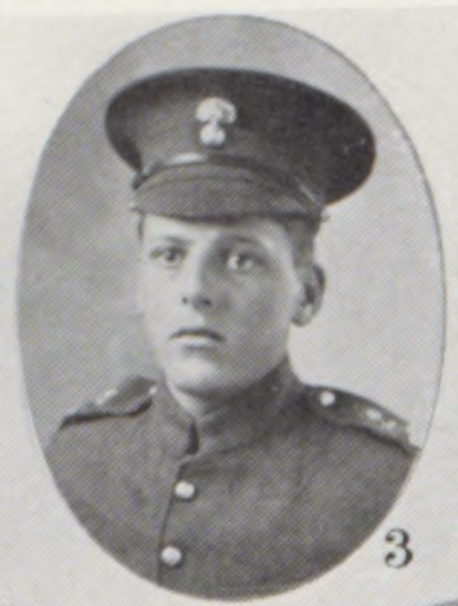
Mike Laviolette, a labourer, was born New Year’s Day, 1896. He was wounded October 16, 1916 in the attack on Regina Trench, shortly after arriving at the front. He suffered a gunshot wound to his right arm which caused nerve damage and led to numbness. He spent months in hospital in England to be rehabilitated. When he returned to duty, he was assigned to No. 52 District, No. 112 Company, Canadian Forestry Corps, rather than returning to the 87th, or another infantry battalion.
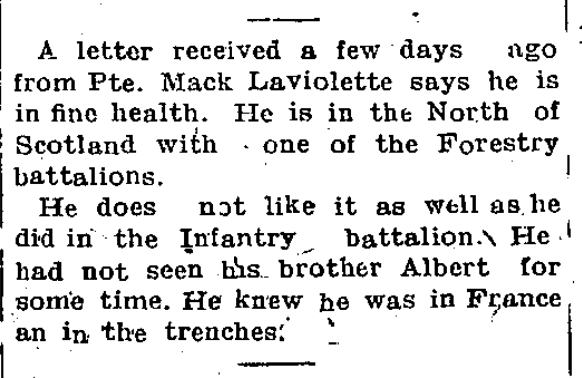
The Review reported September 7, 1917 that Mike Laviolette “was in fine health in the north of Scotland with his forestry battalion… He does not like it as he did the infantry battalion.” It added that “He had not seen his brother Albert for some time. He knew he was in France and in the trenches.” Laviolette fell ill and died June 12, 1918 while his forestry battalion was working at Chillingham, in Northumberland. No. 112 Company noted he suffered from gastritis, but the medical personnel at Alnwick military hospital recorded that he was “gravely ill” due to nephritis which debilitates the kidneys.

It was a cruel fate to survive a gunshot wound only to die suddenly from an illness so far from the front. It is possible he suffered from a bladder infection which went untreated and spread to his kidneys. At that point, hospital staff were unable to save his life. A condition known as “trench nephritis” was common at the time and the symptoms were described as “breathlessness, swelling of the face or legs, headache, sore throat, and the presence of albumin and renal casts in urine.” The Review published that he “numbered with those who sleep in Flanders.” This graceful statement and writing that he had succumbed to a gas attack were inaccurate. He was 22 years old when he died.
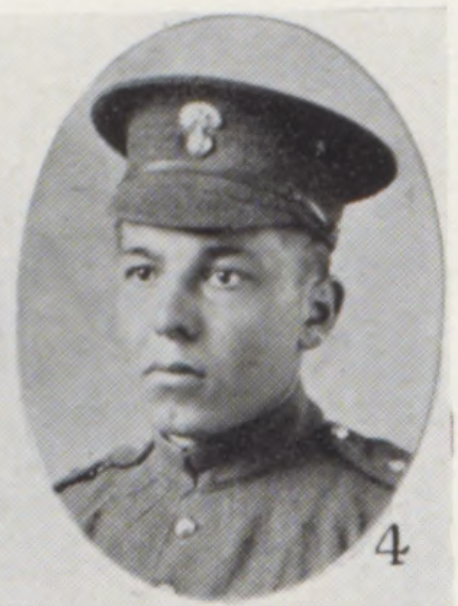
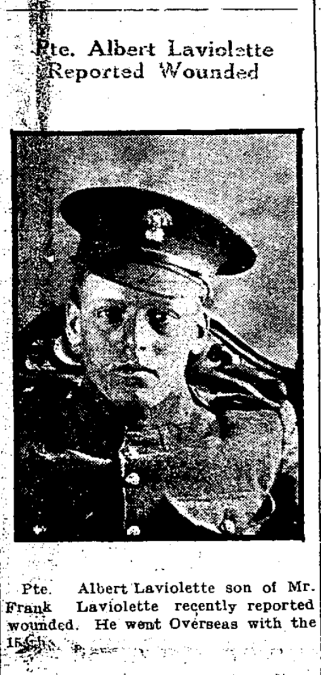
Albert Laviolette, a brickmaker, was born April 22, 1897. Both he and his older brother Mike were illiterate, as they were unable to sign their names on their attestation papers. In addition, although their father Frank was listed as next-of-kin, the Reverend A. Beausoleil, Vankleek Hill was listed as point of contact. Albert survived the war, but was wounded by shrapnel August 15, 1917 at the Battle of Hill 70. Later, he faced a severe bout of sexually transmitted infection which led to orchitis and hospitalization. The scar from his shrapnel wound remained visible on his face after the war. Albert returned to Vankleek Hill May 23, 1919. He had been away four years.
According to the Eastern Ontario Review, Friday, May 30, 1919, a celebration was organized in Vankleek Hill September 1, 1919 for the returned, wounded and deceased soldiers of the town and district. It included a parade, singers, bands, a banquet, as well as speeches in English and French. The highlight of the day was the calling of 95 names, or their next of kin, to receive “a beautiful gold medal suitably engraved.” With hindsight, we can wonder whether this was a celebration, or an expression of relief.
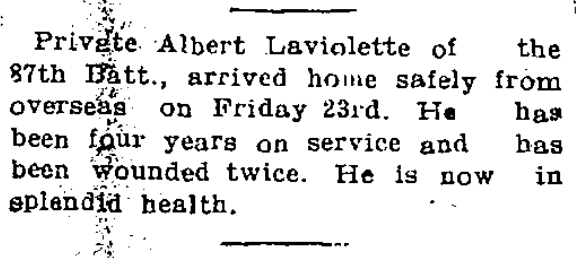
In the Second World War, Albert Laviolette was with the Veteran’s Guard of Canada which had various roles, such as guarding military installations, or maintaining security at prisoner-of-war camps in Canada. He died in January 1975 and is buried in Notre-Dame Cemetery, Ottawa.
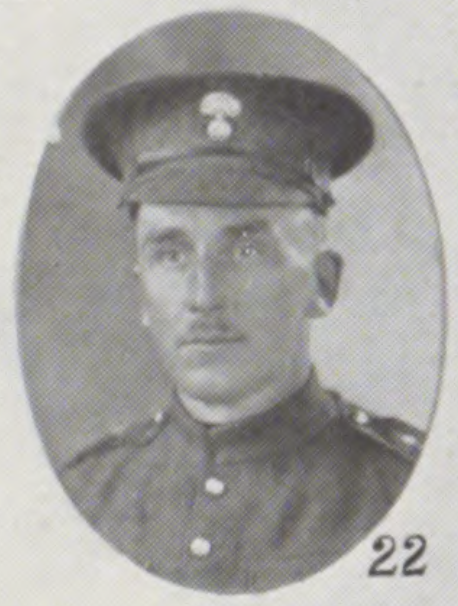
Gusty (Gustave) Villeneuve, a bread driver for Cunningham Bakery, Ottawa, was born 13 October 1883. Shortly after arriving in France in September 1916, he fell off a wagon he was unloading and struck his head just above the left eye. He was unconscious for several hours and noted his vision blurring. Despite this, he returned to duty. He was then wounded during the attack on Desire Trench, November 18, 1916.
Shrapnel was removed from his right hand, hip and thigh. He was 33 years old when wounded. As a result of striking his head, his vision got progressively worse and his left eye went completely blind. He was deemed medically unfit and was sent home to Canada November 6, 1917. He rejoined his wife Mary Jane (Marie Jeanne), his two daughters and son. Villeneuve passed away January 1, 1950. His burial place is unknown to the author.
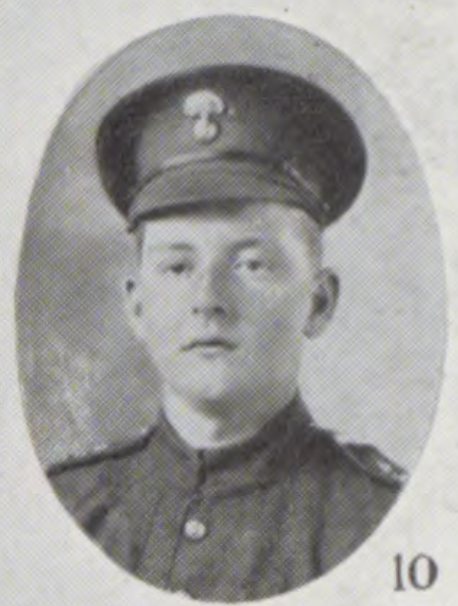
Aldaige (Aldège) Crevier, a farmer,claimed he was born November 10, 1897 at enlistment. However, a Canadian Grenadier Guards historical document notes he was 16 at the time of his enlistment. His real birth year was 1899. He was “killed in action” “in the field” November 7, 1916, on a day when the 87th Battalion was relieved in the trenches. He was 17 years old when he died. He has no known grave and is commemorated on the Canadian National Vimy Memorial with the names of 11,285 Canadian soldiers who died in France and whose final resting place was unknown when the memorial was built. At the base of the memorial is carved “To the valour of their Countrymen in the Great War and in memory of their sixty thousand dead this monument is raised by the people of Canada.” In truth, the monument commemorates Crevier, the Laviolettes and Villeneuve with their disparate war experiences.
Conclusion
I never sought to write an article about what I found in Alnwick, but hoped my sons would learn about remembrance and the importance of not forgetting the lives of people shattered by war. They are aware that lives continue to be shattered today in Ukraine, and elsewhere.
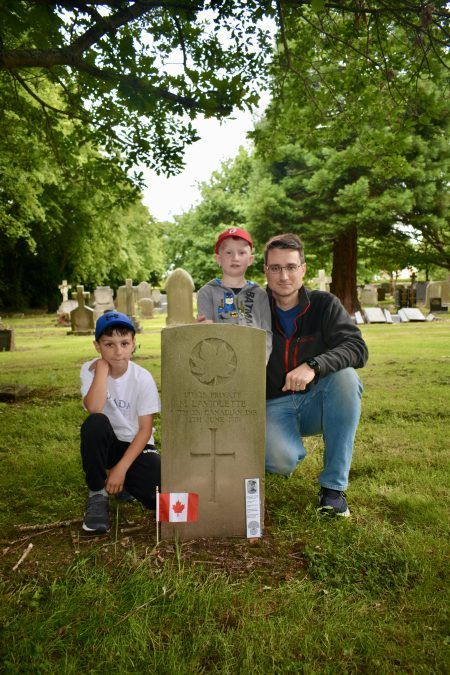
I thought that Mike Laviolette must have been lonely those long months spent in hospital away from his comrades and dependent on others to write for him or read the letters he did receive. I wondered if anyone from Laviolette’s family had been able to make the trip to Northumberland to visit his grave. Albert came home, but were his thoughts scarred by the horrors of the war? How did Villeneuve face life with a serious impairment? Crevier vanished, how did his family take the news? Did they hope there had been a mistake and that he would one day walk through the door? Unfortunately, many families reacted this way in their grief.
Jonathan F. Vance wrote in Death So Noble that “Canada’s memory of the war conferred upon those four years a legacy, not of despair, aimlessness, and futility, but of promise, certainty, and goodness. It assured Canadians that the war had been a just one, fought to defend Christianity and Western civilization, and that Canada’s sons and daughters had done well by their country and would not be forgotten for their sacrifices.” The meaning of the war – whatever it might be – varies on a personal level, a family one, and more broadly a regional one. I think it is essential to remember the ordinary Canadians affected by the war. This will help keep its memory alive. No deaths in war are glorious, but all are tragic.
Additional material
How to research the Vankleek Hill-ers who fought in the First World War
Searching for your relatives’ war records, known as service files, has gotten easier, specifically for First World War service personnel. The First World War era records have been digitized by Library and Archives Canada (LAC) and can be accessed online. The digitized war diaries are another important source of information as they provide a day-to-day account of events pertinent to a specific unit or formation. In addition, newspapers published at the time of the conflict may shed light on events that affected specific people involved in the war effort. Thankfully, The Review (previously known as the Eastern Ontario Review) has an excellent archive which is easily accessible online. After scrutinizing its archive, I determined that Mike Laviolette was transferred to the Canadian Forestry Corps after recovering from his gunshot wound. I did not understand the entry in the service file until I read a report published in The Review at the time. I was curious to see what role Albert Laviolette played in the Veteran’s Guard of Canada, but was not able to search those records before this article went to print.
Researching Vankleek Hill’s war dead is possible and accessible. The documents aren’t just for historians. However, service files of Second World War veterans remain protected by LAC, with the exception of services files of those deceased during the war. These have been digitized in partnership with Ancestry. No paid membership is required to view these records. Other records require an application and that certain conditions be met. This is explained on LAC’s website.
A good place to begin research on war dead is the Canadian Virtual War Memorial which is an initiative of Veteran’s Affairs Canada. It “is a registry to honour and remember the sacrifices of the more than 118,000 Canadians and Newfoundlanders who, since Confederation, have given their lives serving in uniform.” For readers who want to know more about Canada’s role in the First and Second World Wars, I recommend four books by Tim Cook of the Canadian War Museum: At the Sharp End: Canadians Fighting the Great War, 1914-1916, Shock Troops: Canadians Fighting the Great War, 1917-1918, The Necessary War: Canadians Fighting the Second World War, and Fight to the Finish Canadians in the Second World War, 1944-1945.
Remembrance and war graves
Searching for war dead, like Mike Laviolette of Vankleek Hill (buried in Alnwick, UK), illustrates the importance of organizations like the Commonwealth War Graves Commission (CWGC). Founded in 1917, its mission is to “commemorate almost 1.7 million individuals, ensuring that all the Commonwealth men and women who died during both World Wars are commemorated in a manner befitting their sacrifice.”
As Stuart Hadaway explained in Missing Believed Killed, by the twentieth century, it was no longer acceptable that the treatment of the dead be “erratic” and that by the 1940s, “it had simply become politically and socially unacceptable to leave service personnel behind: it is part of the debt that they are owed.”
Hadaway highlighted the changes in attitudes: typically, in the past, for ordinary soldiers or non-commissioned members, such as sergeants, “fate still held only the nameless corner of a foreign field.” He added “Soldiers were regarded, as the Duke of Wellington so succinctly put it, as ‘the scum of the earth’, and in his army as well as most others, an announcement on the Parish notice board at home was the best eulogy they could expect.”
Canadian First World War veteran and author Will R. Bird expressed the desire for care after death and memorialization in Sunrise for Peter, which originally appeared in MacLean’s in June 1931. Bird’s character, Private Peter Teale, “had never dreaded death nearly as much as he had dreaded being left as a discard on a battlefield, to be rat-eaten and fly-blown, blackened and shrivelled, and at last hastily covered in a shell hole by a careless burial party.”
I have a particular interest in the CWGC, as my grandfather was one of its gardeners in France until settling in Canada with his family in 1967. Last fall, I was able to visit some of the cemeteries where he had worked. I was particularly impressed with the beautiful Cabaret-Rouge British Cemetery, Souchez, which contains 3197 graves. One of the headstones in the cemetery marks the original grave of the Canadian soldier now resting in The Tomb of the Unknown Soldier in Ottawa.
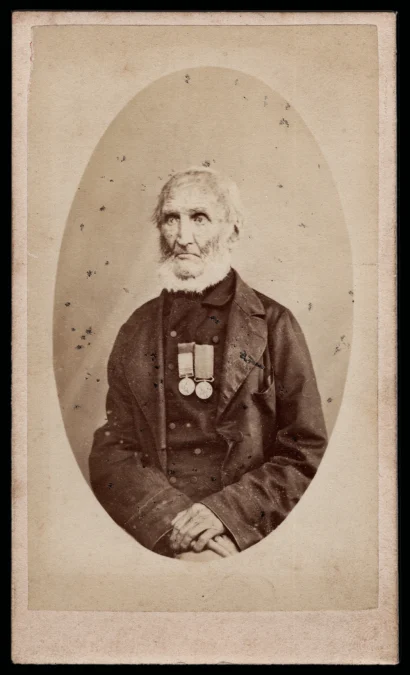
Many war graves would be lost without the stewardship and care of the CWGC. Few families could have assured the care of war graves, and wealthy families may simply have repatriated their dead. I think Mike Laviolette’s grave is a perfect illustration of this as he lies isolated amongst thousands of civilian graves. The replacement of his headstone is ensured by the CWGC. In contrast, somewhere in Alnwick lies one of Wellington’s veterans, Charles Ormond. He survived ten battles of the Napoleonic Wars, including Waterloo, and passed away in 1875. Local historian Nick Lewis has been searching for his grave, but it may be lost.
The dead of the First World War continue to be found. For example, the remains of Canadian soldiers who fought at the Battle of Hill 70, like Albert Laviolette, were found at the construction site for a new hospital in Lens, France. Further south, the CWGC expects many more remains to be found during the construction of the new Seine-Nord Europe Canal. The CWGC is already planning for new burials. As a result of DNA and historical research, remains are sometimes identified and soldiers are given a burial with military honours.
The CWGC cemeteries are as much a part of the legacy of the First and Second World Wars as the course of events that followed them in the 20th century. They are a visual reminder of the human cost of war. Few have questioned whether this cost was justified.
I wonder what fate has in store for the remembrance and legacy of the War in Afghanistan. Its catastrophic end was “Biden’s Saigon” and it added “moral injury to military failure” wrote George Packer of The Atlantic. In Canada, historian J.L. Granatstein asked in Legion Magazine “Was it all worth it?” He concluded “it is unlikely that any American government—never mind a Canadian government—will take on another war that has nation-building as its goal.” It is too soon to predict how Afghanistan will be remembered. I hope the contributions of individuals – Canada’s soldiers, development workers and diplomats – are remembered. They worked under extremely difficult conditions in circumstances they could not control. I’m happy that Canadians fallen in Afghanistan were repatriated and came home to their families but wonder how this will influence the memorialization of the war. Long ago Thucydides wrote that “war is an evil thing,” but we are not likely to see an end to it.