

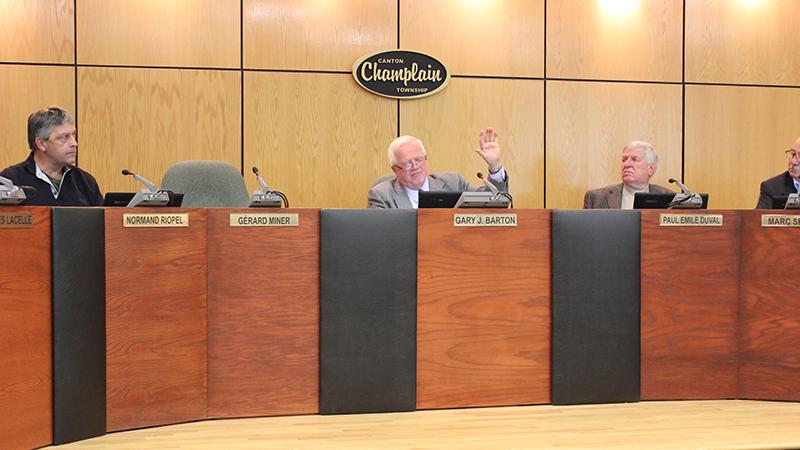
At a November 13 public meeting at Champlain Township, Dominique Lefebvre, senior planner at UCPR, presented the township’s new proposed zoning by-law. Initially, in the new proposed by-law, the Heavy Industrial zoning had steel mill and cement plant mentioned as possible uses. In the most recent version of the by-law, presented to council, the cement plant mention was removed.
“Since 1980, in the by-laws of Longueuil and Hawkesbury West [now called Champlain], the cement plant mention was always there. There were intentions on our part to modify the mention.The comments we received at the public consultation of November 1, clearly indicated that people were concerned about the mention in the by-law. We will keep the zoning option for heavy industrial but will not mention any possible uses. Developers will still have to make a request an exception to change any zone to industrial, just like Colacem did, which was refused by council,” explained Lefebvre.
Although the specific mentions were removed from the proposed by-law, it will have little effect on a request to make a zoning change in the municipality. Ivaco Rolling Mills is itself zoned as an exception. The by-law was reviewed and modified to take into account the changes in the United Counties of Prescott-Russell’s Official Plan and new provincial requirements.
An official hearing concerning the proposed cement plant in Champlain Township with the Ontario Municipal Board (OMB) is scheduled for four to five weeks beginning on September 4, 2018. The parties involved agreed to hear both appeals at once. The first, Colacem Canada Inc. is appealing the Township of Champlain’s refusal of a zoning change; the second, Action Champlain, a citizens group opposing the cement plant, is appealing the United Counties of Prescott-Russell’s amendment to its Official Plan allowing for the plant’s construction on Highway 17.
A few people were concerned at the public meeting when aggregates were mentioned in the new Champlain by-laws. That layer of zoning is a provincial request to identify sites that have aggregates which could potentially be exploited in the future. Properties which have aggregates could be limited to certain uses, but according to Lefebvre, these identification of aggregates will have little to no implication for home-owners living on or near aggregates, it’s merely to identify and protect natural resources.
“Having aggregates on your property doesn’t mean someone can just open a quarry next door. The province wants to identify aggregates reserves so that if ever a property owners would want to secede a portion of their property, there will be another step to undertake to ensure that the new usage will not affect the aggregates reserve,” said Lefebvre.
