

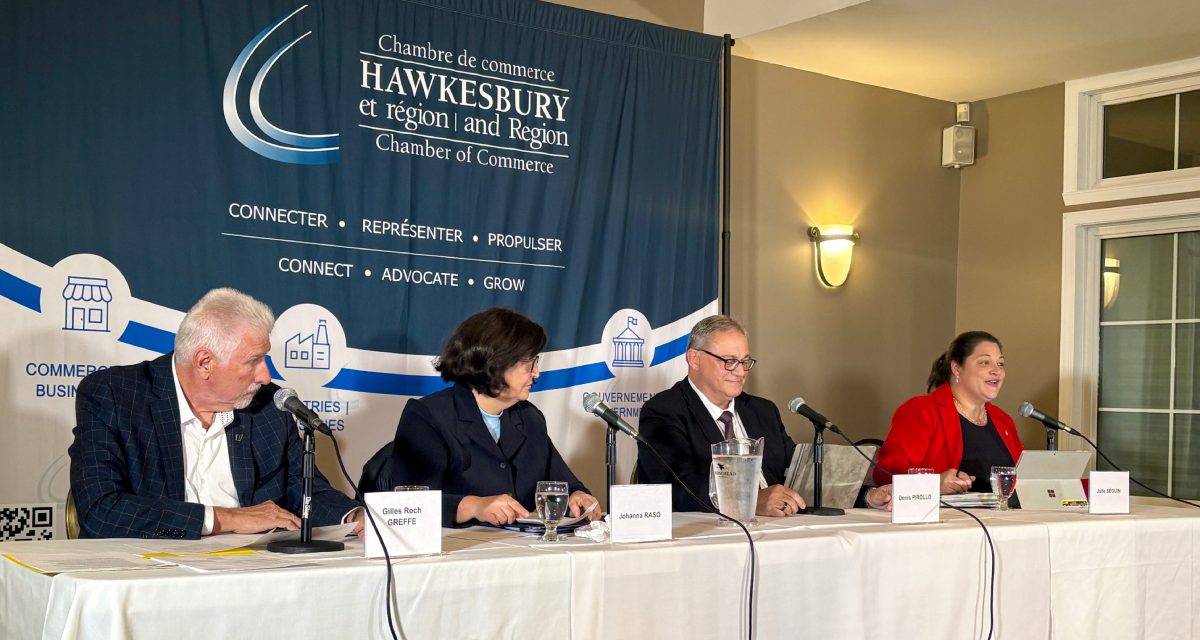
Four mayoral candidates debated road repairs, economic development, municipal finances, transparency, and the future of local cultural and recreational facilities during a debate attended by a full house on Thursday, October 15, at La Cité Golf Club in Hawkesbury.
Gilles Roch Greffe, Denis Pirollo, Johanna Raso, and Julie Séguin participated in the debate, organized by Le Droit in partnership with the Hawkesbury and Region Chamber of Commerce and 92.1 GO FM. François Carrier, editor of Le Droit, moderated the debate ahead of the municipal election on Monday, October 26.
Jeanne Charlebois did not participate.
Infrastructure and municipal finances
Séguin cited the municipality’s 2025 asset management plan, saying 72 per cent of its road infrastructure was in poor condition. She also pointed to a $6-million infrastructure investment backlog. She called for studies to assess the town’s capacity to supply electricity and natural gas, drinking water, and wastewater services before committing to development. The studies would help document costs and support provincial and federal funding applications. A master street plan was expected to be completed in early 2027.
Pirollo said 58 per cent of the wastewater network was in poor condition and approximately five kilometres of sewer lines still carried both rainwater and wastewater. He called for prioritizing the worst streets and pipes and coordinating underground repairs with road resurfacing. He identified McGill Street and Chenail Boulevard as locations needing improvements and said government funding could cover up to 80 per cent of eligible work, depending on the program and its conditions.
Greffe called for a multi-year plan prioritizing roads, sidewalks, drinking-water infrastructure, and sewers according to their condition, urgency, and available funding. He also advocated seeking government grants. Unlike Séguin, he argued that the wastewater treatment plant had sufficient capacity. He said the water plant had been improved and supported transferring land from Champlain Township to Hawkesbury to facilitate water and sewer extensions.
Raso also called for assessing infrastructure capacity before committing to new development, warning that limitations could discourage investment and increase business costs. She proposed exploring public-private agreements and incentives to attract investment and improve infrastructure.
Greffe described the town’s financial position as precarious. He said municipal debt had increased by 52 per cent during the previous council term, property taxes had risen by 25 per cent, and reserves had declined from $10 million to $6 million.
He called for clear spending priorities, costed project plans, and closer monitoring of expenditures, arguing that economic development could expand the tax base and generate revenue for services.
Séguin emphasized protecting municipal assets while respecting taxpayers’ ability to pay. She proposed annual pre-budget consultations and said decisions should reflect the asset management plan and municipal staff recommendations, with all councillors involved.
Pirollo prioritized road repairs and tourism spending, calling for proposals with clear costs and timelines. Raso described the budget as a tool for managing risk and setting priorities, emphasizing documented decisions and cooperation between the mayor and council.
Transparency and communication
Séguin proposed greater use of the municipal website, social media, local newspapers, and a monthly newsletter, alongside quarterly financial statements and a public record of projects, costs, and timelines.
Pirollo called for bilingual summaries after council meetings, including individual councillors’ votes on important matters. He also proposed telephone access to information in either official language for residents without internet access.
Raso proposed bilingual summaries before meetings, followed by reports outlining decisions, costs, and timelines. Greffe supported bilingual summaries after meetings, better access to information through municipal and local news outlets, and public consultation before major decisions.
Economic development and local businesses
Raso proposed assessing infrastructure constraints, preparing an investment catalogue for the industrial park, reducing administrative delays, and helping businesses navigate municipal approvals. For downtown merchants, she suggested working with the Chamber of Commerce to identify available government subsidies.
Greffe called for simpler permit procedures, clearer requirements, and predictable response times. He also advocated regular discussions with merchants, the Chamber of Commerce, and economic development organizations to identify obstacles.
Séguin said the town should act as a partner rather than an obstacle to business, emphasizing communication with economic development and business-support organizations.
Pirollo called for closer cooperation with Main Street property owners, entrepreneurs, and artists. He proposed a dedicated tourism budget, a designated person responsible for results, measurable objectives, and public reporting.
Pirollo said the municipal budget allocated no funding to tourism and cited 27,915 annual visits to the Carillon Canal locks. He argued that festivals and waterfront activities could attract visitors downtown, benefit businesses, and generate sponsorships.
Culture, recreation, and the waterfront
Séguin said she had defended the Le Chenail Cultural Centre during her council term and helped extend its lease beyond the election. She advocated a lease of more than 10 years to help the centre secure funding for renovations to Gill House without placing the entire cost on taxpayers.
Raso described Le Chenail as a regional asset and called for cooperation with cultural and agricultural partners while protecting the waterfront and local heritage. Greffe emphasized supporting cultural organizations, local artists, and accessible programming. Pirollo also supported continued cooperation with Le Chenail.
Greffe advocated maintaining existing recreation facilities and consulting families, youth, seniors, and user groups about programming. He also supported restoring council committees, including a recreation committee, to improve communication with local associations.
Séguin said recreation can foster young people’s sense of belonging and may contribute to crime prevention. She cited parks, sports fields, the arena, and free skating and swimming, calling for better coordination with local organizations.
Raso highlighted festivals, Confederation Park, and the waterfront, proposing multi-day events to encourage overnight stays and local spending.
Pirollo proposed approaching three neighbouring municipalities within the first six months of a new council term to discuss sharing arena and pool costs, potentially allowing residents of those municipalities to pay the same rates as Hawkesbury residents.
Downtown revitalization
Greffe proposed safer sidewalks, better lighting, benches, greenery, and clean, accessible public spaces. He also called for working with property owners and merchants to improve storefronts, fill vacant spaces, and attract businesses. Craft markets, cultural activities, and family events could be supported by a plan with a budget, timeline, and measurable results.
Séguin said revitalization must go beyond beautification to support merchants, attract businesses, and give people reasons to visit and stay downtown. She emphasized communication with the Chamber of Commerce and property owners.
Raso proposed workshops to help businesses identify available grants and subsidies, while identifying street repairs and vacant storefronts as priorities.
Pirollo linked revitalization to the waterfront, festivals, and tourism, calling for a designated person to coordinate the work and report publicly on results.
