

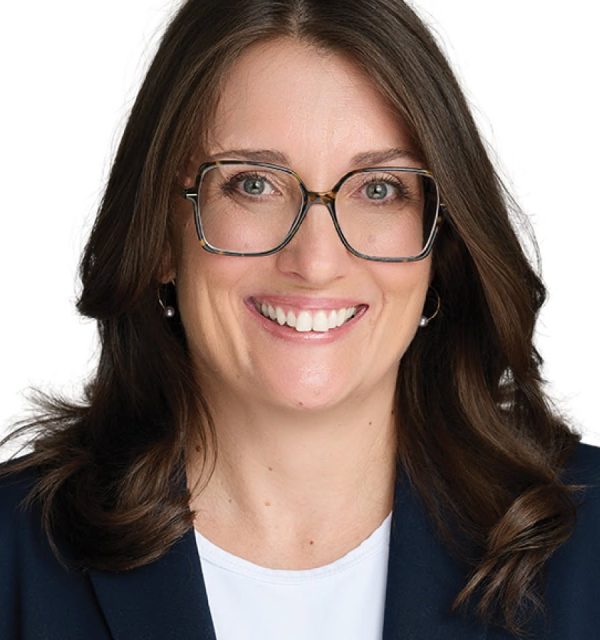
Julie-Andrée Numainville, the Coalition Avenir Québec (CAQ) candidate for Argenteuil, says healthcare, Autoroute 50 safety, and supporting local businesses through ongoing trade tensions would be among her priorities if elected as the Member of the National Assembly (MNA). The party is campaigning under the Équipe Christine Fréchette banner.
Numainville also addressed the proposed Alto high-speed rail project, Québec’s language policies, and the possibility of another referendum on Québec independence during an interview with The Review.
Healthcare
Numainville said access to local healthcare services is one of the most urgent issues facing Argenteuil, particularly as the riding has an aging population. More than one in four residents of Argenteuil is 65 or older, she said, adding that residents regularly tell her they want to receive more care closer to home rather than travel long distances for services that could be provided locally.
She specifically pointed to home care and support for seniors, pregnancy follow-ups, dialysis, and other health services.
“Our government also wants to strengthen the role of centre local de services communautaires (CLSC) as the gateway to local services and home support,” Numainville said.
She said this approach could be particularly important in a riding such as Argenteuil where distances between communities are significant, and the population is aging.
The CAQ has proposed investing an additional $1 billion over four years in home support, which the party says would amount to an additional $400 million per year. Numainville said the investment would be intended to reduce wait times and provide services that are better adapted to individual needs.
At the local level, she said her priority would be protecting existing services at Hôpital de Lachute while working to develop additional services based on the needs of the local population.
“As an MNA, I commit to defending and protecting existing services at Hôpital de Lachute and to working to develop new ones based on the real needs of our population,” she said.
Numainville also said she would work with local stakeholders to strengthen service corridors and improve access to care throughout the riding.
Concerns about Alto high-speed rail
Numainville said the proposed Alto high-speed rail could create economic, tourism, and social development opportunities for Québec, while warning that its potential impact on Argenteuil communities needs to be addressed.
The proposed project is being developed by the federal government through the Crown corporation Alto.
Numainville said concerns have been raised by residents and agricultural producers in Brownsburg-Chatham, Saint-André-d’Argenteuil, and Lachute.
“The route could affect agricultural land, change access to certain properties, complicate the movement of machinery, and fragment farming operations,” she said.
She said those consequences need to be properly evaluated before the project moves forward. Numainville said Alto should meet with citizens, farmers, and municipalities, answer their questions, and demonstrate that different route options have been seriously examined.
The project should also include enough crossings in appropriate locations to allow farmers to access their land and continue their operations. Routes that use existing road rights-of-way and infrastructure corridors should be considered wherever possible, she said.
Numainville said she does not support automatically opposing the project because it is being carried out by the federal government.
“Our responsibility is rather to be part of the discussion, work to improve the project, reduce its impacts, and ensure that the voice of our territory genuinely influences the decisions,” she said.
French language protection
On Québec’s language policies, Numainville said the province must continue protecting and promoting French.
“French is our only official and common language, and it is at the heart of our Québec identity and culture,” she said.
She pointed to the adoption of Bill 96 and the creation of the Ministère de la Langue française as measures taken in recent years to strengthen the position of French in Québec. Numainville said the CAQ would also renew the parliamentary sovereignty provision of Bill 96 and extend the application of Bill 101 to vocational training and adult general education.
She said protecting French requires continued efforts to ensure future generations can live, work, and study in French. At the same time, Numainville acknowledged the importance of Argenteuil’s English-speaking community.
“In Argenteuil, a significant English-speaking community is part of the history and social fabric of our region,” she said.
Numainville said protecting French as Québec’s common language can be done while respecting the region’s anglophone population. However, she did not identify any specific measures or commitments she would make to address the concerns of Argenteuil’s English-speaking community.
“The goal remains to ensure that French continues to hold a strong place in our workplaces, institutions, and collective life, while valuing the Québec culture that unites us,” she said.
Autoroute 50 safety
Autoroute 50 remains another priority for Numainville, who said both immediate safety improvements and the eventual twinning of the highway need to continue.
“We must continue the twinning of the lanes while securing the existing sections right now,” she said.
Numainville said the two processes should advance in parallel and that she would follow the progress of the projects if elected. She said the twinning of Autoroute 50 is planned progressively by section, with the sections between Lachute and Mirabel among those being prioritized.
She also pointed to work to install safety barriers along an initial section between Grenville-sur-la-Rouge and Brownsburg-Chatham. According to Numainville, another 17-kilometre section between Lachute and Mirabel is scheduled to be secured beginning in 2027.
“We are therefore not choosing between securing the highway and twinning it: we are doing both,” she said.
Numainville said residents have told her they want the work to continue moving forward and that she would make sure Argenteuil remains a priority as the projects advance.
Supporting local businesses
Numainville said businesses in Argenteuil are facing uncertainty over tariffs and ongoing trade tensions between Canada and the United States. She said the region’s small and medium-sized enterprises (SMEs) are dealing with rising costs and difficulty planning investments.
“On the ground, residents, workers, and entrepreneurs tell me about very real concerns: rising costs, uncertainty around tariffs, and difficulty planning their investments,” she said.
Numainville said a CAQ government would seek to reduce financial, administrative, and regulatory burdens on SMEs, support business transfers and succession planning, and encourage the purchase of Québec products. She also said businesses need assistance finding new markets so they are less dependent on the United States.
“We must also invest in innovation, research, and high-value-added future sectors,” she said.
Numainville said that, if elected, she would work directly with businesses and economic stakeholders in Argenteuil to ensure government measures respond to local conditions and help protect jobs.
Opposition to a referendum
Numainville said she does not support holding another referendum on Québec independence.
“The position of Équipe Christine Fréchette [CAQ] reflects my own, which is why I chose to be part of this political formation: this is not the time to plunge Québec back into a referendum battle,” she said.
Numainville said Québec instead needs to focus on issues such as purchasing power, economic development, and public services. She said another referendum would create additional political and economic uncertainty at a time when businesses and workers are already dealing with trade tensions and an unstable international environment.
Numainville described herself as a nationalist and said she wants Québec to have greater autonomy and economic strength.
“I am a nationalist, and I want Québec to be more autonomous, stronger economically, and more in control of its decisions,” she said.
However, she argued that greater autonomy should be pursued through government action rather than another referendum.
