

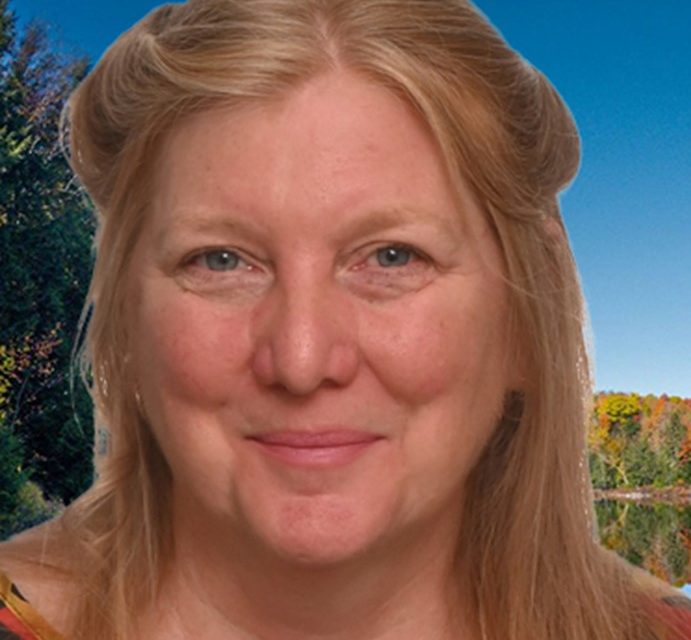
Independent Argenteuil candidate Margaret Brunton says healthcare access, Autoroute 50 safety, opposition to the proposed Alto high-speed rail project, and greater independence for elected representatives would be among her priorities if elected.
Brunton, who is running without a political party, outlined her priorities during an interview with The Review, discussing issues she says have emerged while speaking with residents across the riding.
Healthcare access
Healthcare is one of the issues Brunton says she has repeatedly heard residents raise. She pointed to residents in Harrington who, she said, received letters following the July 2026 tornado informing them they no longer had a doctor because they lived in Québec.
Brunton said she would pursue an agreement between Québec and Ontario that would allow residents of Argenteuil to access healthcare at Hawkesbury General Hospital and other Ontario facilities, while also allowing Ontario residents who work or live in the region to access Québec services.
She said the arrangement could be modelled on existing cooperation between the two provinces.
Brunton also said the new CLSC (centre local de services communautaires) in Grenville should be used “at full force” and argued that Québec needs to improve salaries and benefits for healthcare workers so qualified staff can be retained in the region.
Another part of her proposal would be to bring medical specialists into Argenteuil on a rotating basis. Rather than requiring residents to travel outside the region for appointments, she said specialists could spend roughly two weeks in the area at a time, allowing local patients to schedule appointments while they are there.
Autoroute 50
Brunton described improvements to Autoroute 50 as her “priority number one.”
She wants a properly divided four-lane highway connecting Gatineau with Autoroute 15, with a grassy median rather than a concrete barrier.
Brunton said her experience as a former highway traffic officer in Toronto has influenced her concerns about the route’s safety. She said she generally avoids Autoroute 50 and recently drove it again to assess its condition.
“I think it’s criminal negligence,” she said of what she considers inadequate safety on the highway.
Brunton said the combination of traffic, head-on collision risks, and glare from oncoming LED headlights creates an unnecessary danger. She said she would work with the Sûreté du Québec (SQ) on highway security while pursuing improvements to the road itself.
Alto and existing rail infrastructure
Brunton said she has established what she describes as a regional common front against the proposed Alto high-speed rail project. Her position is that Argenteuil should not have a high-speed rail route built through the region.
She argues that agricultural land should be protected and points to the history of expropriations in Mirabel as an example of the potential consequences of major transportation projects on rural land.
Instead, Brunton said existing railway infrastructure and stations should be used, including infrastructure in communities such as Calumet. She argues that existing rail lines could provide transportation benefits to smaller communities without requiring the same scale of new construction.
“Alto is not for us,” she said.
French and English services
Brunton said she supports protecting the French language and Québec’s culture, including through investment in theatre, music, dance, and the arts. At the same time, she said English-speaking residents should continue to have access to essential services in English.
Brunton, who has worked as an English-as-a-second-language and special-needs teacher, said some people may have difficulty learning another language despite making the effort.
Her position is that essential services should be available in both French and English when required.
Independence referendum
Brunton was also asked how she would vote if Québec held another referendum on independence.
After initially discussing the need for “healing” between Québec and Canada, she gave a direct answer when pressed.
“I’m voting no,” she said. “I’ll vote no for this one.”
Brunton said she wants a strong Canada and views the division of responsibilities between the federal and provincial governments as an important part of the federation.
Tariffs and local concerns
The economic impact of United States tariffs and Canada-U.S. trade tensions has not been a major topic in Brunton’s door-to-door conversations, she said. Instead, residents have primarily raised issues they encounter locally, including Autoroute 50, healthcare, roads, and the proposed high-speed rail project.
She said the conversations have reinforced her focus on regional issues that she believes have a direct effect on residents’ daily lives.
Brunton also spoke about the importance of transportation connections between Argenteuil and neighbouring Ontario communities, including improvements to the Long-Sault Bridge between Grenville and Hawkesbury. She said infrastructure connecting the two sides of the Ottawa River should be viewed as a source of security, dignity, and economic opportunity for the region.
Homelessness and parliamentary reform
Brunton is also the founder of the Organization of People United for the UnSheltered And (deserted, destitute) Group, or OPUSA, which she describes as an organization focused on helping unsheltered people.
OPUSA’s approach is based on three stages: finding people who are living without stable housing, restoring their stability, and reintegrating them into the community. Brunton said she wants to begin applying that approach in Argenteuil by making better use of resources that already exist rather than simply seeking additional funding.
Parliamentary reform is another part of Brunton’s platform. As an independent Member of the National Assembly (MNA), she said she would be directly accountable to constituents rather than to a political party and its leadership.
Brunton said party discipline can require elected representatives to follow their leader’s position, while an independent representative has greater freedom to speak and vote according to the interests of the people in the riding.
She connected that position to her studies in political science at Queen’s University and her interest in parliamentary reform. Rather than approaching Argenteuil primarily through provincial party politics, she said she wants the riding’s specific needs to drive the work of its elected representative.
The Québec provincial election is scheduled for Monday, October 5.
