

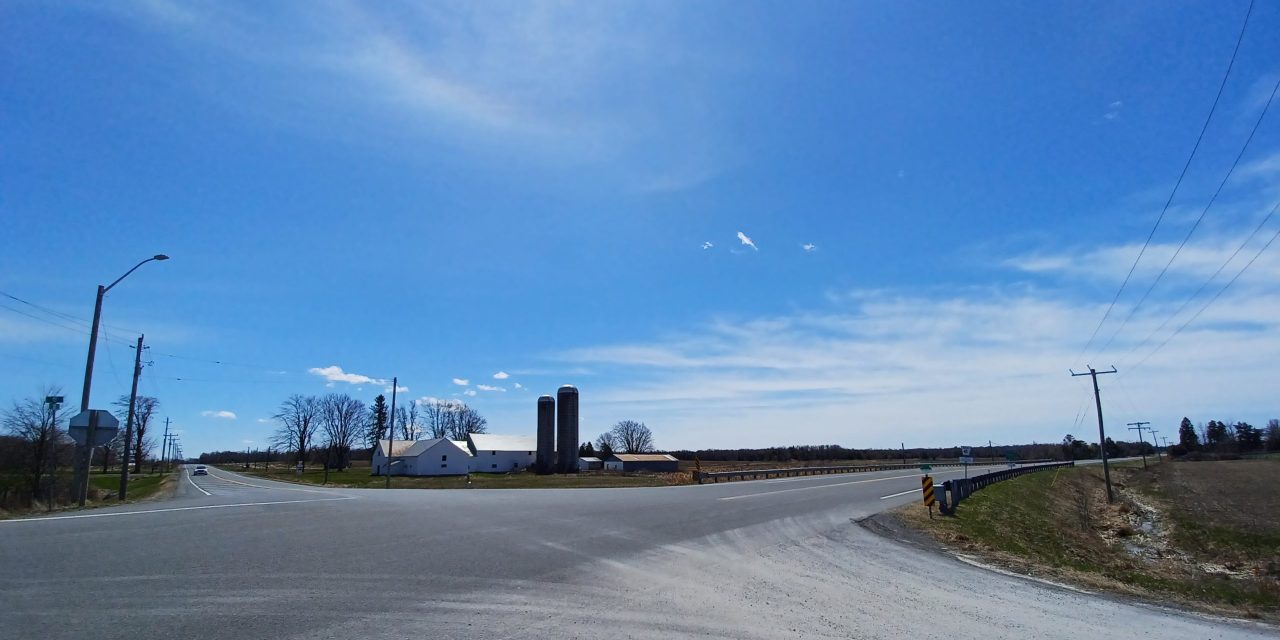
On Monday, April 20, a report outlining the recent review of intersections across the United Counties of Stormont, Dundas, and Glengarry (SDG) was presented to SDG Council. The review found no changes are currently warranted at the intersection of County Road 43 and County Road 20 near Apple Hill.
The study examined both the north and south legs of the intersection, focusing on traffic volumes, collision history, and overall safety. In both cases, County Road 43 continues to carry the majority of traffic, with average daily volumes of more than 3,100 vehicles, compared to approximately 2,000 on County Road 20.
According to SDG Director of Transportation Cameron Harper, the intersection remains a two-way stop, with County Road 20 stop-controlled. Features such as warning signage, pavement markings, turning lanes, and nighttime illumination are already in place.
Additionally, Harper noted that neither an all-way stop nor traffic signals are justified under current provincial traffic guidelines. Volume thresholds and traffic patterns did not meet the required criteria, with compliance levels falling below the 80 per cent benchmark for considering additional controls.
“For this study, we also needed to collect turning movement counts. We had staff go out, set up a pole camera, and manually counted every turning movement at that intersection over a few hours,” Harper said. “That took a little bit of time, and that’s why this report is maybe a month later than I would have liked to have brought it to council.”
Collision data remained within expected ranges for a rural intersection of this type.
“One thing when we’re talking about collisions is it’s important to differentiate between reducible and non-reducible collision types. That means if we were to install traffic lights, would a certain type of collision be prevented?” Harper said.
“With the installation of traffic lights, we may be able to prevent some t-bone collisions but not necessarily rear-end or single-vehicle motor collisions.”
Over three years, the south leg recorded five collisions, while the north leg recorded three. No fatalities were reported, and no consistent collision pattern was identified in the study.
“The intersections studied are functioning properly and safely,” Harper concluded.
Staff recommended continued monitoring of traffic volumes and collision trends, but no upgrades or modifications at this time.
