

By Shawn MacWha
During the First World War, more than 620,000 Canadians served in the military, an impressive number given that the population of the country during that period (1914-1918) hovered around eight million people. The overwhelming majority of these recruits served in the army, although approximately 5,000 sailors also enlisted in the Royal Canadian Navy. As for the air force, Canada didn’t have one until 1920, aside from the short-lived Canadian Aviation Corps which was formed in 1914 and disbanded in 1915 after having acquired a total of one aircraft. But that does not mean that Canadians did not serve in the air during the war. Indeed, over the course of the hostilities almost 6,000 Canadians eventually served in the British Army’s Royal Flying Corps and the Royal Naval Air Service, which merged in 1918 to form the Royal Air Force.
Ernest George Higginson Jr., a young man from a well-known family in Hawkesbury, Ontario, was one such man and was part of the first generation of Canadians to fight in the air. He was born on July 25, 1894 in Saint John, New Brunswick, the son of Ernest George Higginson Sr. and Clara Pattee. Although his father was born in New Zealand, both of his parents had strong ties to Eastern Ontario and had been neighbours while growing up before marrying in Hawkesbury. During the early 1890s the family briefly moved to New Brunswick before returning to Ontario and settling just south of Hawkesbury near Clara’s parents.
As a child Higginson attended school in Hawkesbury before graduating from the local High School and moving to Toronto where he went to university. Returning to Saint John in the spring of 1917 Higginson joined the Royal Flying Corps which was actively recruiting prospective pilots in Canada. Following three months of training at Camp (now Canadian Forces Base) Borden he was sent overseas on July 22, 1917 and promoted to the rank of Second-Lieutenant.
Upon his arrival to England, Higginson was assigned to the 73 training Squadron which was based at the Lilbourne airfield about 30 kilometres east of Coventry. It was there that Higginson completed his flight certification before being granted his flight status on September 4. Only one month later, on October 4, 1917, Higginson was flying a Sopwith F.1 Camel fighter plane on a training mission over southern Scotland when he lost control of his aircraft and nose-dived into the ground. Higginson was severely injured in the accident and rushed to Craigleith Military Hospital in nearby Edinburgh but his wounds were so grave that he died there later that day.
It is not entirely clear why Higginson lost control of his aircraft, as he was known to be a careful flyer. That said, the Sopwith Camel was a notoriously difficult plane to fly as most of its weight was located in the front third of the air frame, making it prone to unexpected nose-dives in the hands of inexperienced pilots. Given that the 73 Squadron had only just begun to receive these airplanes at the beginning of October it is likely that Higginson, being unfamiliar with the new type of aircraft, made the same fatal mistake that so many other British pilots did during training. Sadly, Higginson was the first of many pilots from 73 Squadron to die in the war.
In January, 1918 the Squadron was moved to France where it began to engage in combat operations over the Western Front. There Higginson’s surviving comrades engaged in numerous sorties against the Germans, specializing in ground attack roles, until the end of the war. Interestingly, another Canadian who served in 73 Squadron during the First War One was Winnipeg-born Sir William Stephenson. Becoming an ace, with 12 aerial combat victories, Stephenson would go on to lead British intelligence efforts in North America during the Second World War. Sir Ian Fleming, creator of the James Bond franchise once wrote of him that “James Bond is a highly romanticized version of a true spy. The real thing is William Stephenson.”
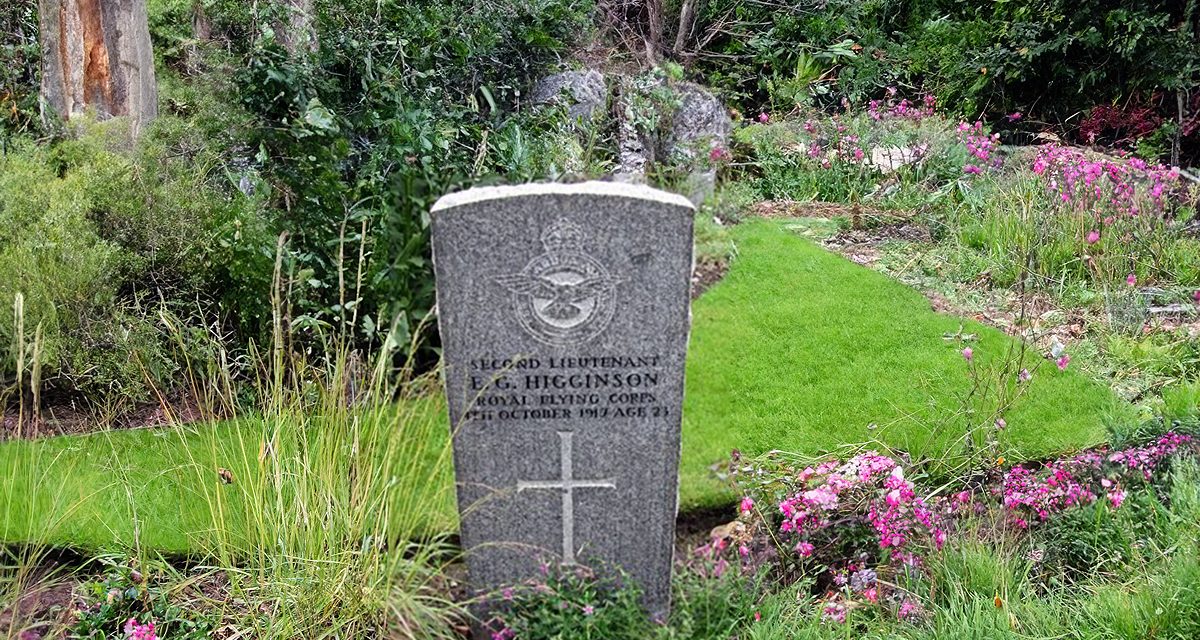
Higginson was buried at the Comely Bank Cemetery in Edinburgh where his grave is marked with a military headstone. His name is also inscribed on the gravestone of his parents and his older brother, which is located in the Cassburn Cemetery just outside of Hawkesbury. Higginson and his service are also commemorated on page 578 of Canada’s First World War Book of Remembrance and on the Hawkesbury Cenotaph, which is located in that town’s Veterans Park on Cartier Boulevard.
His parents and siblings are gone. His friends and comrades are gone. His joys and fears, likes and dislikes, dreams and worries are all gone. But we remember him here, as we should remember those brave souls who risked all, and sometimes lost all, for our country.