
By Shawn MacWha
Of the nearly two million Canadians who served in the military during the wars of the last century only 94 of them won the Victoria Cross, the highest award for bravery offered in the British Commonwealth. Thain Wendell MacDowell was one of those people.
Born in Lachute, Québec on September 16, 1890 MacDowell spent most of his childhood in Maitland, Ontario. There, he attended the local primary school and then the nearby Brockville Collegiate Institute before moving on to the University of Toronto’s Victoria College with the idea of becoming a lawyer. Throughout his studies he was a noted athlete who excelled at sports such as rugby and hockey.
Just before the outbreak of World War One MacDowell joined the militia, serving with the 41st Regiment, Brockville Rifles for a year before transferring to the Queen’s Own Rifles in Toronto. On February 1, 1915 he joined the 38th Battalion of the Canadian Expeditionary Force, a unit comprised primarily of recruits from Eastern Ontario who had volunteered to fight in Europe. In August, 1915 MacDowell, along with the rest of his battalion, was sent to Bermuda to safeguard that island from a possible German attack. After ten months of garrison duty in the North Atlantic he was transferred to England in May, 1916 and then onward to the front lines in France in August, 1916.
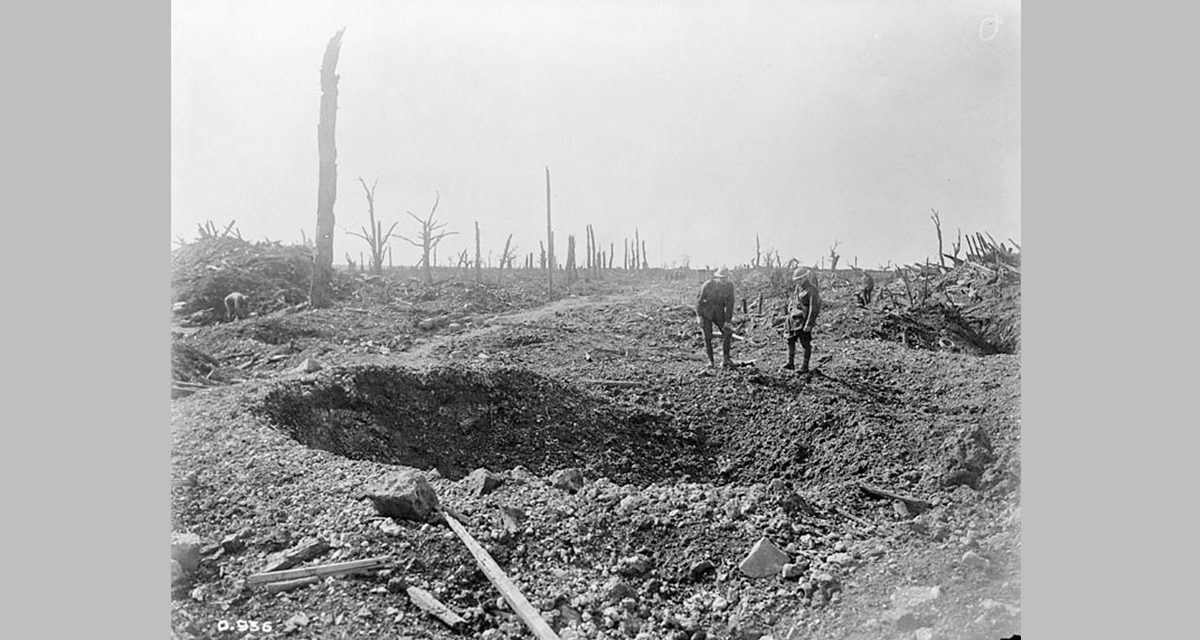
In the autumn of 1916 MacDowell participated in the final stages of the Battle of the Somme which had started at the beginning of July. On November 18th took part in an attack against the German lines where he was responsible for the capture of three enemy machine guns and 53 soldiers. One of his superior officers at the time recounted the day that “Captain MacDowell was in the thick of the fight. The casualties were heavy, and when all of the officers were out of the fight he took command, consolidated the lines and led in the attack,” For his bravery during this action, MacDowell was awarded a Distinguished Service Order. Unfortunately, he was also wounded quite seriously, suffering shrapnel wounds to his left hand and being severely concussed due to the explosion of a nearby bomb.
After he recovered from his injuries MacDowell was returned to active service and was part of the Canadian Corps’ preparations for the infamous Battle of Vimy Ridge in the spring of 1917. The main assault in that fight began on Easter Monday, April 9, when more than 15,000 Canadians attacked German positions along the length of the ridge. MacDowell, commanding B Company of the battalion, was part of the initial assault but as the battle progressed, he and two enlisted men became separated from the rest of their unit. Undeterred, they continued to advance on their own, clearing two enemy machine gun nests. Next the trio entered the German trench lines which appeared to be abandoned at that location. MacDowell, however, saw the entrance to a dug-out and after posting his two men on either side of the entrance descended 52 steps into the darkness in search of the enemy. Upon rounding a corner at the bottom of the stairs he came face to face with a large number of German soldiers.
Finding himself greatly outnumbered, MacDowell bluffed his foes and shouted commands back up the tunnel as if he was in charge of a much larger force. The Germans fell for it and 77 of them immediately surrendered to the presumably astonished, and much relieved, Canadian. For his audacity and bravery that day, MacDowell was awarded the Victoria Cross and even though he was again wounded in the hand during the fight, and also suffering from bronchitis, he nonetheless remained at his post for five days until finally being evacuated for treatment.
These deeds, however, were not without their cost. Aside from his physical wounds during the summer of 1917 he was also afflicted by trench fever. This was an infectious disease caused by louse bites and was common in the filthy conditions of the battlefield. Much more seriously, as the fighting progressed MacDowell also suffered from what was then called “war neurasthenia” but is now recognized as post-traumatic stress disorder. The cause of this condition was listed in his medical records as being “stress of service and shell-fire” and it left him with a number of debilitating symptoms including insomnia, exhaustion, irritability, difficulty in concentration, body tremors, stammering and fits of tears. The problems began soon after he was first wounded in November 1916 and worsened after the events at Vimy Ridge, leading him to being sent home to Canada for three month’s leave in the summer of 1917. MacDowell’s rest, however, did not have the desired effect and during his time at home he suffered from a complete “nervous breakdown” for which he was treated at the Brockville General Hospital. Alas, so dire was the need for soldiers in Europe that MacDowell was returned to England in February 1918. Fortunately he remained in London for the duration of the war and never returned to combat.
When the fighting ended, he came home and picked up the pieces of his life. He returned to university and earned a Master of Arts degree, married and had a family and worked as the private secretary to the Minister of National Defence from 1923 to 1928. Later in life he became involved in the mining industry and eventually served as an associate member of the Canadian Institute of Mining and Metallurgy.
Thain MacDowell died of a heart attack in Nassau, Bahamas on March 28, 1960. He was returned to his hometown and buried at the Oakland Cemetery in Brockville, finally at peace. On this Remembrance Day, as on all days, we should recall that in war not all wounds are physical, and that even soldiers capable of extraordinary acts of bravery are often forced to pay a very steep price for their actions. And for that we owe them our profound gratitude.