

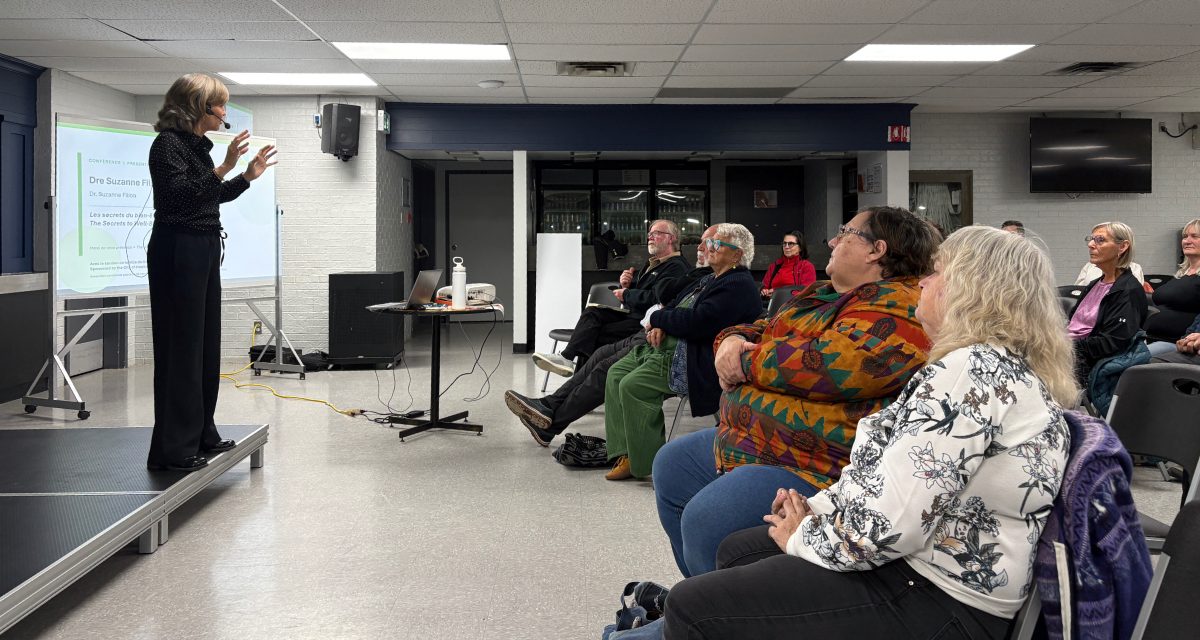
Wellness is about more than being happy, according to clinical psychologist Dr. Suzanne Filion, who told an audience of approximately 65 people in Hawkesbury that maintaining well-being requires deliberate effort, self-awareness, and a willingness to address difficult parts of life. Filion spoke as part of Mental Illness Awareness Week at an event at the Robert Hartley Sports Complex on Tuesday, October 6, sponsored by the City of Hawkesbury and United Way East Ontario.
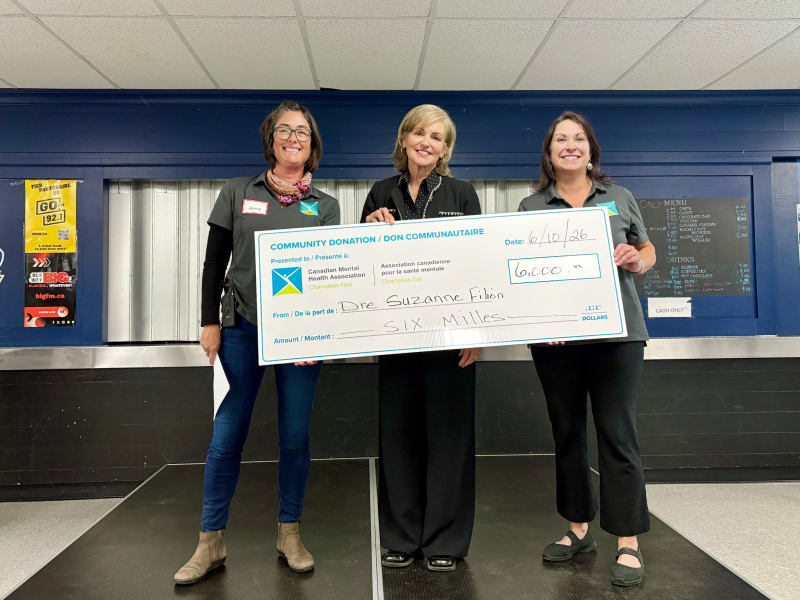
Before her presentation, she made a $6,000 donation to the Canadian Mental Health Association (CMHA) Champlain East. The donation was part of a distribution of proceeds from her book, Les secrets de la luminothérapie: Vaincre la dépression et améliorer son énergie, son humeur et son sommeil (The Secrets of Light Therapy: Overcoming Depression and Improving Energy, Mood and Sleep), to nine organizations. She said her only condition was that the money be used for mental health purposes.
A bilingual speaker and longtime mental health professional, Filion has held clinical, administrative, and executive roles, including at Hawkesbury and District General Hospital. As director of mental health and addictions, she helped develop and implement more than 15 community programs. She later served as vice-president of development and integration at the hospital.
Her professional work has focused on trauma, post-traumatic stress, anxiety, depression, resilience, and workplace psychological health. Her presentation, delivered in both French and English, centred on wellness and the distinction she makes between wellness and happiness.
Happiness can be temporary, she said, such as the enjoyment of a meal with a friend or a vacation. Wellness, by contrast, is a more sustained state of being “relatively well most of the time.”
Filion said her goal was for everyone in the room to leave with at least one practical idea they could incorporate into their lives. She organized the presentation around two important considerations and three pillars of wellness.
Her first message was that people should recognize their own value and resilience. Using humour, she described conception as the first race a person ever wins, noting that people begin life against extraordinary odds. The point, she said, was to recognize that people have already demonstrated an ability to persevere.
“Please, never give up,” she told the audience.
Her second major point was that unresolved experiences from the past can continue to influence how people respond to situations in the present. She encouraged people not to be reluctant to seek psychotherapy when past experiences continue to affect their lives.
Filion also shared a personal experience, describing being the victim of workplace bullying in 2014. She said the experience affected her sleep, eating, and emotional well-being, eventually leading her to seek therapy.
She said the decision proved important because, shortly afterward, she experienced two significant family losses: her brother died following cardiac arrest, and her mother died after becoming seriously ill.
Filion used the image of a truck pulling a trailer to explain how unresolved experiences can add weight to a person’s life. The more “boulders” in the trailer, the more difficult it can become to deal with new challenges, she said.
Three pillars
The first of Filion’s three pillars was setting boundaries with toxic people. She described toxic relationships as those that leave people feeling physically or emotionally distressed after an interaction. Her advice was not necessarily to sever relationships, but to establish appropriate boundaries.
Those boundaries could include seeing someone less often, spending less time with them, or avoiding deeply personal conversations.
“You do not have to answer your phone,” she said, using humour to illustrate that people are allowed to protect their own time and energy.
The second pillar was understanding what is and is not within your control. Filion said people often expend considerable energy attempting to control circumstances, other people, or events over which they have little influence.
She used a traffic delay on the way to Hawkesbury as an example. She could not control the traffic, she said, but she could control how she responded to it.
The same principle, she suggested, applies to relationships, including those between parents and adult children. She said parents can offer advice, but ultimately their adult children have their own lives and must be allowed to make their own decisions, including mistakes.
The third pillar was the way people talk to themselves. Filion argued that internal dialogue can influence how people respond emotionally and physically to events. She particularly cautioned against catastrophizing and using absolute language such as “never,” “must,” and “have to.”
Instead of telling oneself that something is “terrible” or impossible to overcome, she suggested using more measured language, acknowledging that something may be difficult or hurtful without treating it as a catastrophe.
The LASER approach
Filion then turned to the LASER framework outlined in her book, which she described as a collection of practical approaches to wellness. The letters represent light, alimentation, sleep, exercise, and relaxation. In English, she noted, the acronym requires changing the “A” to an “N.”
Light was a major focus of her discussion. Filion spoke about the role of morning light and circadian rhythms and said some people may benefit from light therapy, particularly during the darker months of the year.
Filion also encouraged people to “eat the rainbow,” meaning incorporating a variety of naturally colourful foods into their meals. She advised avoiding large meals too late at night.
Exercise, she said, does not have to mean intense workouts. Filion encouraged people to walk at a moderate pace, noting that physical activity can positively affect mood. She also emphasized the importance of social connection, saying relationships and interaction with others are essential components of well-being.
Her advice was straightforward: if someone is isolated, find a reason to get out of the house.
“You have to do something. You can’t just sit there thinking well-being will come to you,” she said.
Filion framed the final component, relaxation, not as an indulgence but as a necessity. Filion said taking time to slow down and recharge better equips people to function and support others.
In her conclusion, she returned to the central themes of her presentation, including recognizing one’s own worth, seeking professional help when needed, and distinguishing between what can and cannot be controlled. Her goal for the audience was simple: leave with at least one idea they were willing to incorporate into their lives.
“If you leave with at least one thing where you say to yourself, ‘I think I’m going to try that,’” she said, “for me, that will have made offering you this evening worthwhile.”
