
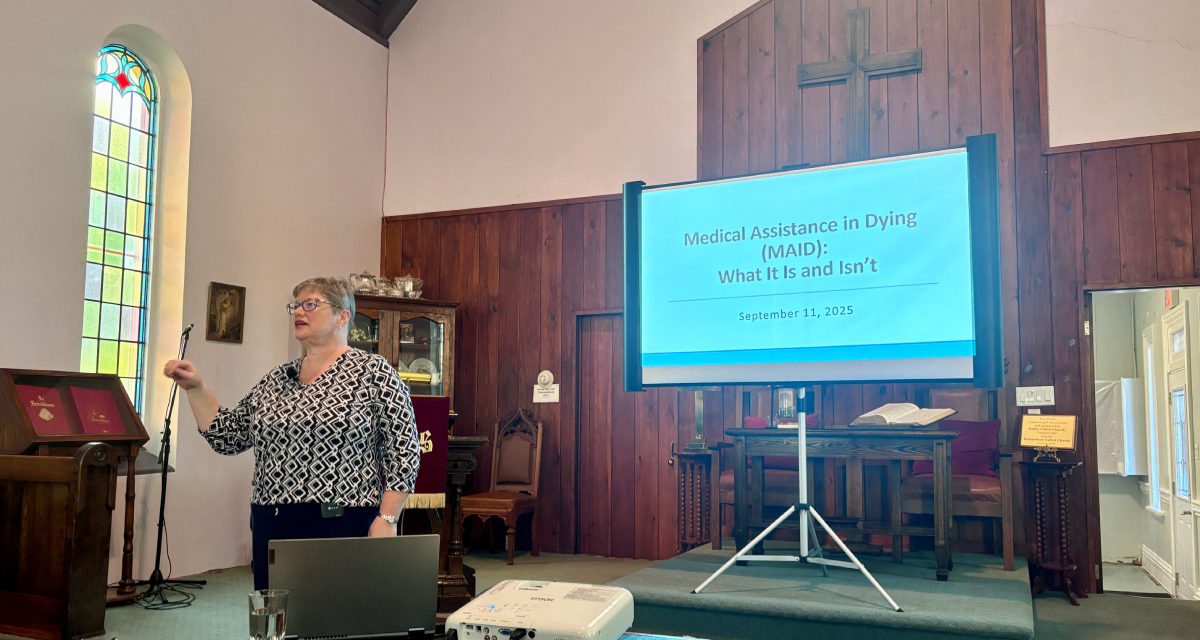
On Thursday, September 11, the Genesis Cooperative Community of the United Church of Canada (GCC) launched its first speaker series event at Trinity United Church in Vankleek Hill. The evening focused on Medical Assistance in Dying (MAiD), with Christy Simpson of Dalhousie University’s Department of Bioethics outlining the criteria, process, and challenges related to the topic.
Before the presentation, organizers requested that attendees submit any questions to be discussed during a light meal and refreshments with Simpson.
Simpson is a bioethicist, assistant professor, and former President of the Canadian Bioethics Association. She has an extensive background focusing on ethical issues in healthcare at the clinical, organizational, and systems levels. She advocates supporting patients, families, and healthcare providers navigating complex decisions, including whether to pursue MAiD.
“I don’t tell people what to do, I don’t tell doctors what to do. My role is to help people think through what matters most to them when they are facing difficult healthcare decisions,” Simpson said.
What is MAiD?
MAiD is the legal process where a physician or nurse practitioner can assist a patient in dying, either via injection or a self-administered prescription. Simpson said that MAiD is distinct from ordinary medical care and has multiple legislative safeguards to prevent its abuse.
“One of the more prominent cases of MAiD was brought to the Supreme Court of Canada (SCC) in the 1993 Sue Rodriguez case,” Simpson said. “Rodriguez was a 42-year-old woman from British Columbia who was diagnosed with Lou Gehrig’s disease, also known as ALS.”
Simpson explained that Rodriguez requested the courts to allow for MAiD to help her end her life at the time of her choosing, without the physician facing criminal charges. Rodriguez’s case reached the SCC, where she argued that the prohibition of assisted suicide violated her Charter rights, including protection from cruel and unusual treatment.
In 1993, the SCC ruled 5-4 against Rodriguez. Since then, the debate on MAiD access has evolved following the unanimous SCC ruling in 2015, leading to Bill C-14 legalizing MAiD under specific conditions in 2016.
“We moved from a complete prohibition in the 1990s to a carefully regulated medical service within just over 20 years. The Supreme Court unanimously recognized that to deny access to assisted dying violated people’s Charter rights,” Simpson said.
Criteria and Categories of MAiD
Simpson explained that as MAiD continues to evolve and adapt through legislation, the six main criteria someone requesting MAiD has remained relatively the same:
- The individual must be eligible for government-funded healthcare
- Be 18 years of age or older
- Have the capacity to make their own healthcare decisions
- Make a voluntary MAiD request free from coercion
- Have all the necessary information to make an informed decision
- Must have a grievous and irremediable medical condition
- Includes serious and incurable illnesses, diseases, or disability
- Be in an advanced state of decline that cannot be reversed
- Experience unbearable physical or mental suffering that cannot be alleviated under acceptable conditions for the patient
If a patient can demonstrate or provide the above, they can be eligible to apply for MAiD. Simpson clarified that how one defines suffering can vary; “Suffering is not just physical pain. It can be psychological, spiritual, or existential. What is unbearable is something only the patient can themselves define.”
Additionally, MAiD has been classified into two distinct categories: Category 1, where the individual’s death is reasonably foreseeable, and Category 2, where the individual’s death is not reasonably foreseeable and requires a 90-day waiting period. The 90 days are meant to give the patient time to explore treatment options and support services.
Category 2 patients are also required to have at least one MAiD assessor who is qualified in the patient’s condition.
Simpson said that some individuals may not pursue MAiD if approved, but “for many people, just knowing that MAiD is an option gives them a sense of control, even if they never go through with it.”
The assessment process requires two independent healthcare assessors to meet with the patient individually and assess the client’s request based on the criteria above. Then, Simpson says, patients will be required to have an individual witness (who cannot be a family member or friend) to sign the formal MAiD request.
Patients are able to choose the timing of MAiD, with informed consent being reconfirmed before the procedure.
MAiD Looking Forward
Simpson highlights that particular considerations must be examined when dealing with MAiD requests and the individuals seeking the procedure.
“We encourage patients to talk with their families, but legally, the decision is theirs alone. Family members don’t have to agree—and they can’t veto the patient’s choice,” Simpson said.
Confidentiality is maintained at the wishes of the patient. Families may not be notified that their family member has passed away through MAiD, though Simpson encourages people to talk about this beforehand if possible.
“MAiD can take place in hospitals, people’s homes, long-term care facilities, and even in hospices if that’s consistent with their philosophy. Families are often present, and people may choose to include their spiritual leaders,” Simpson explained. “It can be a very intimate and personal moment for those involved.”
Ultimately, Simpson says, it becomes about a sense of control over one’s life. Conversations must be had around suffering, dignity, and end-of-life choices. As an individual’s suffering is subjective, assessors must always consider both the physical and psychological dimensions of cases.
Canadian children’s author Robert Munsch announced he was recently approved for MAiD, saying he was diagnosed with dementia in 2021 and began struggling with Parkinson’s-like symptoms. He wanted the option to proceed with MAiD as he began to experience real difficulties with communication.
Munsch explained in a New York Times Magazine interview, saying, “I can feel it going further and further away,” describing how dementia has been affecting his thoughts and work. Munsch said that his decision was influenced by watching a sibling endure a prolonged death from ALS, as he wished to preserve his own dignity.
