Wildfire smoke from hundreds of kilometres away again drifted into the region on Wednesday, July 30, bringing smelly air, reduced visibility, and potential respiratory health problems.
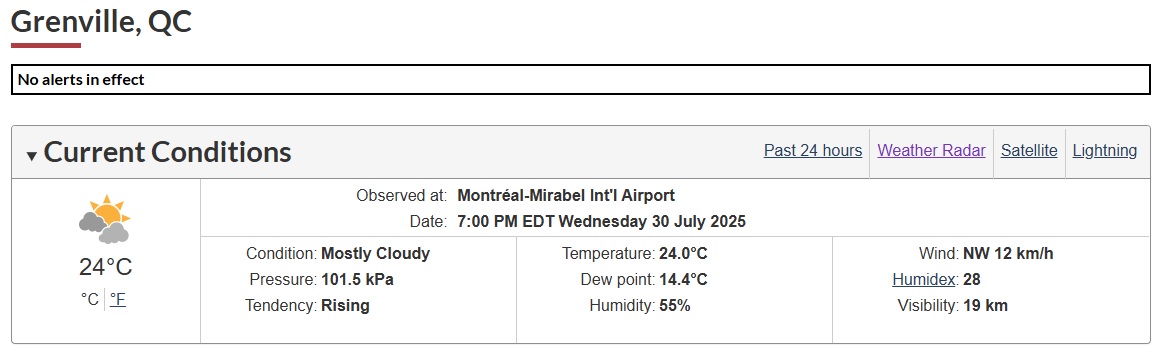
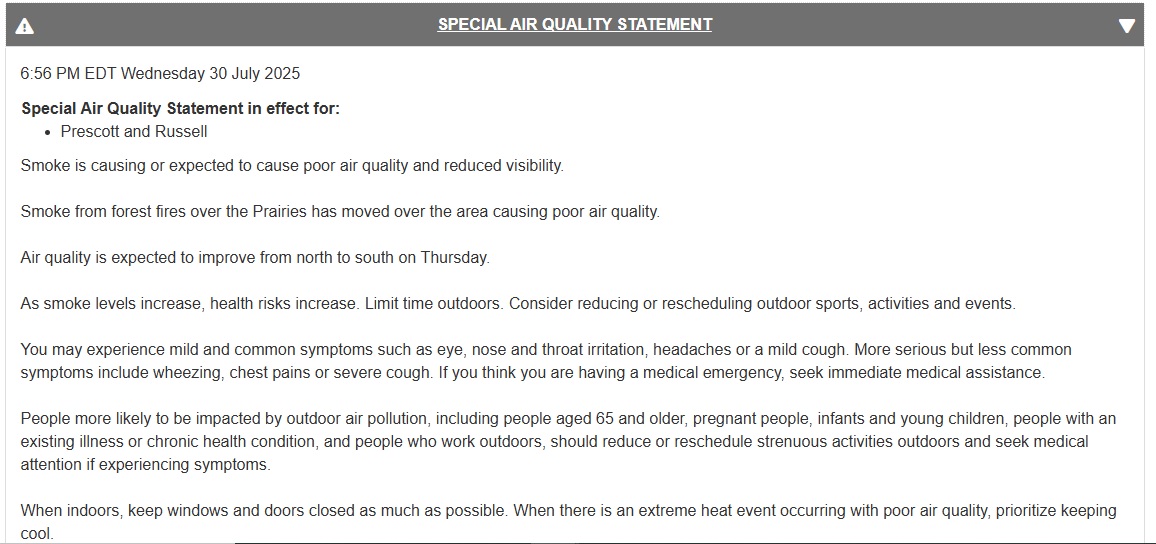
That afternoon, Environment and Climate Change Canada (ECCC) issued a Special Air Quality Statement for all of Prescott and Russell counties. In Québec, a Special Air Quality Statement was also issued for Montebello. However, no such advisories were issued for Grenville. As most readers should be aware, smoke does not usually stay on one side of the river or within boundaries made by governments.
During a previous round of smoky air in June, The Review inquired with ECCC about why there is not a more uniform issuance of Special Air Quality statements for communities along the Ontario-Québec boundary. No explanation was given about why advisories for bad air are being issued without the understanding that smoke crosses boundaries, but the federal agency did explain that smoke is unhealthy and what the nation’s official weather forecasting personnel are doing to detect it and advise the public of its potential harm.
“ECCC’s Regional Air Quality Deterministic Prediction System is used year-round to forecast air quality conditions, including how smoke from wildfires is expected to move across North America. This information helps Canadians to better prepare and protect themselves and those in their care,” explained Spokesperson Samantha Bayard.
A further outline was also provided of how the various activities by the federal government undertakes to determine the environmental and health hazards of transient wildfire smoke to the public. These include providing Air Quality Health Index (AQHI) forecasts for communities across Canada. The AQHI is calculated based on the relative risks of a combination of common air pollutants that are known to harm human health. These pollutants are ground level ozone (O3), particulate matter (PM2.5/PM10) and nitrogen dioxide (NO2). During wildfire smoke, the AQHI+ is calculated using only PM2.5, which is the dominant pollutant in wildfire smoke that is measured continuously.
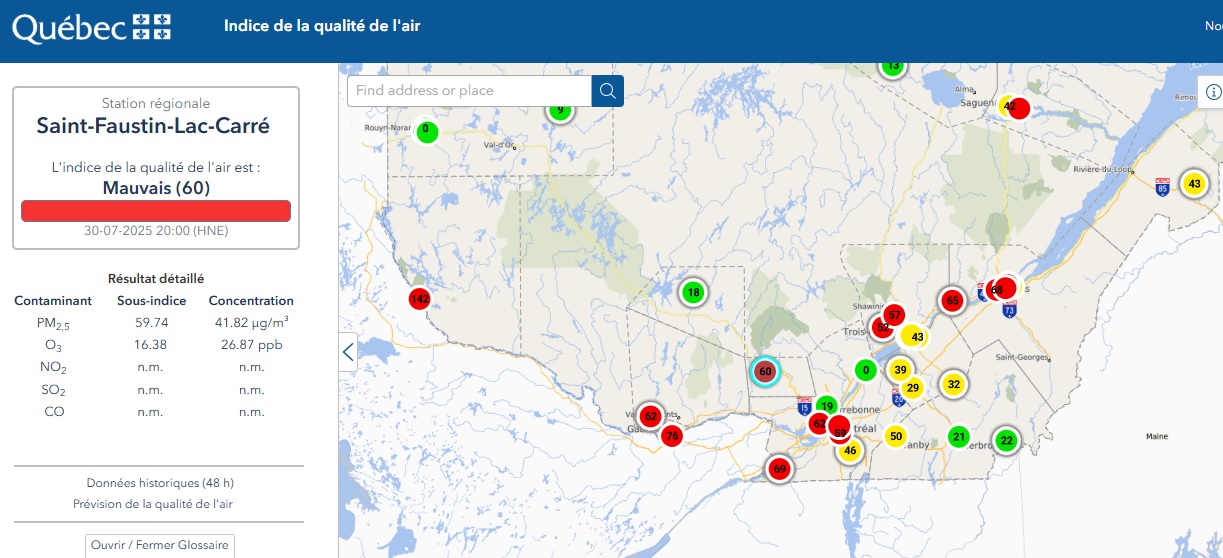
In Québec, the provincially-managed InfoSmog program uses the AQHI+ PM2.5, to issue its own smog alerts when the air quality is exceeding the pollutant thresholds. During the evening on July 30, InfoSmog air quality index for southwestern Québec was listed as poor because it was 51 and greater. The index at St-Faustin-Lac-Carré near Mont-Tremblant was 60. In Gatineau, the index was 76. An index of 1 to 25 is good, and 26 to 50 is acceptable.
ECCC provides its own air quality and wildfire smoke forecast maps. These maps show the total concentration of PM2.5 in smoke plumes and how wildfire smoke is expected to evolve and move across North America over the next 72 hours. And it of course issues its own Special Air Quality Statements
Personal notifications about wildfire smoke are also available to users of ECCC’s WeatherCAN mobile app, available for iPhone and Android. This allows people most at risk from wildfire smoke to be informed when their AQHI number (3 to 10+) is observed or forecast.