
A rabid fox found on a property in Chute-à-Blondeau was euthanized after testing positive for rabies, but not the variety of rabies normally found in foxes. It was the type of rabies normally found in bats.
Resident Janet Cote said there had been a fox around their property for the past five years since she and her husband Alan moved to Chute-à-Blondeau. On April 1 of this year, the couple noticed an adult fox on their property which soon had five kits or baby foxes.
“We watched them nursing and playing from the inside of our house,” she said.
On May 1, they noticed that one of the babies was not nursing along with the others and appeared to be much smaller in size and was not as active.
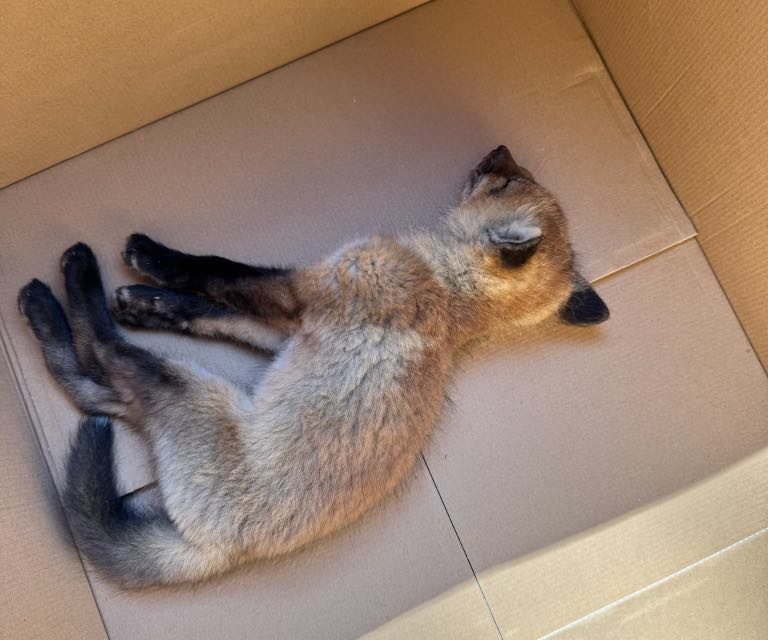
Cote said that on May 11, the entire fox family was outside and four of the kits were very active and playing. The littlest one ventured out onto the lawn and lay down. It was warm and sunny that day and the mother left the kits and four of them went back to the den and the little one stayed, laying on the lawn.
“After an hour, it hadn’t moved and we decided to intervene as we weren’t sure if it had passed away,” Cote said.
Alan went to see the small fox and discovered it was still alive. He was wearing gardening gloves and picked it up to bring it closer to the front of the house and laid it on the grass. He added a large pair of fireplace mitts to his hands and placed the fox in a large cardboard box. Janet then contacted Holly’s Haven, an animal rescue centre in Dunrobin and made arrangements to bring the sick fox to them the evening of May 11.
On May 12, Holly’s Haven contacted Janet Cote and informed her that the sick fox had seizures that morning, so it was taken to a veterinarian and it was euthanized. The body of the fox was tested. On June 13, Cote received a call from a nurse at the Eastern Ontario Health Unite (EOHU) and said that the fox had tested positive for rabies. The nurse interviewed the couple to determine if there had been a transmission of rabies through their minimal contact with the fox.
“I did not have contact with the sick fox and Alan decided that it would be prudent to receive treatment,” Janet said.
The EOHU arranged treatment for Alan at Hawkesbury and District General Hospital. Janet said he has had no symptoms and is feeling fine.
EOHU Medical Officer of Health Dr. Paul Roumeliotis said that preliminary testing did not indicate the specific variety of rabies. He said it is likely that a bat bit the fox, or the fox found the infected dead bat, which caused the transmission.
Roumeliotis said the variety of rabies does not affect how potential human transmission is treated.
An estimated 16 per cent of bats have rabies. Roumeliotis said anyone who does get bitten by a bat should seek immediate medical attention. He also emphasized it is important for pet owners to get their dogs and cats vaccinated against rabies to protect the animals against illness and to prevent any potential transmission to humans.
According to Ontario Ministry of Natural Resources (MNR) spokesman Mike Fenn, the transmission of bat rabies to another non-bat mammal is not unusual. The MNR typically detects up to two such cases each year. The last case of bat variant rabies in a non-bat mammal in Eastern Ontario was detected in a skunk in 2018.
“The Ministry is confident that this does not indicate any increased risk to the health of people or wildlife,” Fenn said.
He continued by explaining that while it is not common for bat variant rabies to occur in other species, it is possible in skunks, foxes, mink, and other mammals who scavenge on dead bats.
The MNR believes public education and pet vaccination are the best strategies for protecting people and pets from bat rabies.
Further information is available at Ontario.ca/Rabies.