

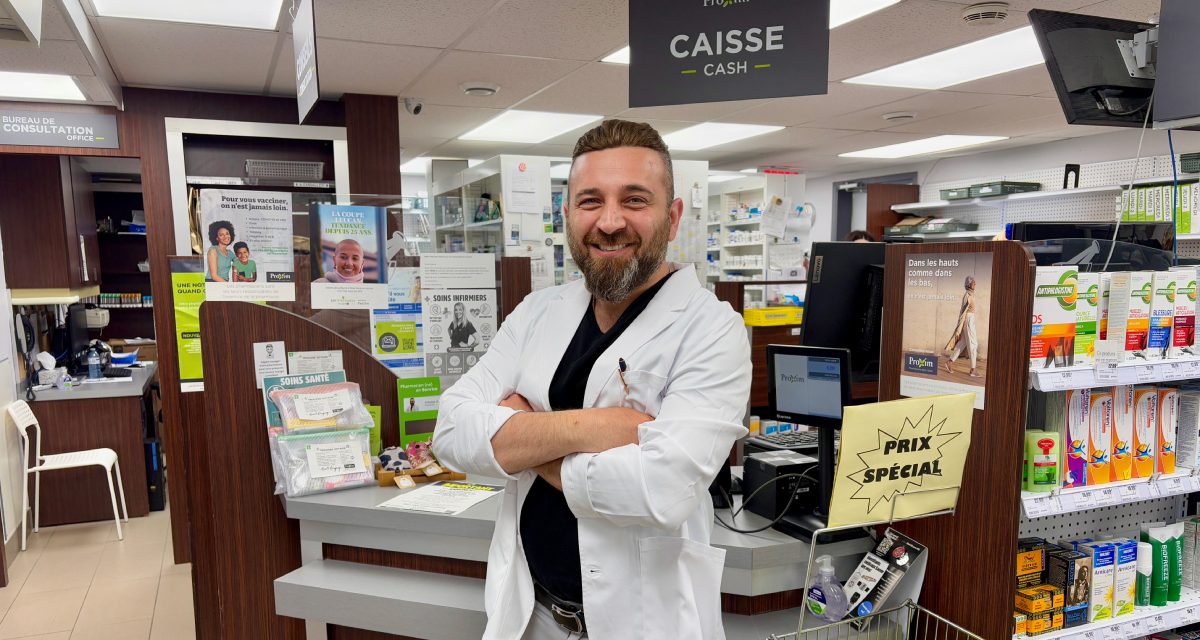
Since 2023, staff at Pharmacie Antoine Karam Inc. have been helping Argenteuil residents with minor medical treatments and prescriptions. As long emergency room wait times become the norm in Québec, pharmacists like Antoine Karam are taking on greater public health responsibilities.
Karam seized the opportunity to acquire the pharmacy located at 324 rue Bank in Brownsburg-Chatham so he could focus on helping as many people as possible.
“It’s been the best decision,” Karam said. “Above all, I try to help people here at the pharmacy so they don’t have to sit through long waits in the ER—especially if I am authorized to treat them.”
Law 31, passed by the provincial government in March 2020, enables pharmacists to broaden the care they provide to reduce the burden on Centres locaux de services communautaires (CLSC) and emergency rooms.
“There are private nurses, nurse practitioners, and physicians, but they’re disconnected from RAMQ, Québec’s public insurance system. These services are only an option for those who can afford to pay out of pocket.”
We’re talking about hundreds of dollars in terms of costs,” Karam said. “That’s why we offer free consultations to our patients.”
With the expansion of pharmacist powers through Law 31, Karam explained that pharmacists have the training, knowledge, and ability to treat minor ailments, make individual decisions on medication, and manage conditions that would otherwise require patients to wait hours to see an emergency room doctor.
The expanded pharmaceutical offerings include having pharmacists prescribe medication for certain minor conditions (such as cold sores, mouth ulcers, and minor aches) when the diagnosis and treatment are known, extending doctors’ prescriptions so that treatment is not interrupted, adjusting prescription dosage, and prescribing laboratory tests if necessary.
Karam joked, “We’re not going to do a heart bypass surgery in aisle two—but for conditions like acid reflux, urinary tract infections, cold sores, and eczema, there’s no reason we can’t help as pharmacists.”
Common services offered at the pharmacy include extending prescriptions, smoking cessation, vaccinations, urine tests, pain management, diabetes management, allergies, and minor infections.
Although the pharmacy does not currently have a nurse practitioner on hand, Karam said this was something he is looking to offer in the future for patients.
“We do have a nurse, Roxanne Francoeur, who can conduct ear cleanings, wart treatments, vaccinations, and wound treatment and care,” Karam explained.
“What I’m trying to do here is have a one-stop shop for your medical needs. If we can’t treat the ailment here, we will ensure you are referred to someone who can. Ultimately, if I can help them, I will.”
Healthcare wait times and limited access to family doctors continue to pose challenges for Québecers.
Karam highlighted that access to public healthcare was not what it used to be. He explained that the medical field is more complicated, and the pharmaceutical field even more so, due to endless bureaucracy.
“In 2003, to treat type two diabetes, we had about three classes of medication we could use. Now, we have more than ten classes of medications. This applies to blood pressure, hypertension, and other heart conditions, as well,” Karam said.
He also identified Québec’s perceived lack of organization and allocation of resources by the provincial healthcare system as not helping lengthy wait times either.
“As pharmacists, we’re also dealing with legalities that prevent us from diagnosing and then prescribing medication for certain individuals.”
“Let’s say I have a patient who clearly has diabetes. I don’t have the right to diagnose him, but it’s fairly simple to,” Karam said.
Another common issue Karam finds with some of his patients is that they do not have access to a dedicated family doctor. He finds that many doctors who are either retiring or stopping their practice for another reason do not have succession plans or other physicians lined up to take over their patients’ care.
Karam said that about 20 to 30 per cent of his patients do not have a family doctor, which is significant. Others do have a family doctor, but could not get in touch or faced long delays for appointments.
“Ultimately, if I can help someone, I will,” Karam concluded.
