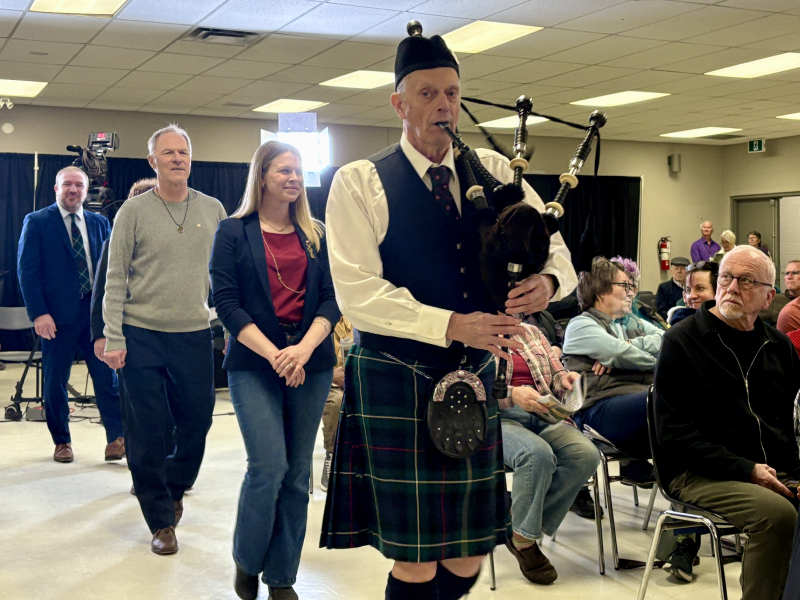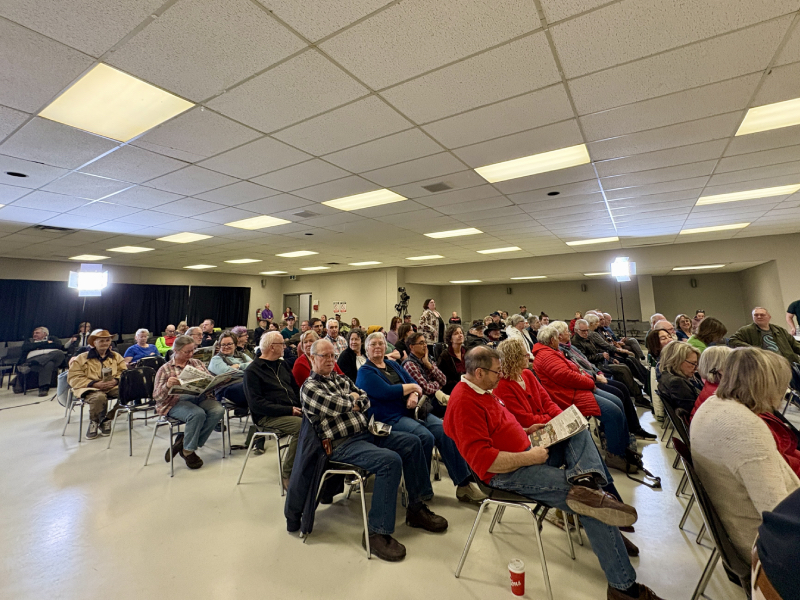
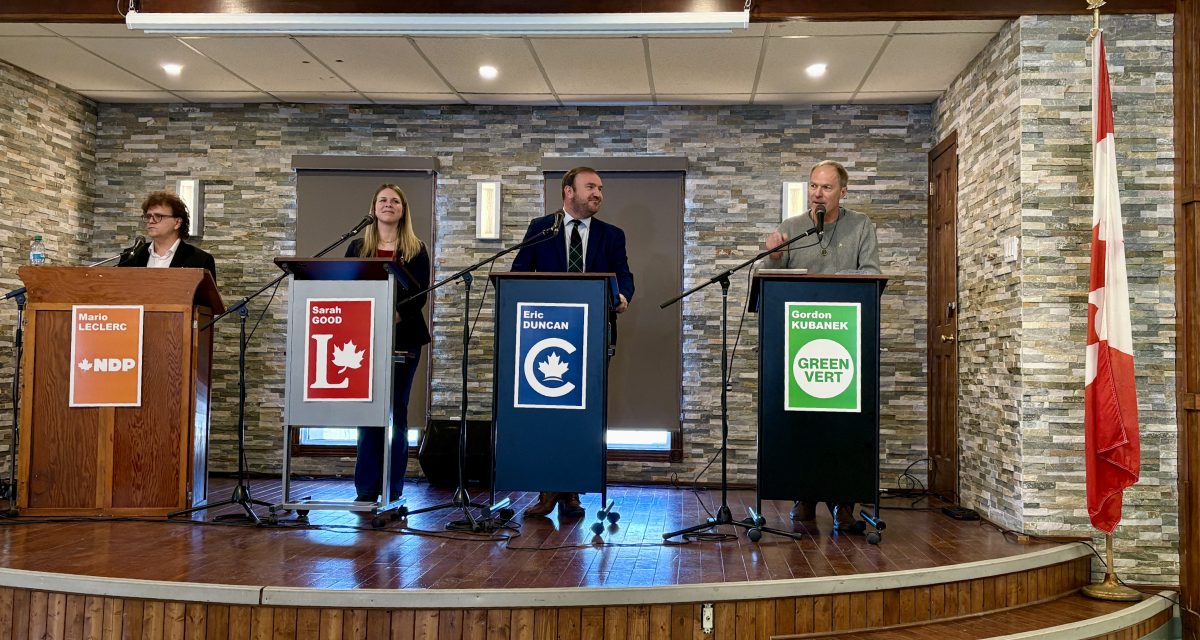
On Sunday, April 13, federal candidates for the Stormont-Dundas-Glengarry (SDG) riding debated national issues at the Glengarry Sports Palace in Alexandria.
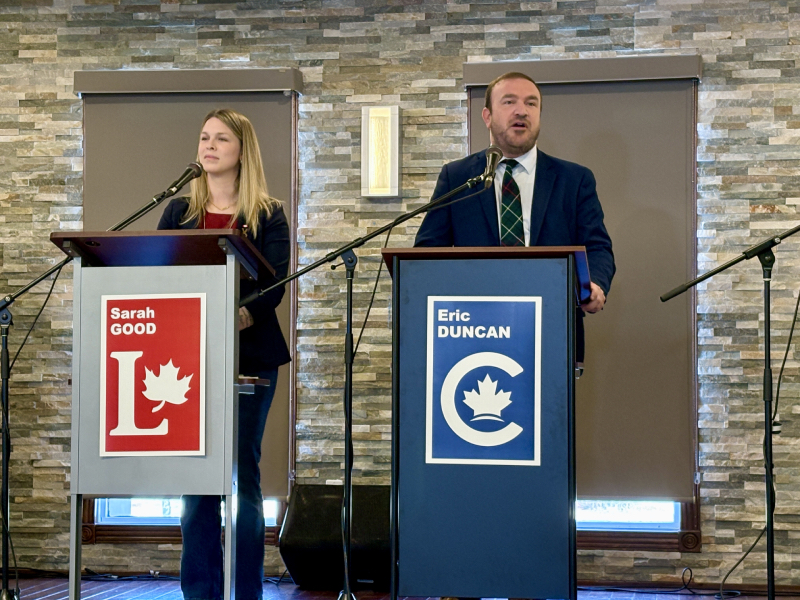
The New Democratic Party (NDP) candidate Mario Leclerc, Liberal candidate Sarah Good, Conservative candidate Eric Duncan, and Green Party candidate Gordon Kubanek were present for the debate.
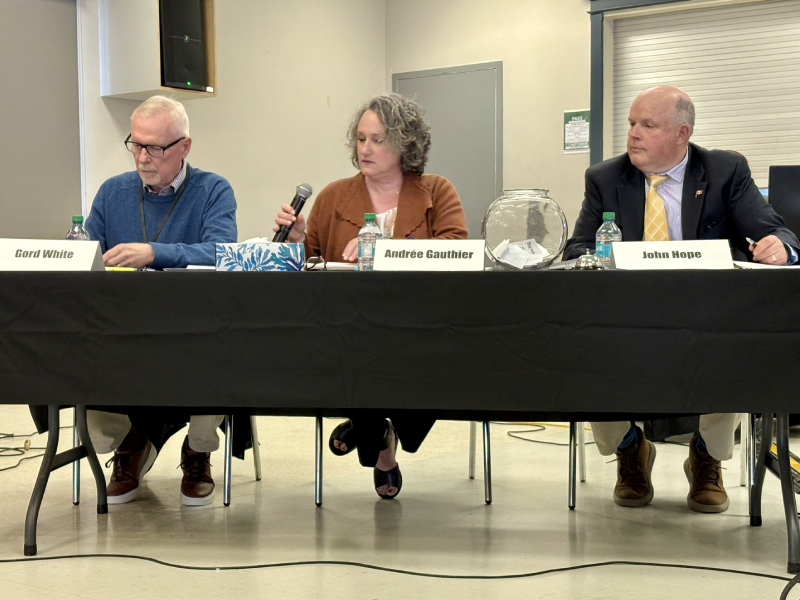
Moderators Gord White, Andrée Gauthier, and John Hope posed four pre-selected questions—two in English, two in French—while ensuring candidates stayed within time limits.
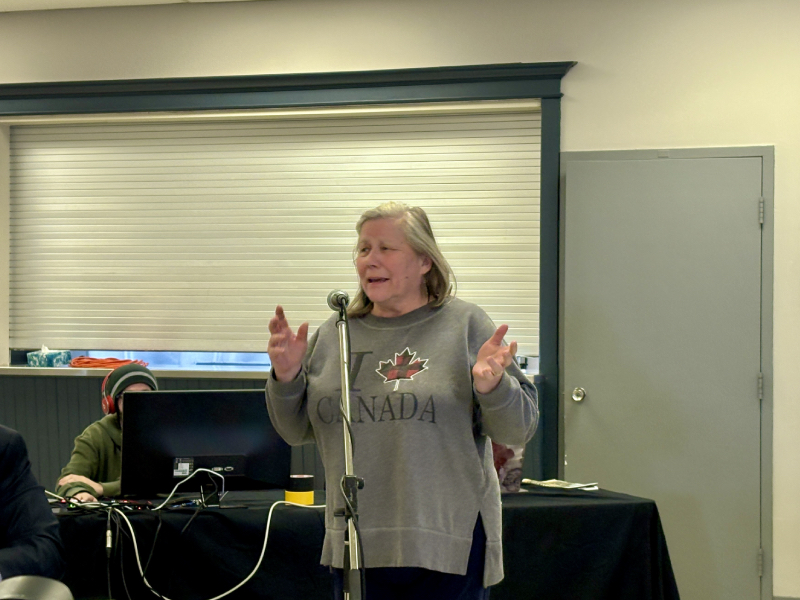
Four audience members were also able to ask the candidates questions.
In the last election, 62 per cent of 53,200 eligible voters in SDG cast ballots, electing Duncan as Member of Parliament (MP). Following the 2021 census, the riding’s boundaries were redrawn to include North Glengarry, formerly part of Glengarry-Prescott-Russell.
Debate topics included government transparency, foreign aid, electoral reform, and the Canadian news media landscape. Candidates also addressed public safety concerns such as violent crime and bail policies, as well as the environment and the Carbon Tax.
Transparency and Foreign Aid
The first question asked candidates what their government would do to keep Canadians informed on where taxpayer dollars are being spent globally.
Leclerc emphasized Canada’s foreign aid priorities: “We promote three things: security, stability, and democracy,” referring to the positive contributions Canadians make on the global stage.
“The answer is transparency and accountability. Nobody is safe until everyone is safe,” he concluded.
Kubanek highlighted how foreign aid contributes to global health and security, explaining that, “We reduce infectious diseases because those diseases come here. We create trade and economic opportunities. We also prevent security threats, which arrive here as well. It is an investment.”
Duncan criticized the Liberal government’s spending over the past nine years: “Our national debt as a country has doubled to over $1.3 trillion. The average Canadian family now pays $10,000 more in taxes annually than in 2015. We have a role as Canadians to help, but at the end of the day, there are a lot of dollars and a lot of programs that lack accountability.”
He then argued that much of the foreign aid spending lacks transparency and was in favour of giving more power to the Auditor General.
Good spoke on the importance of maintaining global relationships that Canada currently has that were a result of its foreign aid contributions.
“When it comes to transparency, it is essential that our Member of Parliament has clear, honest, and frequent communication with their constituents. My commitment to you is to produce annual public fiscal reports so that you do not have to look for this information yourself,” Good concluded.
Electoral Reform and Youth Voter Engagement
Kubanek explained that historical voter turnout has been dependent on the level of civic excitement the election brings and if voters feel their vote matters, drawing some comparisons to the United States and Germany.
“When voters feel they have an impact, they show up. Those systems that have higher voter participation have some form of proportional representation. There are probably some people out there who would not vote for me, thinking, ‘It is a wasted vote.’ With proportional representation—previously promised by the Liberal government—that would not be the case,” Kubanek said.
Duncan suggested having more people run for office as a way to combat low voter turnout among younger generations.
He described that voter turnout increases when candidates are relatable: “Somebody they knew, somebody their age talking about their issues made a big difference. I think there is going to be a larger turnout this election because a lot of younger individuals are focused on affordability and home ownership.”
Good stated she would continue the fight for electoral reform if elected, saying that she was also disappointed when the Liberal election promise was not kept. Good also suggested examining the role of Elections Canada in being able to teach people more about the importance of our electoral process.
Leclerc explained that electoral reform is a shared responsibility and that Elections Canada has the educational resources to keep Canadians informed. He also suggested lowering the voting age to 16 as a way to encourage more youth to participate in the democratic process.
Canadian News Media Landscape
A debate attendee asked candidates whether they viewed the Canadian Broadcasting Corporation (CBC) as a necessity and if it should be defunded and dismantled.
“Pierre Poilievre has made this pledge in his leadership race and here now,” Duncan said.
“We have a lot of tough choices. The CBC needs to have its budget reduced, and there are many ways in which I believe we can do that. Bonuses at the CBC amount to tens of millions of dollars at a time when viewership is down, revenues are down, and the organization is struggling,” Duncan claimed.
He also pointed to the Liberal legislation, bills C-11 and C-18, which he claimed restrict news dissemination in Canada, highlighting that disinformation and misinformation flourish when the proper mechanisms are not in place. He then cited Canadian news media not being able to be shared on social media sites like Facebook.
Good said, “Canadians rely on Canadian journalism, and we cannot rely on United States-owned multi-billion-dollar news corporations to provide us with reliable, truthful journalism.”
“It is unwise to rely on foreign media for accurate news—especially today with increasing use of Artificial Intelligence (AI), foreign interference, and fake news.” To combat this, Good reinforced the need to have a reliable Canadian source for news information that people can count on.
Leclerc agreed with Good on the necessity of Canadian news media, defining the Conservative calls for cuts to the CBC as a grave error, especially in light of misinformation and biases.
Kubanek concluded by calling for the government to take stronger action against media monopolies, not just in news, but across other sectors as well.
Photos by Philip Oddi: