

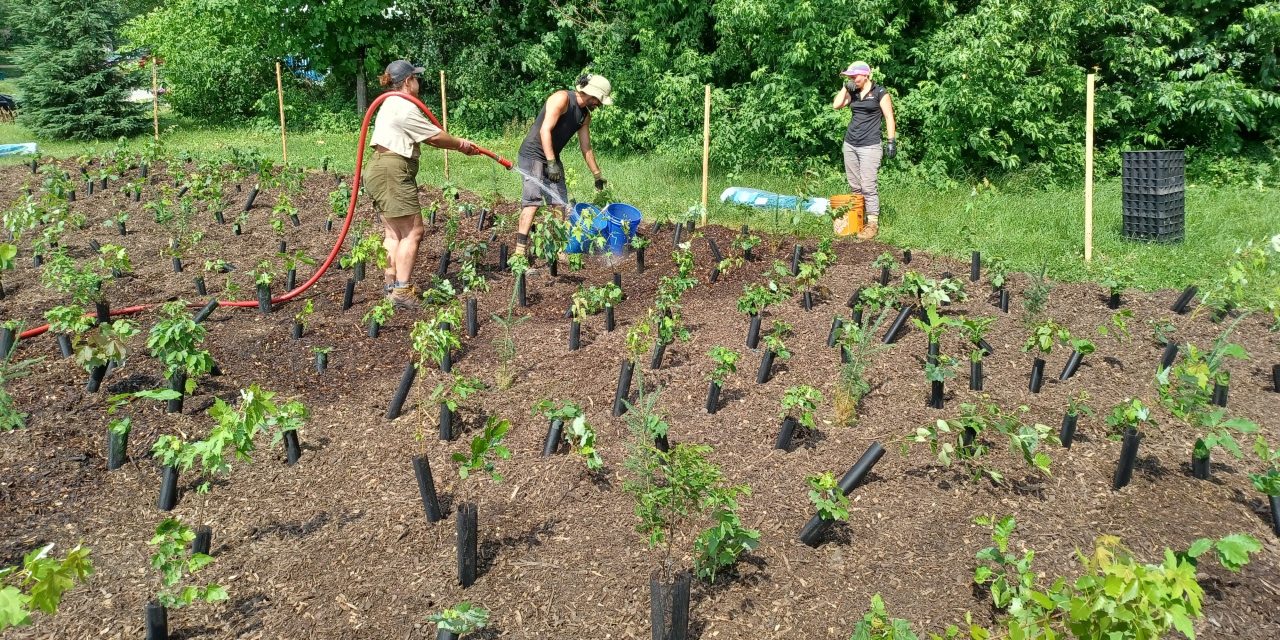
A small forest is now growing on a vacant lot in Lachute.
It is called a microforêt or microforest and the city of Lachute is planting them on city-owned land. On Thursday, June 20, a crew from Arbre-Évolution, an organization specializing in reforestation, was at the corner of rue Bellingham and rue Fillion planting 750 small trees of various native species on just 250 square metres or 2,691 square feet. The microforêt concept is intended to be a measure to enhance the land through a plantation which will offer various ecological benefits.
Jorge Rojas of Arbre-Évolution said the concept is meant to accelerate the process of recreating a natural tree canopy and revitalize urban space, especially vacant land. He explained that by planting many trees close together, they will grow taller faster.
“They’re fighting for light,” Rojas said.
Oaks, maples, and spruces are among the trees planted at the site, matching what is already found in local forests.
Rojas said deaths of some of the trees will occur, but most will grow to establish a high shade canopy.
“The stronger trees will prevail,” he said.
The Lachute microforêt is the first of its kind in Argenteuil, but Rojas said the method is taking root across Québec.
“It’s a very popular technique right now,” he said.
Lachute Mayor Bernard Bigras-Denis said the lot where the first microforêt has been planted is one of the lots the city purchased in 2019 because the land is in a high-risk area for flooding and was affected by the large flood in the spring of 2019 along nearby Rivière du Nord.
“It’s a very good project to increase biodiversity in the urban sector,” Bigras-Denis said.
He explained that the current microforêt planting is the first phase of the project and an additional 75 trees will be planted on two other city-owned lots along rue Fillion, and possibly near the municipal airport. Bigras-Denis said the project is part of the city’s green orientation and efforts to reduce urban heat islands by increasing the amount of shade in the urban area during the summer when the hot sun heats up the pavement.
Urban heat islands are often associated with large cities. However, Bigras-Denis said a study commissioned by the city shows they also exist in Lachute.
Bigras-Denis said the Lachute microforêt project is costing $20,000 but the city is only responsible for 50 per cent of the cost. The remainder is covered by Arbre-Évolution. He also said that Waste Management, a large waste collection and disposal firm, is also buying carbon credits in Lachute’s microforêt to offset the company’s greenhouse gas emissions.