
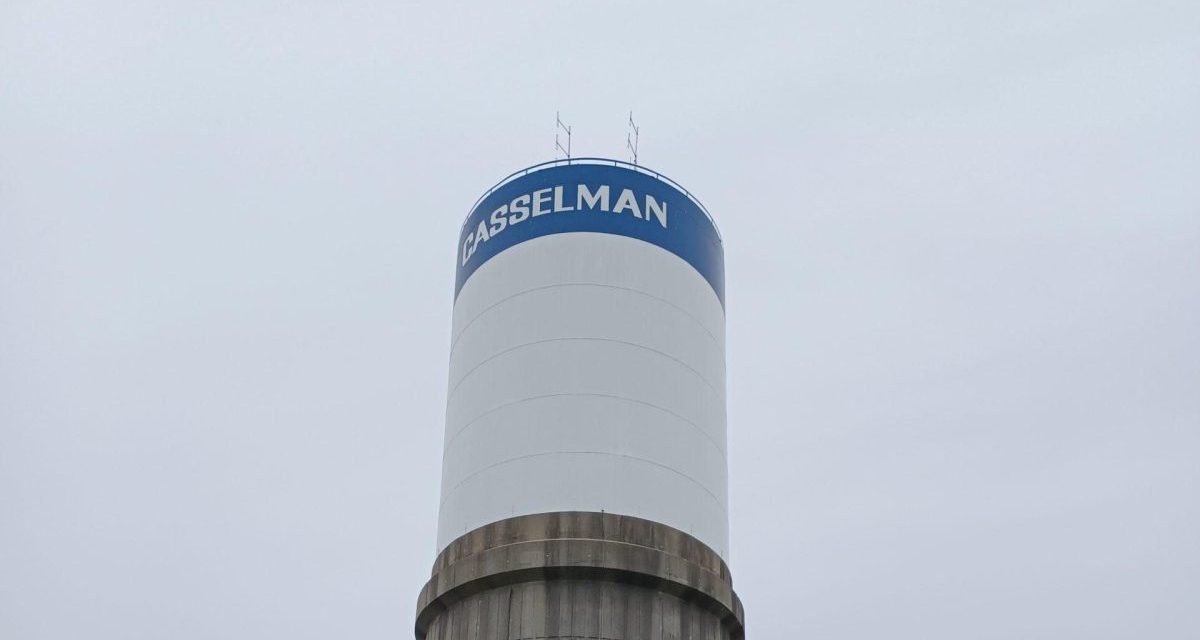
The mayor of Casselman says residents will see an improved appearance in their municipal tap water this spring and they can expect improved communication from the municipality about water quality.
That assurance from Mayor Geneviève Lajoie followed an update on efforts to remove manganese from the water. For several years during the spring and summer months, manganese in the water of the South Nation River has made the water in Casselman look brown or yellow. In 2023, it was particularly noticeable and led to significant concerns from residents.
Manganese is a naturally occurring ore found in bedrock. Manganese ore is rarely used on its own, but is a key ingredient in the manufacture of steel and aluminum. It also dissolves easily, which is why somewhere, deep down below the surface, it is entering the water of the South Nation River, which also happens to be the source of water for Casselman. The Province of Ontario, which regulates drinking water safety, does not have a legal limit for manganese in drinking water. However, the federal government does have a guideline. According to Health Canada, the maximum acceptable concentration (MAC) for total manganese in drinking water is 0.12 milligrams per litre (mg/L). As an example, on July 7, 2023, the manganese level in Casselman was 0.35 mg/L. and 0.45 mg/L. On July 21, 2023, the level was one mg/L.In September 2023, chemist and water treatment expert Dr. Bill Dallala informed the municipality that to remedy the manganese problem, a series of changes are required to the chemical processes used to treat the water in Casselman. The Ontario Clean Water Agency (OCWA), an agency of the Ministry of the Environment, Conservation and Parks (MECP), operates the Casselman water system under contract with the municipality.
According to a report presented to Casselman council on Tuesday, February 20, 2024, Dallala, with the collaboration of OCWA has been conducting testing, analysis and research on the required process and equipment requirements. One of the necessary steps to make the proposed changes possible is to obtain approval from the MECP. However, the changes Dallala is proposing have never been used before in Ontario, and therefore, the MECP does not have the expertise to provide feedback. The approvals process is long. The next few months will be spent obtaining the required approvals from the MECP, engineering drawings, and getting ready for the pilot testing in April, including the proper equipment needed. Constant monitoring will be done, and Council and our residents will be informed of progress.
“We’re hoping they’ll (residents) see a difference in April,” Lajoie said.
The mayor described Dallala as “brilliant” in his field and noted he also resolved problems with manganese in the water at Calypso waterpark.
Casselman has received a $1 million federal grant for the effort to resolve the effects of manganese on the municipal water system. The municipality has also contributed $266,700. The project was included in the 2024 municipal budget.
Lajoie said she is also ensuring the municipality develops a strong communication plan to better inform residents of the situation with their water and efforts to resolve the manganese-related problems, no matter the result.
“They’ll see a difference for sure, either way,” she said.
Casselman resident Stephanie LaMaina established a Facebook group and community awareness effort in response to the water situation in summer, 2023. Following the report to council on February 20, LaMaina said she was also hoping for improved communication to residents about the situation, which Lajoie has promised.
“It’s a step in the right direction,” LaMaina said.