
Gender.
It’s become a hot topic recently but it’s not always an easy one to think about. Having people inform you that their pronouns have changed, or meeting someone who uses pronouns that you are not familiar with might be difficult to understand. It might even make you uncomfortable.
Understanding gender and confronting this discomfort should matter to all of us, regardless of our gender identity. We may be in a place of transition these days—accepting the changing societal landscape but perhaps not fully understanding it.
This article invites you to open your mind — just a little.
This all started with an invitation to visit Fred and Bonnie Cappuccinos’ home in North Glengarry. Fred, 96 and Bonnie, 88, said they had something they wanted to talk about. They got right to it. They were deeply saddened by the December 2022 mass shooting at Club Q, a gay nightclub in Colorado. It has been identified as a hate crime.
Fred and Bonnie think that some people don’t understand homosexuality.
“We really don’t know what we can do, but we have to do something,” Fred offered. “People feel that you can choose that lifestyle, but it isn’t a choice. Some people are born that way,” Fred continued, mentioning that unlike what some people think, gay people are not perverts. There are no more perverts among gays than in the rest of society, Fred added.
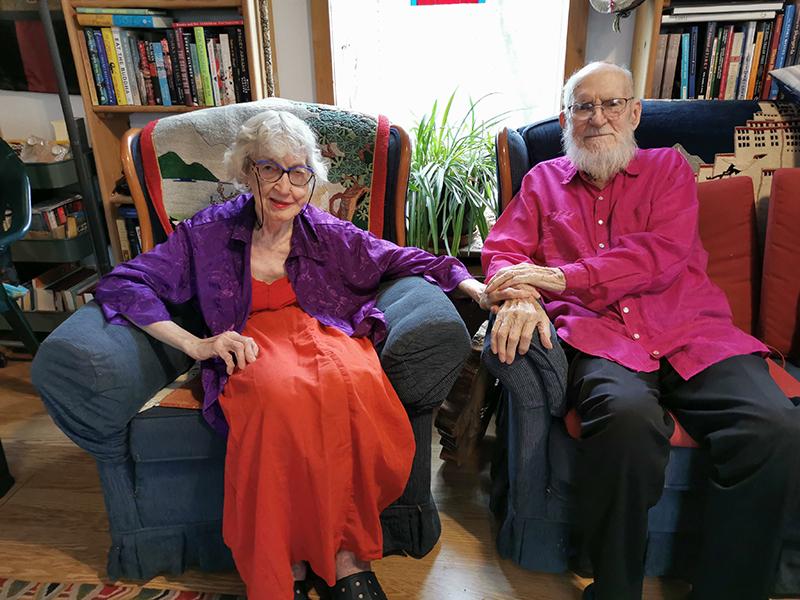
The Cappuccinos are known for their steady support of homes for children in different parts of the world. The organization they founded in 1985 is called Child Haven International. The organization assists children and women in need in four countries by providing food, education, health care, shelter, and clothing and emotional and moral support. The Cappuccinos have raised funds for their work during these past decades but beyond their work for Child Haven International, they adopted 19 adopted children, to add to their own family of two children.
It was the 1995 suicide of one of their sons that left them with questions. Their son Kailash took his own life just weeks after the death of his best friend, who had died by suicide. Kailash was inconsolable after his friend’s death. Fred and Bonnie only later realized that Kailash may have been gay. They wonder if Kailash would still be alive today if there had been less judgement and hate in the world.
We have to stop thinking that we need to make gay people change. If society could be more accepting of the way people were created, it would eliminate a lot of fear and hatred, according to the Cappuccinos.
One retired gay man who wished to remain anonymous and has lived in the region since 1998 says things are different today. But in the 1970s in Saskatchewan, “My mother wanted to kick me out of the family,” he says.
As young as six or seven years old, he knew that there was something different about his feelings when compared to the other boys his age. Growing up with those feelings wasn’t always easy.
“Yes, there were hurtful things. I was beaten up. I wasn’t invited to birthday parties, for example, but you can’t let the negativity get to you," he says, thinking back to different times over the years when he was ridiculed, even as an adult in the workplace.
“Nobody wants to be gay,” he said, meaning that it is not a direction that one can simply choose.
He says he lives by the credo, “To thine own self be true.”
How is life today?
“Everyone is nice to me but I do notice that when it comes to groups of men, for example, that if one of the guys is a friend when we are one-on-one, he doesn’t acknowledge me when he is in his group.”
“All I can say is it does get better. I think those who are the most uncomfortable may be the ones with the most fear or maybe they have doubts about their own sexuality”, he continued.
Coming out
If someone finds out that I am gay and they say, “You didn’t tell me you were gay; I always reply, “You didn’t tell me that you were heterosexual.” He laughs.
He has his own views on ‘coming out’ as a gay person. “What business is it of anyone’s? Why should anyone care if I’m gay?” he asks.
And his family back home? His mother came around. He went on to a responsible job and career in the banking industry and says that he has always been honest with others and with himself.
“People are changing,” he says.
At age 26, Cayden is a transmasculine/nonbinary intersex human whose pronouns are they/them or it/its (dealer’s choice) and they really just want you to treat people like human beings first.
Cayden has spent most of their life in the region and attended Laurentian Regional High School where they felt it was unsafe to be their self. Growing up as an intersex person for them meant that they never fit into the rigid male/female stereotypes of the binary genders. But that didn’t stop them from trying to force themself to conform out of fear of harassment and physical harm.
“I didn’t come out in high school, it was just safer that way,” Cayden said.
Cayden says that lost employment opportunities, people finding out their deadname from legal documents, and dealing with being misgendered are all some of the challenges that they routinely face. Hospital trips always come with a side of anxiety for Cayden as they are never sure if the staff will use its correct name or its deadname.
Is it hard to live in a space that is not strictly defined as female or male?
“Life is interesting,” Cayden says cryptically. It is a walking encyclopedia of terminology, online resources and is accommodating and generous when it comes to explaining the changing landscape.
“I get it” says Cayden, when asked about how people can react to physical appearances that are androgynous — difficult to define as masculine or feminine. In a sense, reality is broken. There is more to sexuality and gender than our appearances and the clothes that we wear. And I get that for many people, it’s really scary to have your binary idea of what gender is flipped on its head,” Cayden says. At the same time, Cayden says that being nonbinary is not new, and that the gender has existed since humanity has existed.
Cayden’s ability to talk about gender is connected to lots of introspection. “I talk to a lot of people about their lives.” Cayden is happy to say that even if some people are still figuring it out, there is more acceptance. But there is still hate online and in person, Cayden commented.
“People need to stand up and be allies. Call out your friends when they are out of line. The small things can help people feel safe,” Cayden said.
Locally, you can find out more about the Prescott-Russel LGBTQ+ Alliance here: https://www.lgbtq-prescottrussell.com
