
Is it a fossil? Or what exactly is it?
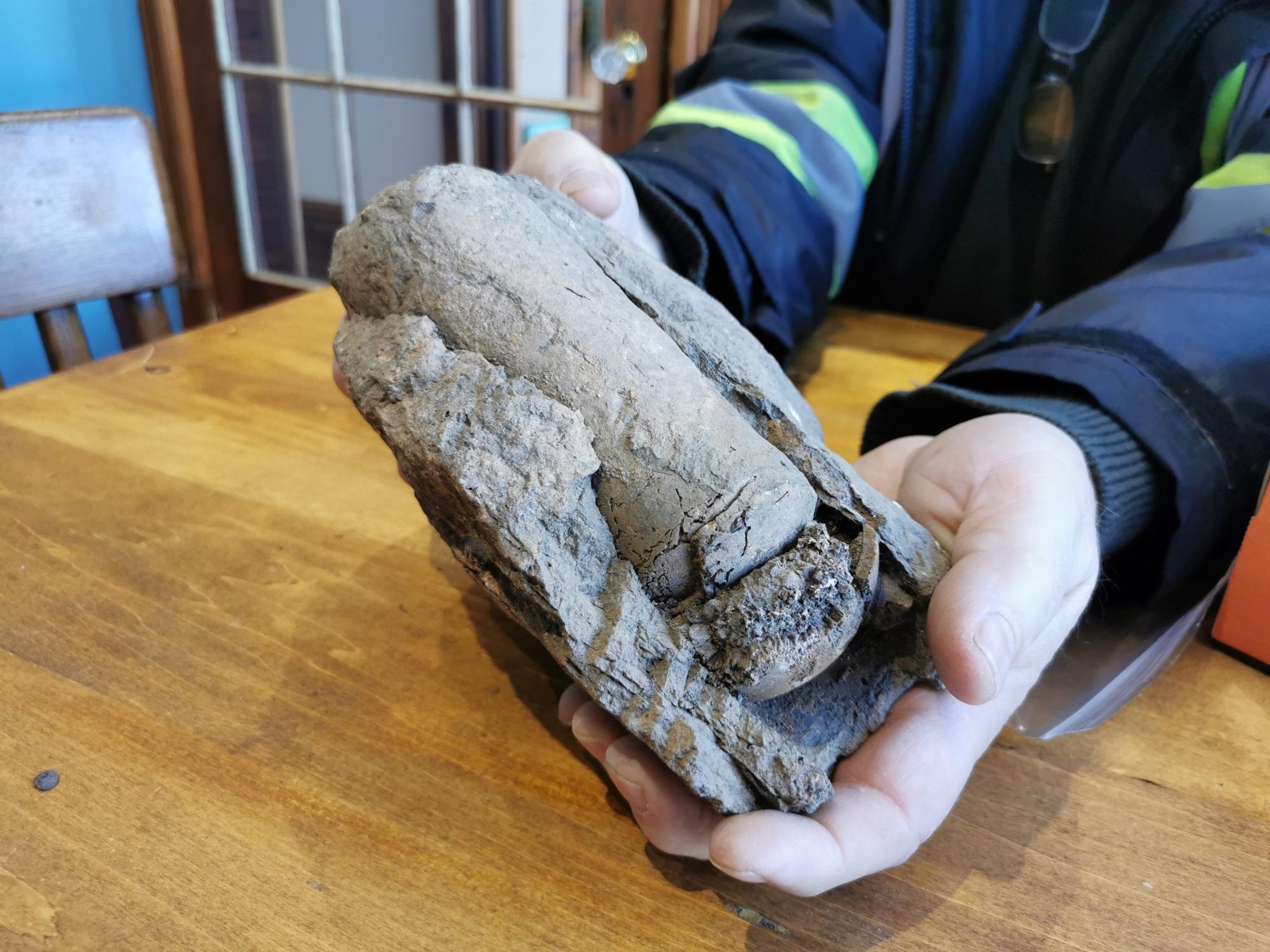
A few weeks ago, we wrote about local contractor Philip Bradley and his quest to find out if an unusual find was a fossil and if so: how old was it?
Bradley visited The Review where we took a few photos and sent those images off to the Museum of Nature in Ottawa. An expert replied in January and surmised that the stone cylinder was a fence post.
Bradley decided to take it a step further. We caught up with Vankleek Hill native Jean-Luc Pilon, retired after 33 years as Curator of Central Archaeology for Northern Canada, formerly with the Museum of Civilization (now called the Museum of History.) We thought he might be able to set us on a path to learn more.
Pilon and Bradley met up in a Tim Hortons parking lot in Casselman recently so that Pilon, now living in the Ottawa area, could take a look at the find.
While Pilon is pretty certain it is not a fence post, he acknowledges that it is hard to say much when one only sees photographs. In the meantime, he has sent photos to a paleontologist that he knows. He is still waiting to hear from that expert.
But Pilon thinks it is much older than just 10,000 years old. “I think we are easily looking at millions of years,” he said, adding that he is not a bone expert and that this is not his area of expertise.
Glaciers were big earth movers, he relates, something carrying items long distances over the landscape. Rocks, bones and other items would be carried along and then re-deposited far from their original resting place, he says.
The story behind the story of this find is the enthusiasm of both Bradley and Pilon, both Vankleek Hill Collegiate Institute alumnae.
Bradley says he has had an interest in fossils and local finds for decades. Pilon’s enthusiasm dates back to his school days and carried him into a career where he followed a fascination with learning how ancient people lived. He recalls playing in a neighbour’s back yard as a child and finding fossils.
“We would be in the back yard where there were lots of soft maples and we would find little seashells in there,” he related.
“But what really got me started was finding a stone in the St-Grégoire school yard – about 2 1/2 inches long and 3/4-inches wide at the base. It had nice little striations on it. I must have been in Grade 4 or 5. I thought it was an Indian arrowhead made from flint,” he related. “I wanted to get some flint from Matte’s (a tobacconist shop at the time) –I wanted to find out all about it and how people used it. I was fascinated with how people did things before,” Pilon continued.
Let’s move forward in time. It is 1973 and Pilon was in his first year at university, studying–what else–the past. He took the arrowhead to an archaeologist at the Royal Ontario Museum in Toronto.
“It turned out to be a fossilized tooth,” Pilon related, adding that he remembers sitting down with archaeologist Walter Kenyon.
Pilon spoke about local finds in Eastern Ontario, explaining that items found on a farm near Pendleton were tested and found to be 4,700 years old. There was an archaeological site there and traces of fire pits were found. The soil was sifted and butternut fragments were found. Butternuts and their fat and oil would have been part of a winter diet, Pilon conjectured. He mentioned findings that are in the Blaney’s Creek area, too.
Sometimes there are sites which tell a story and you know that something happened there, he explained.
Pilon’s career focused on how people lived in the northern parts of Canada, especially indigenous peoples. He believes that today, many people have their own finds, which they keep out of their own fascination with the past.
He recalls that years ago, a visit to the Museum of Nature’s research and storage facilities impressed him. There were aisles of floor-to-ceiling storage, with massive pieces encased in plaster of Paris. He remembers seeing an item from Canada’s Badlands that had been found in 1916.
“Some of these items were found over a century ago and they have been catalogued, but not yet opened and studied – we don’t always know what’s in them or what mysteries they will reveal or what stories they will tell about some species,” Pilon said.
“The stone that Philip found – the person whose land it is on had already discovered it and put it aside for this moment. Who knows what it is? The best way is to put it in front of a paleontologist,” Pilon emphasized.
It was kind of weird to be in a parking lot looking at something in the back of a car, Pilon joked, referring to his meeting with Bradley. “There is always a little bit more to learn. The last word has not been written yet,” Pilon ended.
If your find is something of value, do you have to surrender it to a museum?
Not necessarily, says Pilon. It is more about the recording of the find, than who owns it. Museums often make copies of items, and allow you to keep what you found. But leaving it in the care of a museum means that some day, someone might be able to ask new questions of it, using new techniques. It can be a legacy for the future.
You can find the most interesting things on people’s window sills, Pilon joked. “People find these things and they keep them.”
Pilon should know. After all these years, he still has the fossilized tooth he found in the St-Grégoire school yard those many years ago.
We will be following the story. Stay tuned.

Jean-Luc Pilon holds a fossilized tooth that he found in the St-Grégoire school yard many years ago. It set him on a path to learning about the past.
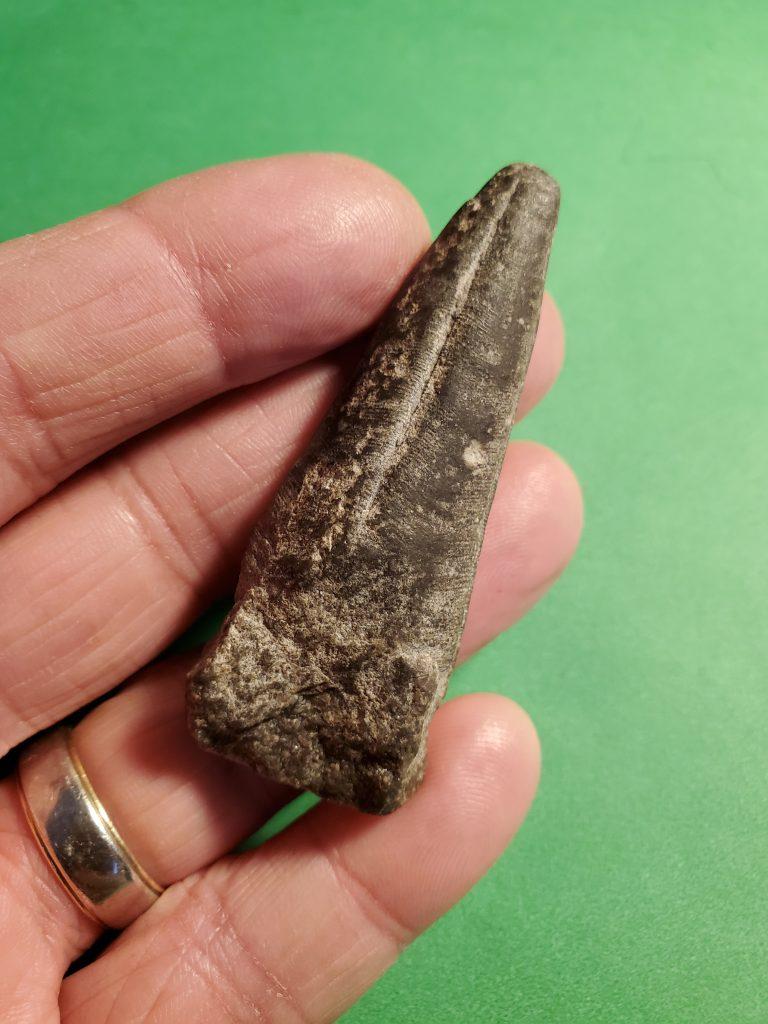
Jean-Luc Pilon has kept the fossilized tooth that he found so many years ago.
