
Roch Seguin fields calls from all over Canada at his home south of Alexandria, where he repairs and restores antique snowmobiles
Roch Seguin was only introduced to antique and vintage snowmobiles seven years ago, but in just that time he has seen tremendous growth in collecting the historic machines.

“It was done – it was totaled,” says Roch Seguin, of the John Deere 295-S racing sled he found near Vankleek Hill. Submitted photo
Seguin, who lives in Green Valley, south of Alexandria, has become the ‘go to’ person for information on older snowmobiles, repairing and restoring both his own machines, as well as those of other enthusiasts. He fields inquiries from all over Canada about where to find parts for vintage sleds, particularly for John Deere models – which he himself rides.
“My dad and his brother grew up in the era of all these sleds,” says Seguin, who first had his interest piqued when his father and uncle returned from a vintage show in Québec in 2015, where they saw more than 300 vintage snowmobiles.
“I heard them talking about it and I wanted to join in so the next year I got myself an older sled.” Seguin is not a mechanic himself, but he learned the craft from his father and is comfortable working on vintage machinery. In Vankleek Hill he found a rare racing model John Deere 295-S that he was able to restore from scratch.
“It was done – it was totaled,” Seguin remembers, noting that racing sleds – even in trashed condition – are very valuable due to their rarity. “They’re rare because they didn’t make too many of them to begin with and because they were the flagship of the company.”
John Deere dealers each received only one 295-S in 1974.
“That was (John Deere’s) first attempt at a racing snowmobile,” Seguin relates, adding the old girl is a definite sleeper sled that surprises many riders on new machines. “It doesn’t look like it, but it has a lot of cool parts.”
“It’s an older snowmobile, but the skis come off the ground and you’re keeping up with them and they’re going ‘wow’.”
Antique vs. vintage sleds
For collectors, a snowmobile is considered vintage if it is more than 25 years old. Some even consider a 15 or 20-year-old sled vintage, due to the fast pace at which snowmobiles design has progressed. Models more than 50 years old fall into the antique class.
Scott Allen is a collector of both vintage and antique snowmobiles. The Vankleek Hill resident has about a dozen older machines, in various states of condition, that he enjoys restoring and riding. It’s obvious he loves his vintage snow toys – both for the fun of riding them and the memories they inspire.
“They’re fun to work on,” Allen enthuses about the hobby. “As a kid I can always remember (riding them) and it was fun.”

Compared to his modern snowmobile (right) Scott Allen says riding on his 1972 Skidoo Nordic is “like driving a Chevette compared to a Cadillac”. Photo: Reid Masson
Allen is also a member of the Eastern Ontario Snowmobile Club and rides modern sleds on the group’s trails. The biggest difference between a modern snowmobile and antique models, he says, is the comfort factor.
“It’s like driving a Chevette compared to a Cadillac,” says Allen, pointing at his modern two-seater and an antique 1972 Skidoo Nordic two-seater parked beside it. “If you take a look at the two, there’s heated seats on the new one and heated handlebars, a plug-in for your phone.”
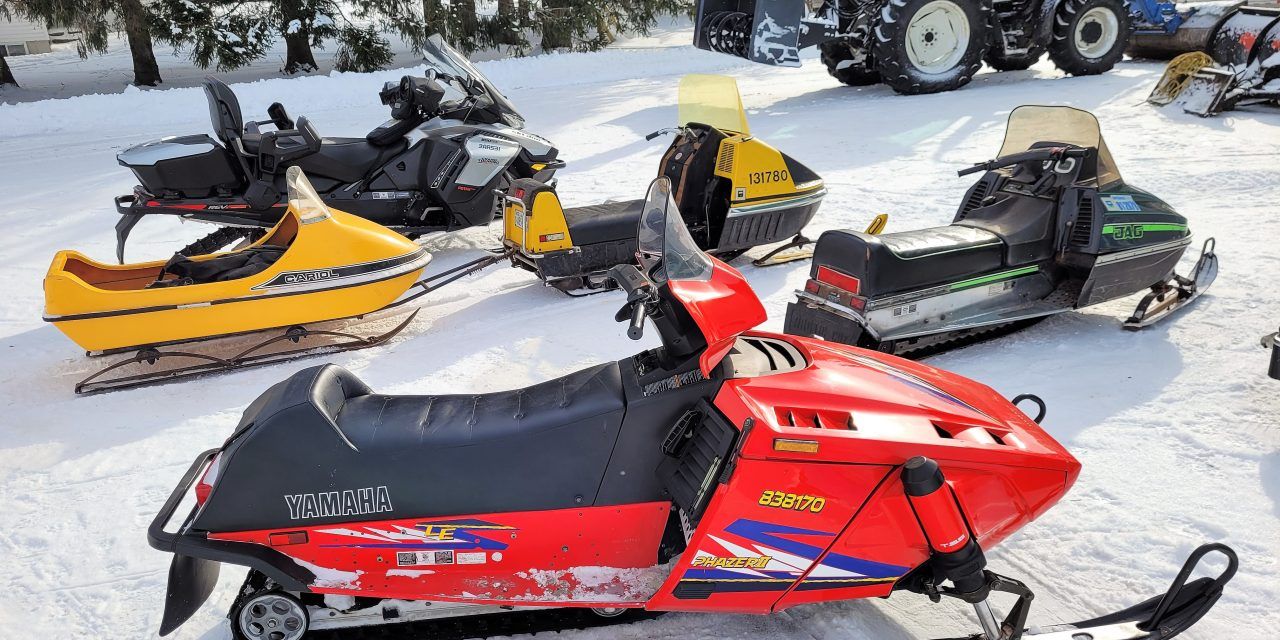
Nearby is the 1995 Yamaha Phazer (in foreground of main photo) that Allen recently had restored by Roch Seguin for his son. Although it is more than 25 years old and falls into the vintage category, the design was very modern for its time. Unlike Allen’s antique sleds, the Phazer can easily run on club trails and is licensed for them.
“It’s still a good machine to ride,” he says of the Yamaha. “It’s not as comfortable as the newer ones – there’s a big difference in suspension – but it’s fine on smoother trails.”
Not ideal for club trails
As with many vintage snowmobile collectors, most of Allen’s rides on his vintage machines are on private land, rather than on club and provincial trails.
“We’ll go down to the neighbour’s and back – 20 kilometres is about it,” Allen says. “That was a big ride back when they came out, if you did 30 kilometres in a day, or after supper go to a neighbour’s house.”

One thing the older snowmobiles do have going for them is their simplicity, which makes them much easier to get going again if something does go wrong. Photo: Reid Masson
Vintage two-stroke snowmobiles are simply not as reliable as their modern-day four-stroke counterparts Allen explains, and not just because they are old. Keeping them going required regular maintenance and one didn’t want to get too far from home even when they were new.
“If you had 10 people in a group you’d wait until everybody got theirs going, because you were never sure if they’d start or not,” Allen reminisces. “Now you just start, take off and go – it’s rare you see one stuck on the side of of the trail.”
One thing the older snowmobiles do have going for them is their simplicity, which makes them much easier to get going again if something does go wrong.
“You can tinker with them,” Allen explains, noting if a modern snowmobile breaks down on the trail, there is little the driver can do. “If they don’t start on the trail now, they’re not going to start.”
Seguin also limits his antique snowmobiling to private lands and shorter trips and says that is common among enthusiasts.
“It’s a challenge to keep that thing running, because it’s an older machine and a little more finicky,” Seguin says. “Just going out and coming back to me is a success.”
Like Allen, he admires the simplicity and durability of the older machines.
“It’s incredible taking them apart and looking at all the hardware,” Seguin gushes. “The nuts and bolts are still almost like brand new.”
“Compared to the stuff that you see today, everything was so well made and the quality is there. Those are 50-year-old sleds and everything on them is still workable.”
Older sleds turn heads, parts hard to find
“People take notice,” Seguin says, of being asked all the time about his John Deere 295-S and his wife’s Scorpion Stingerette – the first snowmobile designed to appeal to women.

The Scorpion Stingerette was the first snowmobile designed to appeal to women and came with a sparkly pink hood and seat. Submitted photo
“It came with a sparkly pink hood and a sparkly pink seat,” Seguin laughs. “It turns heads like crazy.”
As the popularity has grown, collecting antique and vintage snowmobiles – and in particular finding parts – has become more difficult and expensive.
“Nowadays people are not only hoarding parts, they’re collecting,” says Seguin, who searches across North America to find what he needs. “People that are into this are really into it.”
He recommends coming up with a budget and getting started with a basic vintage snowmobile. Mid-1970s to mid 1980s Bombardier sleds are the least expensive and one can still find a decent, running example for about $1,000.
Once you’ve found a sled the next step is to just ride it..
“The whole family can join in,” Seguin says. “We have trails at the back of my house that people go on and can connect.”
I really enjoy that aspect of being with people and being outside.”

Scott Allen with some of his antique and vintage snowmobiles, alongside a modern machine. Photo: Reid Masson

Roch Seguin (right) on his 1974 John Deere 295-S racing sled, along with another enthusiast whose John Deere snowmobile he restored. Seguin fields calls from all over Canada from people seeking his help to find John Deere snowmobile parts. Submitted photo
