

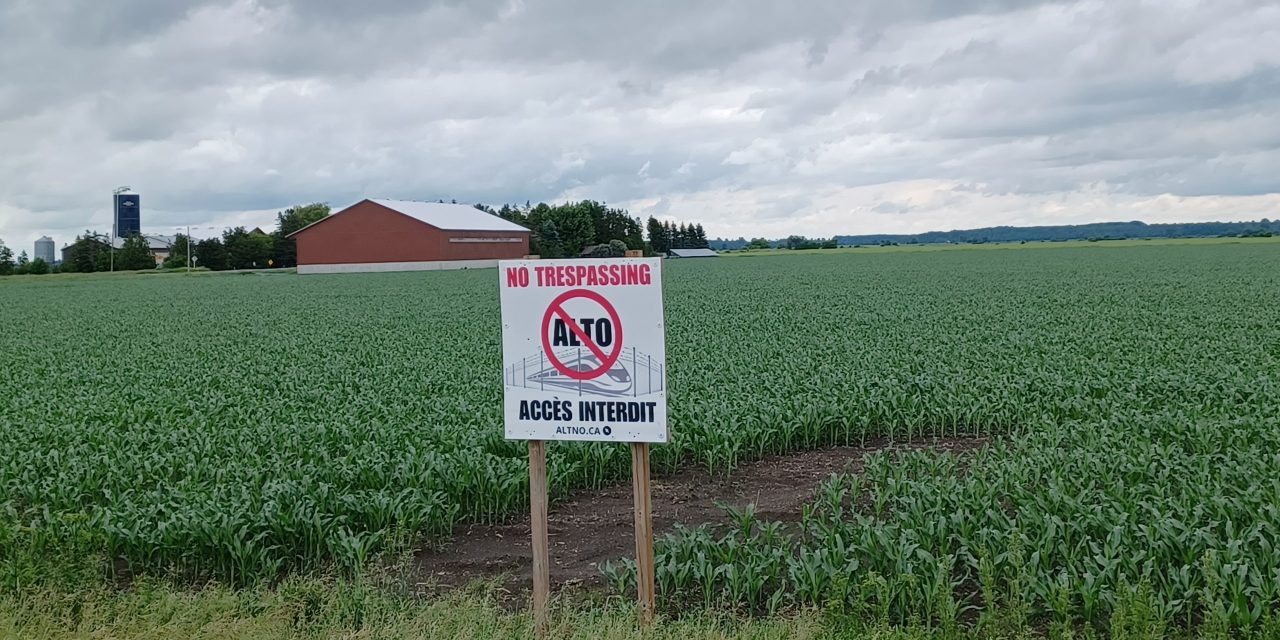
Provisions in the 2026 federal budget that would allow the Minister of Transport to bypass the regular federal expropriation process to acquire land for the Alto high-speed rail project are doubtlessly unpopular with landowners who are concerned the Ottawa to Montréal line will affect their properties.
On Thursday, November 26, legislation was introduced in the House of Commons by Minister of Finance François-Philippe Champagne to implement provisions of the budget announced on November 5. The changes, intended to streamline preconstruction work for the planned 1,000 km electrified high-speed rail corridor from Toronto to Québec City would include giving the federal government the ability to expropriate land without public hearings, transfer ownership of the land directly to the private Cadence consortium which is part of the project, and crossing disputes for split farms and municipal roads to private arbitration.
The legislation would give Alto special powers to assist and enable its objective. These powers would include exemption from rules involving railway crossings under the Railway Relocation and Crossing Act, parts of the Railway Safety Act, the Impact Assessment Act, and exemption from the entire federal Expropriation Act.
“The government is granting themselves unprecedented powers,” said Mike MacGillivray, owner of Kirkview Farms on the Laggan-Glenelg Road in North Glengarry. MacGillivray has been critical of the proposed Alto project and is concerned it will affect his land.
“They’re really destroying the democratic process,” he said of the new legislation.
MacGillivray said the legislation would give too much power to the Minister of Transport. He added that as of Thursday, November 26, plans to quantify the need for a high-speed rail project were still vague or unavailable.
“They don’t have a business case; they don’t have a mandate.”
The Alto crown corporation, which is a government-owned company in the same sense of the Canadian Broadcasting Corporation (CBC) and Canada Post, is trying to emphasize that the legislation is a government initiative. However, Alto spokesperson Marlee Socket said the legislative changes will benefit the company’s effort to begin building the project.
“We’re building Canada’s first high-speed rail network. That requires an updated framework designed for high-speed rail. The proposed measures would help us move forward responsibly toward the start of construction in 2029–2030. A more streamlined process does not mean reducing protections for affected property owners or project oversight,” Socket said.
She continued, saying Alto is designing the network with the people and communities who live nearby in mind.
“That means identifying potential impacts early and working to mitigate them through design, including, the integration of grade-separated crossings that maintain access to affected communities and properties.”
Socket emphasized Alto remains committed to acquiring property through individual agreements, rather than by using the powers granted through new legislation.
“Alto aims to prioritize negotiated agreements and engage directly with property owners. Fair compensation will be assessed based on the circumstances of each property and farming operation, considering not only the market value of the land required, but also applicable impacts over time on the remaining property,” Socket said.