

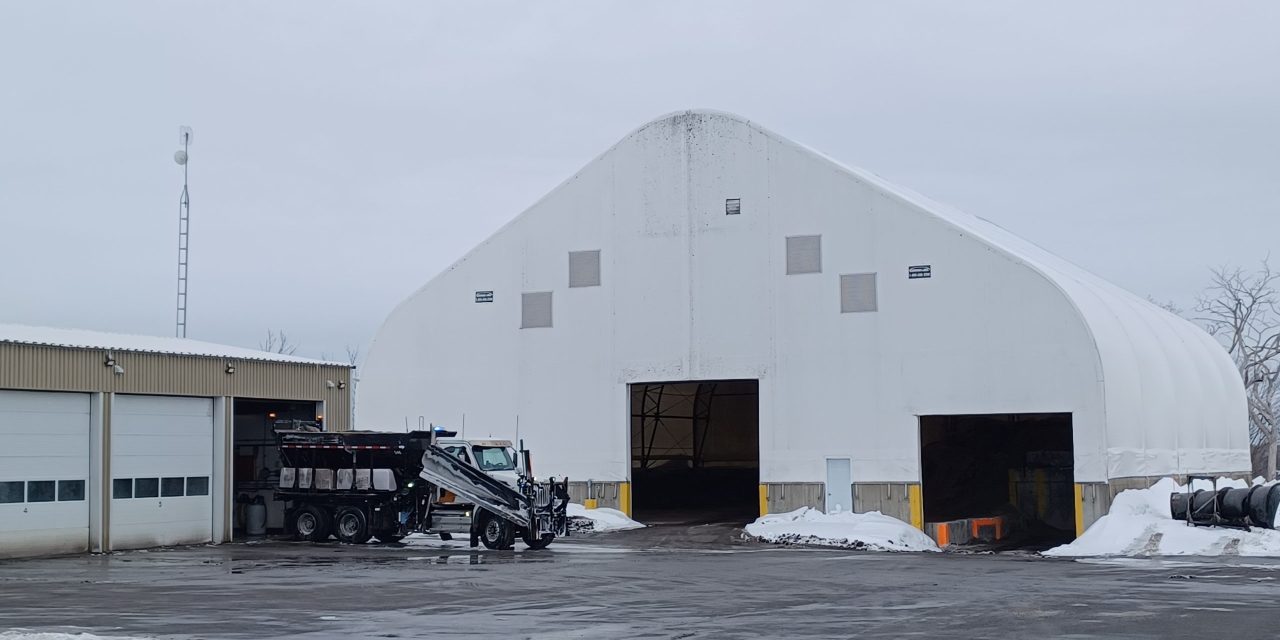
The shortage of road salt in Ontario this winter has led the United Counties of Prescott and Russell (UCPR) to do what many other local governments are doing across the province and mix sand in with the salt being applied to icy and snowy roads.
On Wednesday, February 25, UCPR Council adopted a recommendation in a report from Director of Public Works Jeremie Bouchard to have department employees continue to blend sand with salt to reduce overall salt consumption. The adopted recommendation further directs the Public Works Department to engage with local municipalities to purchase any surplus salt that may be available for use by the UCPR, and that the UCPR will pay a proposed surcharge of $68.60 + HST per tonne for any salt supplied beyond the contracted estimated quantity from its main supplier.
One municipality which may be a source of additional salt is Alfred and Plantagenet, which currently has roughly 1,000 tonnes of surplus salt. The township has offered to sell the salt to the UCPR at the original contract unit price of $89.21 + HST.
According to Bouchard’s report, in early-January, several other counties across Eastern Ontario were informed by their salt suppliers that additional road salt could not be supplied for the rest of the season due to significant inventory shortages because of a more severe than expected winter season. The UCPR contacted its supplier, Windsor Salt, and was informed that the company would honour the contracted estimated quantities. The Public Works Department began blending sand with salt to reduce salt consumption.
On February 5, the UCPR received an email from Windsor Salt advising that, due to the salt shortage, any salt usage beyond our contracted estimated quantity would be subject to a surcharge. The supplier explained that the additional cost, set at $68.60 + HST per tonne above the current contract rate of $89.21 + HST per tonne, is driven by several extraordinary factors. Specifically, Windsor Salt is deploying winter ships, which are not normally scheduled at this time of year, to transport material from their Northern Québec mine to Montréal exclusively to support Ontario customers. The surcharge also reflects significantly higher stockpile costs in Montréal.
The UCPR sought legal advice about the surcharge and legal counsel confirmed that the contract does not allow price adjustments when estimated quantities are exceeded and that Windsor Salt cannot unilaterally impose new pricing terms based on market conditions. As a practical option, the UCPR attempted to push back on the price increase but Windsor Salt made it clear that there was no room for negotiation.
Bouchard’s report further indicated that challenging Windsor Salt’s price increase may not be advisable at this time due to the historically good relationship between the UCPR and the salt supplier. The UCPR also contacted other potential salt suppliers as alternatives, all declined to supply salt due to the current province-wide shortage.
Russell Township Mayor Mike Tarnowski asked about potential environmental effects of increased residual sand on the roads after spring melting.
“Environmental impacts are technically less than the salt consumption that we put on the roads, in the ditch and wherever else,” replied Bouchard.
The Nation Mayor Francis Brière suggested permanently using a mix of sand and salt.
Bouchard said in principle, some study should be made.
Champlain Township Mayor Normand Riopel asked if the sand and salt mix is also being used on major, high-traffic routes like County Road 17.
Bouchard said the mix has been used on County Road 17 since mid-January without significant difference to road conditions.