

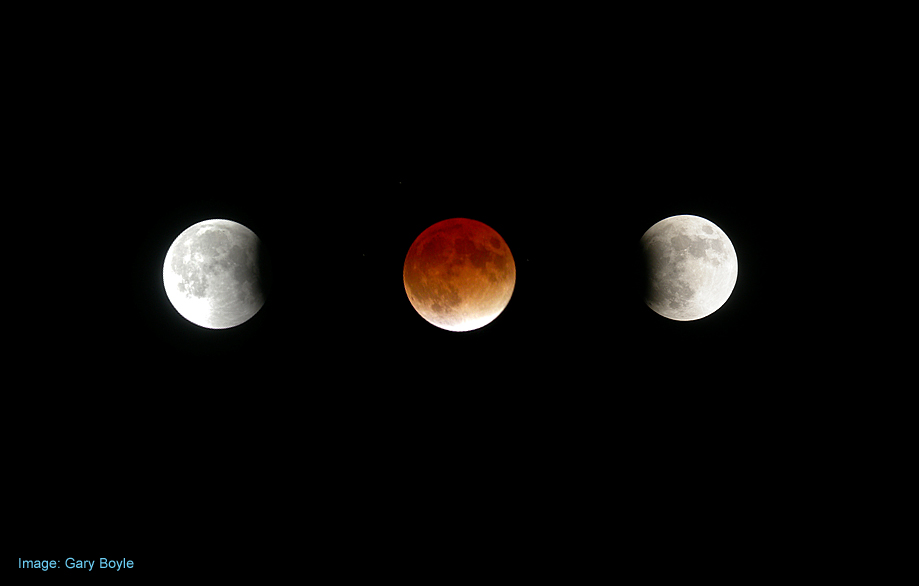
Throughout the weeks and months, we see the Sun by day and the Moon by night. However, a few times each year, the Sun, Earth and Moon align to produce solar and lunar eclipses.
We do not see an eclipse every month because of the Moon’s slight tilt in its orbit around Earth. Sometimes the full Moon passes above Earth’s shadow in space, while in other months it passes below it. When the alignment is just right, the Moon slips into this cone of darkness, creating a lunar eclipse.
This celestial event will take place in the early morning of March 3. In the Eastern time zone, the eclipse will begin at 4:50 a.m., reaches mid-eclipse at 6:33 a.m., and the Moon will set shortly after at 6:39 a.m., meaning viewers may miss the final stages as it dips below the horizon.
A lunar eclipse is completely safe to observe. During the event, the full “Worm Moon” will gradually turn a darker orange as sunlight bends through Earth’s atmosphere, similar to the effect seen during a red sunset. This differs from a solar eclipse, where special protective glasses are required.
While the eclipse is underway, or on any clear night, look for the bright planet Jupiter high in the sky, setting around 4 a.m. Orion the Hunter and other prominent winter constellations will also be visible. Smartphone apps can help guide viewers in identifying these star patterns.
Looking ahead, the next solar eclipse will occur on August 12, with its path of totality stretching from Greenland to Spain. Another event, a partial lunar eclipse, will take place overnight on August 27 into the morning of August 28, when about 96 per cent of the Moon will be immersed in Earth’s shadow.
