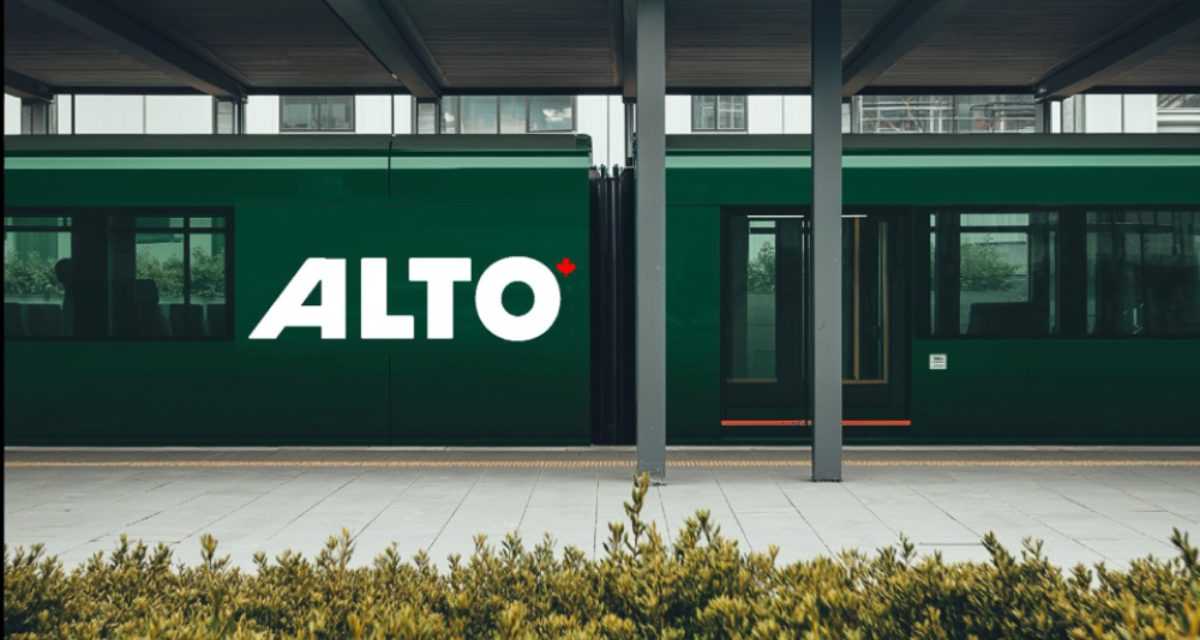
City council in Clarence-Rockland questioned representatives of Alto about the proposed high-speed rail project on Thursday, March 12.
Officials from the federal crown corporation planning to build the Ottawa to Montréal rail line delivered a presentation to council and addressed several issues.
“The purpose of this meeting is for council to receive information and ask questions so we can better understand the project and its potential impacts on our municipality,” said Mayor Mario Zanth.
He also urged people with varying opinions of the project to remain civil.
“We all care deeply about our communities and the best way to move forward is to make sure the conversation remains respectful and constructive.”
Prescott-Russell-Cumberland Member of Parliament Giovanna Mingarelli was to originally attend the meeting, which had first been scheduled for Wednesday, March 11. However, due to the bad weather on March 11, the meeting was rescheduled to March 12 and Mingarelli was unable to attend.
Alto Manager of Community Relations for Ontario Alexis Doyle presented an overview of the project and plan. She was joined by Vice President of Environment Anne-Marie Gaudet, Director of Real Properties and Relations Jean-François Rousseau, and Senior Project Manager Lindsay Lashley who each provided answers.
Doyle noted that the origins of Alto go back to 2022 when it began as VIA High-Frequency Rail and transitioned to Alto in February 2025.
Alto estimates the economic benefits of the high-speed system, which will eventually connect Toronto, Ottawa, Montréal, and Québec City will be equal to 1.1 per cent of Canada’s gross domestic product (GDP) or $24.4 billion. The project will require an estimated 50,000 tonnes of steel, of which one third can be provided by Canadian suppliers. Due to passenger-only trains traveling at speeds of up to 300 kilometres per hour, Alto will require a dedicated track. Trains are estimated to travel every 30 minutes with 20 to 30 daily departures.
Alto is currently in the early part of the Development Phase, which lasts four years. This phase includes selection of the alignment, regulatory approval, finalizing station locations, and engineering design. Construction is to begin at the conclusion of the development phase, as early as 2029 or 2030.
Doyle said that as of March 31, 68 public engagement activities will have been conducted by Alto. Due to the high level of participation and sustained public interest, the online public consultation period has been extended until Monday, April 24.
Doyle explained that the width of the area under consideration for the rail corridor will be narrowed to approximately one kilometre by the end of this year.
“We will refine this area further with the ultimate goal of a 60-metre width corridor for a double track and auxiliary services,” she said.
Ward 7 Councillor Trevor Stewart said he likes the idea of high-speed rail and sees the business case for it, but he and the community have some grave concerns.
Stewart referred to a recent House of Commons committee hearing where Minister of Transport Steven MacKinnon allegedly said expropriations were to begin almost immediately after the adoption of Bill C-15, which would make it easier for the federal government to expropriate land for major infrastructure projects. The bill is currently before the Senate and could be adopted this week.
“Would this not indicate that a specific route has been chosen, and if so, why has this not been shared with the public?” Stewart asked.
“We are not starting the acquisition process at this time, nor will it start at the passing of Bill C-15,” Rousseau responded.
“Currently, we are aiming to begin the rollout of acquisition next year,” he added.
Rousseau said acquisitions would be done on a negotiated deal basis through discussions with owners to reach agreements to purchase the land. He said expropriation remains a tool Alto could use but the current preference is to begin negotiations with landowners.
Stewart again referred to the Minister’s comment that expropriation was to begin as soon as C-15 was passed.
“Should we be listening to the minister or should we be listening to Alto?” he questioned.
Rousseau said he was personally not aware of the comments allegedly made by the Minister and surmised his colleagues may have more information. He said there has been no indication to start acquisition because there is not yet a formal alignment.
Stewart then asked if the Prescott and Russell Recreational Trail—itself a former Canadian Pacific Railway alignment, could be the alignment and potentially bisect the villages of Hammond and Bourget.
“At this time, we have not refined the corridor to the alignment. That is our goal by the end of this calendar year to narrow down to that one-kilometre area. We are prioritizing existing land use areas to minimize the impact to residential landowners, farmland, and environmentally sensitive areas,” Doyle responded.
She added that Alto is also examining the alignments of existing highway infrastructure, electrical transmission lines, or existing corridors for possible use.
Stewart said he has participated in the online consultations, but residents still have some large concerns, especially in Hammond and Bourget where the trail is near centres of the villages.
“Not only does it not seem feasible in terms of expropriation, but it seems very expensive and quite frankly seems to disturb the ongoing way of life of a lot of us who are in those downtown cores,” he said. He asked for assurance that at all costs, Alto will avoid splitting the two villages with the new tracks.
Doyle said Stewart was correct.
The Councillor then focused on agricultural issues.
“Farmers will be disproportionately affected by this project. Their land will be cut in half in many cases. And, because the train does not have road crossings, it will drastically limit access to their own land through a few very small choke points. Is Alto taking this fact into consideration?” Stewart inquired.
He also asked if compensation for landowners will not only reflect fair market value but also future agricultural profits which would be lost.
Doyle said they understand there will be impacts and the goal is to minimize the impact wherever possible, including with agricultural landowners.
Rousseau said agreements with landowners will include the land price and injurious affection such as access to area bisected and access to the nearest crossing.
Zanth asked if there will be a budget to compensate municipalities and local taxpayers for dead-end roads and changes to routes for emergency vehicles.
Doyle said they will eventually be working with municipalities about where overpass or underpass crossings are possible.
Lashley said there will be early discussions with municipalities to better understand the services that are connected between communities and as much as possible, avoid disconnecting communities and services.
Zanth then asked if de-icing fluid will be used on the tracks in the winter and if the environmental impacts of de-icing fluid have been considered.
Doyle said many other countries with high-speed have weather similar to Canada but could not speak specifically to de-icing methods, but that impacts of operations on the environment will be part of the review process.
Gaudet said any impacts would require Alto be sure it was making the right choices. She said no decision about how ice would be dealt with has been made at this point.
“It is very early. We have a winterization program and we’re at the stage of research and innovation,” Lashley added.
Zanth then asked if Alto will provide a new trail if the existing Prescott-Russell Trail is used for alignment. “Will you commit to creating a separate trail and connecting the whole thing together?”
Doyle said mitigation of impact is part of the process, including impacts on recreational areas.
Ward 8 Councillor Diane Choinière asked if there would be compensation for loss of forest coverage.
Gaudet said collecting information and assessing impact on trees is part of the process. She said they want to avoid impact on important habitats as much as possible.
Choinière then asked what will happen to farmland where access has been cut off.
“They need to get their equipment there and they don’t want to sell that section,” she remarked
Rousseau said Alto is working with the Ontario Federation of Agriculture (OFA) to figure out needs of farm operations. He said they will make every attempt to not cut land in half and use existing lot lines. Rousseau said if land is no longer accessible, corridors to reach next crossing are possible. Height clearances for farm equipment are also being considered.
“Is there a plan in place from Alto’s side when it comes to emergency response?” asked Ward 2 Councillor Stéphane Fournier. He wanted to know if Alto will work with local emergency services to ensure they are prepared for response to rail-related emergencies.
Doyle said that planning and working with municipal emergency response service within the eventual alignment is a priority to ensure the capacity to respond exists in the event of an emergency.
Ward 5 Councillor André Lalonde asked if Alto is working with Hydro One to ensure it has enough electricity for the trains and to ensure Alto will not take away electrical resources for other needs.
Doyle said they are at the early stages of conversation with the Independent Electricity System Operator (IESO) in Ontario, Hydro One, and Hydro Québec. The utilities are waiting for Alto to determine the alignment so they know exactly where the supply will be required.
“I’ve talked to a lot of neighbours and community members who are extremely anxious about this,” Stewart said. He continued by saying they are not getting many answers in return from Alto. He wanted to know when a finalized route may be expected so details may be discussed more specifically and less hypothetically.
“We want to make sure people have some more answers as soon as possible,” she said.