

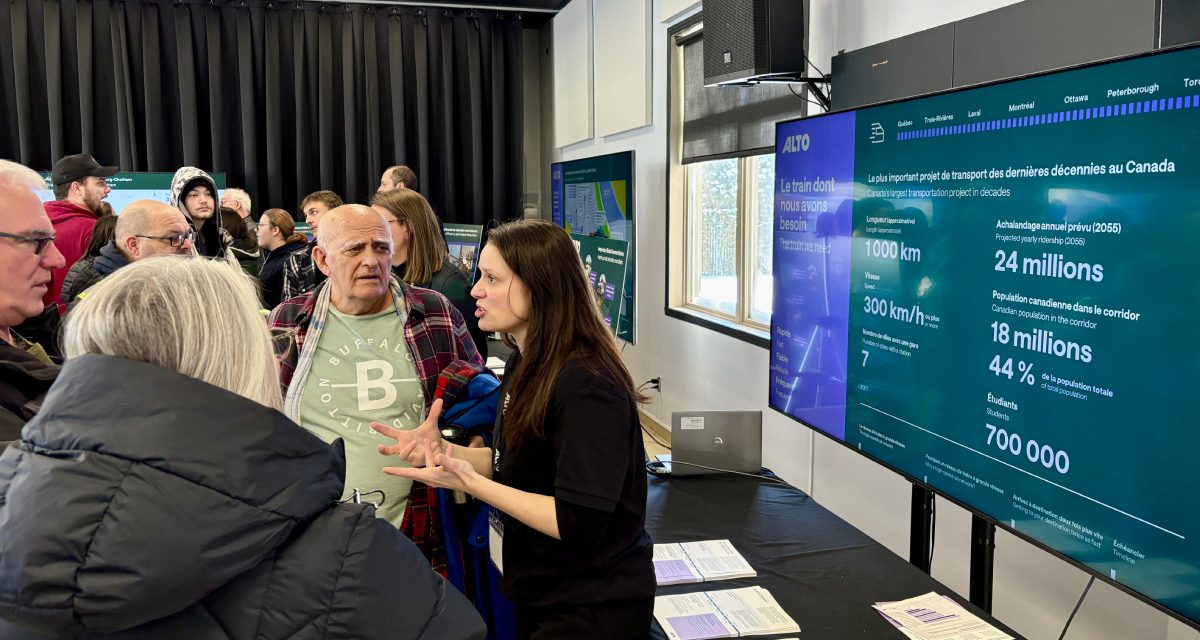
On Thursday, January 29, two public consultations were held at Salle Louis-Renaud community centre in Saint-Philippe regarding the Alto high-speed rail project, drawing numerous residents interested in learning more about the upcoming rail network. The building was packed with eager residents who shared their perspectives and were able to better understand how the Alto project could impact their daily lives.
Alto representatives engaged with hundreds of individuals throughout the day, explaining how the country’s first high-speed rail would reduce travel times by roughly half compared to commuting by car, along a corridor stretching from Toronto to Québec City. Once completed, Alto is expected to cut travel time by nearly half when travelling between Toronto and Montréal, as well as between Montréal and Québec City.

Currently, Alto is planning the first stage of the project, connecting Ottawa and Montréal. Eventually, the line will include stops in Toronto, Peterborough, Ottawa, Montréal, Laval, Trois-Rivières, and Québec City. Alto representatives said the project aims to reimagine intercity travel by providing new transportation options across Canada’s two most populous provinces.
Alto representatives told participants that the train stations are expected to be walkable and designed to support growth around transit hubs, helping to ease road congestion. They added that the high-speed rail would improve access to economic centres and promote job creation, services, and cultural experiences.
Residents were invited to provide feedback on potential locations for the rail line along the proposed corridor. No specific locations have been confirmed yet, but public consultations are considered a key part of the project’s development and pre-construction phase. Design work and impact assessments are expected to take 4 to 5 years, followed by a construction phase anticipated to last approximately 12 years. The first segment of the Alto high-speed rail would connect Ottawa and Montréal and is expected to take 7-8 years for completion, followed by the remaining segments.
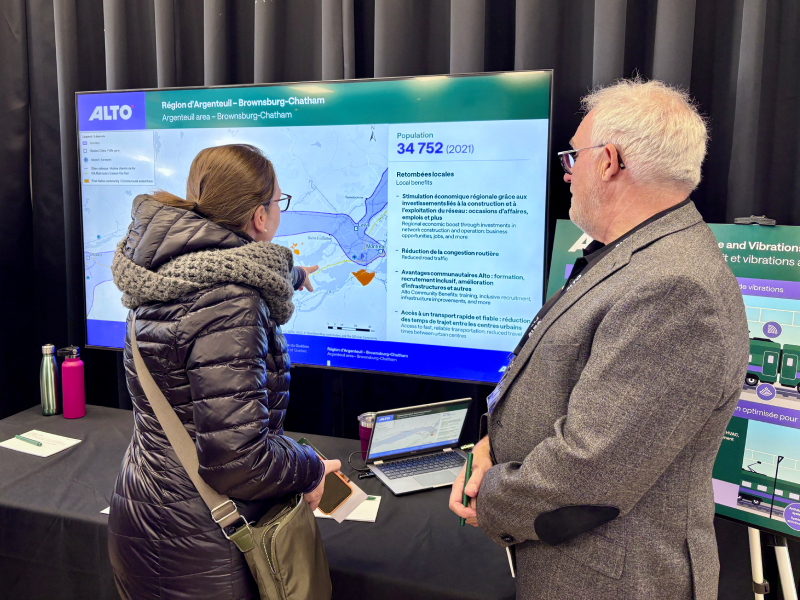


Concerns raised by residents, who did not want to identify themselves, included the project’s estimated environmental impact, the necessity of high-speed rail, and its potential economic gains. Representatives said Alto is taking all necessary precautions to protect the environment and ensure sustainability, while ensuring that the 18 million residents living along the rail have access to dependable, fast commutes. Alto also estimates that the project could add 1.1 per cent, or $24.5 billion, to Canada’s annual gross domestic product (GDP).
The consultation process is expected to continue throughout the winter and spring of 2026, with public consultations planned in other affected communities. In addition to in-person consultations, Alto is hosting several virtual information sessions in both English and French. Residents interested in participating are encouraged to visit Alto’s website at altotrain.ca for more information.
