

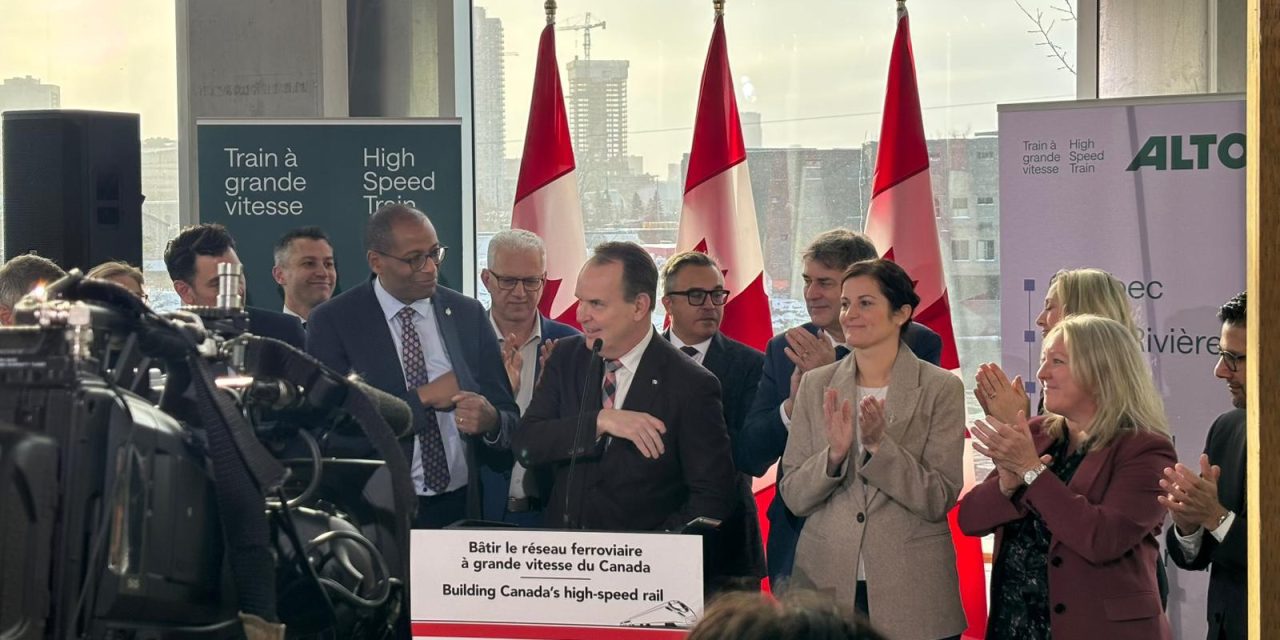
The first part of Canada’s new Alto High-Speed rail project will go from Ottawa to Montréal. That also means it will travel across Prescott-Russell and North Glengarry.
Federal Minister of Transport Steven MacKinnon and Alto President and CEO Martin Imbleau officially announced the first section of the project and the soon-to begin consultation process on Friday, December 12 in Gatineau.
The Alto High-Speed Rail project will be one of Canada’s largest infrastructure investments in decades. Building the first high-speed rail network in Canada will turbocharge our economy, create well-paying jobs, support Canadian businesses and industry while delivering to Canadians the transportation system deserving of a major economy.
The route will cover about 200 kilometres. Construction of the Ottawa-Montréal segment is expected to begin in 2029. Eventually, Alto will also connect Ottawa to Toronto.
Beginning in January 2026, Alto will begin a comprehensive three-month consultation process. Through open houses, virtual sessions, and an online platform, Canadians will have multiple opportunities to share their views on the corridor under study. This process is just the start of a continuing conversation that will go on after the first consultation phase. It will inform the selection of the preferred alignment and station locations, and guide efforts to minimize impacts, and strengthen local benefits.
Alto will continue to engage Indigenous communities, municipalities, and public institutions regarding the project’s development, including design, environmental studies, construction and long-term operations. Each step of Alto’s development will be guided by a commitment to reconciliation and sustainability, while creating real opportunities for Canadians. Full details on consultation dates, formats, and participation options are now available on Alto’s website.
The government is prioritizing Canadian design, products, and labour for the Alto project. Alto estimates the project is expected to boost GDP by up to $35 billion and create tens of thousands of high-quality jobs across the country.
“This announcement marks an important step forward in delivering faster, cleaner, and more connected transportation for Canadians,” MacKinnon said.
Prescott-Russell-Cumberland Member of Parliament Giovanna Mingarelli was also at the Gatineau announcement.
“If we want a stronger, more sovereign Canada, we need modern infrastructure that makes it simpler to travel, collaborate, and do business between provinces. That is exactly what this project is about,” Mingarelli said in a social media post about the announcement.
Currently, VIA Rail provides service between Ottawa and Montréal with stations in Casselman and Alexandria.

If Ottawa was serious about passenger trains, they would have bought more than a few sets of “Turbo” trainsets for CN back in the mid-sixties.
And they surely would have bought VIA Rail enough equipment to run trains at least hourly between the Ville de Québec, Montréal, Ottawa, and Toronto.
Instead, they made massive cuts to VIA in 1981 and 1990 turning what had been a national system into a eastern corridor service with tourist-oriented trains to Vancouver and Halifax. Remember that The Canadian ran through, but did not stop in, St-Eugène on it’s way Ottawa and then Sudbury where it met with the Toronto section then continued to Vancouver.
So my bold prediction now, based on over 50 years of evidence, is that there will be a lot of talk and, ultimately, no action. Sad but true.