

On Monday, July 21, Stormont, Dundas, and Glengarry (SDG) Counties council received an update from the Eastern Ontario Regional Network (EORN) detailing the progress of its Cell Gap Project.
The $300 million project aims to expand reliable and dedicated cellular network coverage for all of Eastern Ontario, with an expected average return on investment of 30-to-1. This means that for every public dollar invested, the region is expected to receive $30 in economic and social benefits through improved connectivity, business growth, and enhanced emergency response.
The visual presented to council below shows the project’s progress, comparing the total number of planned towers to the number of currently operational towers throughout Eastern Ontario.
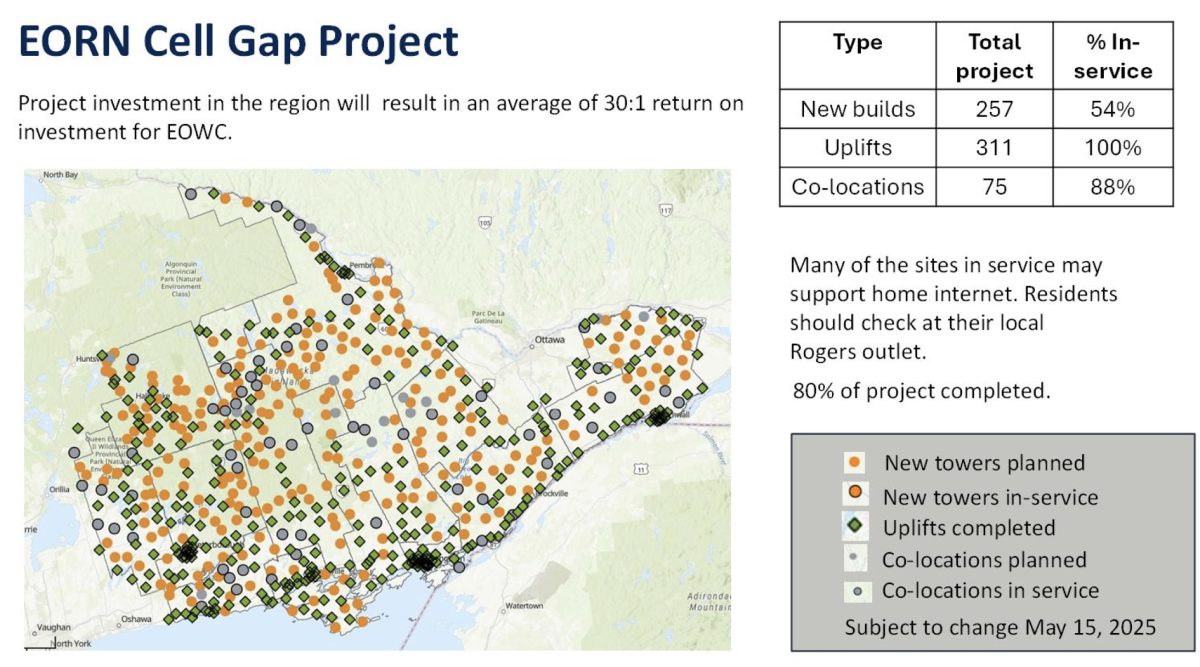
EORN CEO Jason St-Pierre informed council that the project was nearing 80 per cent completion. This includes the refurbishment of 311 cellular towers, with 66 of 75 co-location towers operational as of the end of July.
Out of the 257 planned new towers, 54 per cent have been completed and are now operational.
Although Rogers is the lead partner following a competitive bidding process, other cellphone providers may gain access to the infrastructure depending on their investment interest and negotiations with Rogers.
The goal is to provide 99 per cent coverage for basic cellphone calls, with 95 per cent of the region also able to access email, web browsing, and social media. For high-bandwidth applications like video conferencing and streaming, the project aims to reach 85 per cent coverage.
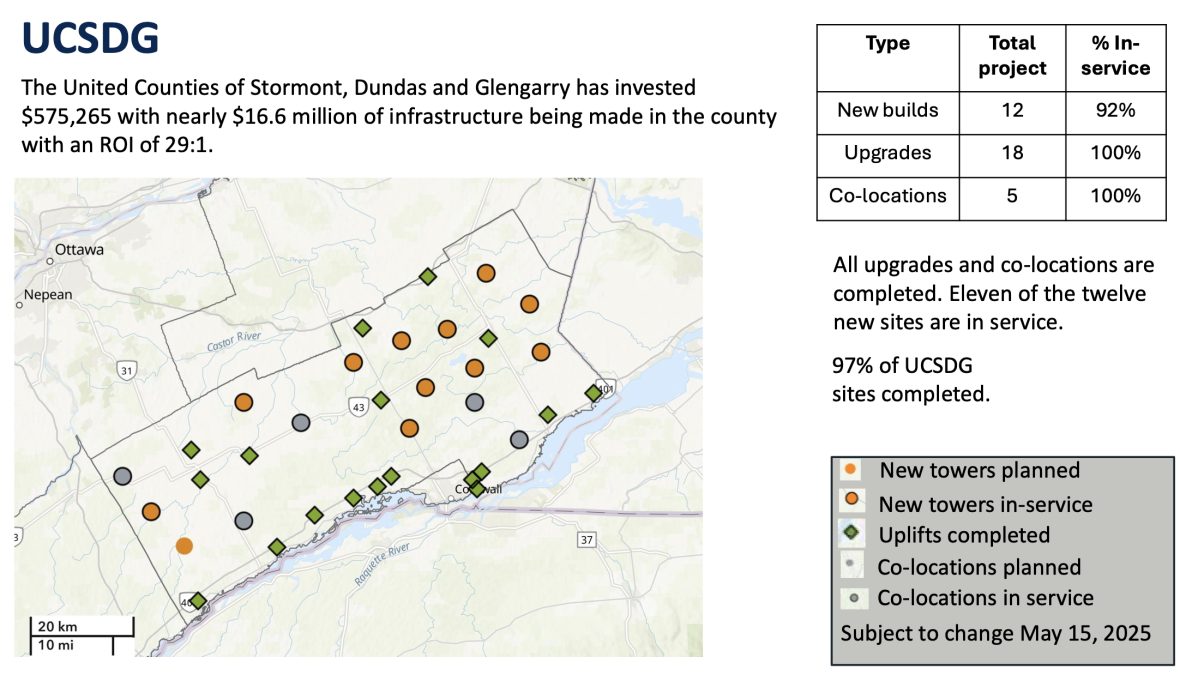
Councillor Jamie MacDonald asked whether gaps in Rogers’ coverage along County Road 34 and south of Alexandria would be addressed. St-Pierre encouraged council members and local officials to report specific locations with poor service so they can be reviewed and forwarded to the team at Rogers.
St-Pierre confirmed that earlier delays had stalled new tower installations but said the project is now on track to reach full completion by its original goal of July 2026.
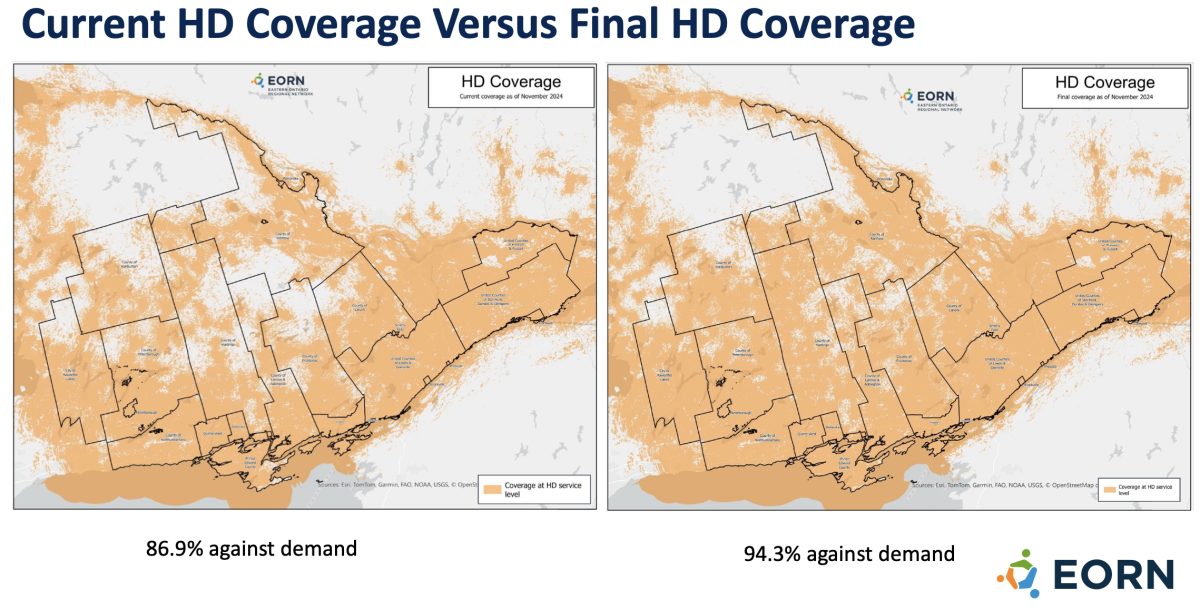
Another submitted map highlights network coverage improvements between 2014 and 2024, with the orange representing the coverage area. It shows that 94.3 per cent of the region now has second-tier coverage, which supports calls, emails, web browsing and social media—just 0.7 per cent below the project target of 95 per cent.