
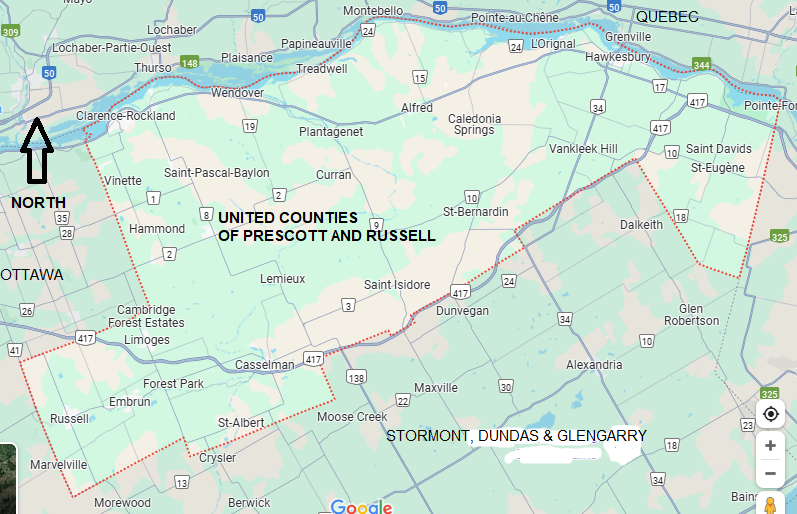
A report on how municipal and regional government services are delivered in the United Counties of Prescott and Russell (UCPR) led to candid discussion about the future of local government in the region when UCPR council met on April 23.
In 2023, the UCPR, in cooperation with the Chief Administrative Officers (CAO) of each of its nine municipalities, began a Service Delivery Review study. On April 23, Kathy Wood, President of Pivotal Momentum, the firm selected to perform the study, delivered her report to council.
“We considered all of the options and probably created some new ones,” Wood said.
The report does not recommend downloading or uploading services between the municipalities and UCPR but instead considers other ideas such as shared services and municipal service corporations as a way of delivering services.
The reason for the service delivery review is an interest by the UCPR and its municipalities to find cost savings and more efficient ways of operating. Wood’s report indicates that the UCPR and nine municipalities currently have combined operating budgets of $255 million per year, and that amount has increased by an average of 3.3 per cent per year since 2012 and is projected to rise to more than $300 million by end of the decade.
There are six main recommendations in the report. One calls for municipal IT services to be enhanced under the operation of the UCPR. The most significant recommendation is for a “reimagined” fire service with centralized training, reconfigured service areas, coordinated public education, and a hybrid approach to human resources involving a mix of full-time and part-time firefighters.
For transportation and infrastructure operations, the report recommends contracting all road maintenance to each municipality for all roads and sharing/renting equipment between municipalities.
The report suggests further examination be done about establishing a municipal services corporation to oversee environmental services (sewer and water) for all of Prescott-Russell.
Wood’s report also recommends the UCPR, and the municipalities share human resources recruitment and retention activities and share procurement activities.
The nine mayors had varying responses to the report.
Clarence-Rockland Mayor Mario Zanth said reviews of service delivery take place regularly at the upper-tier level. He noted how the UCPR is responsible for paramedic services and in Stormont, Dundas, and Glengarry, the counties’ government oversees policing.
Hawkesbury Mayor Robert Lefebvre said he is concerned about delegating powers to a municipal service corporation and wants to learn more about how they operate first.
“We need to move in this direction,” Russell Township Mayor Mike Tarnowski said. He would like to see further financial modelling on how changes to service delivery could unfold, especially if municipal services corporations are involved.
The Nation Mayor Francis Brière said the results of changes to service delivery will be beneficial, but he wants more information before any decisions are made.
“I think it’s just a commonsense approach,” he remarked.
Champlain Township Mayor Normand Riopel said he agrees with the plan in principle. He said the 1998 municipal amalgamations did not necessarily mean money could be saved. He said municipal council must be involved with the discussion about any changes to service delivery, and more information is required.
“We need a full report to make good decisions,” Riopel said.
UCPR CAO Stéphane Parisien reminded council that no further steps will be taken until there is further direction from council and that each municipal council must be involved. Parisien then hinted the current discussion could eventually lead to a single local government for all of the UCPR’s territory.
“This is a blueprint to possibly going to a single-tier government.”
He said such a transition could be many years away though.
A single-tier system would eliminate all nine municipalities and the regional government and replace them with a single, local government like is used in Ottawa and several other Ontario municipalities.
“I think we need to have a bigger picture in mind philosophically about where we want to go,” Casselman Mayor Geneviève Lajoie said.
She said the possibility of single tier local government needs to be boldly examined and wants to examine all of the possible avenues to a result. Lajoie asked if any consideration had been given to having a single police unit serve all of Prescott-Russell. Currently, the region is served by the Hawkesbury and Russell County detachments of the Ontario Provincial Police (OPP).
Wood said it was considered but set aside because municipalities have limited control over how those services are provided. She said there was discussion about creating a single, regional police force, but the topic was also set aside.
“I think I would consider involving our police services, amalgamating our police services together in this plan” Lajoie said.
Zanth cautioned against discussing single tier government at this time.
“If you would like this to fail, start talking about single tier,” he remarked, noting that is not what staff had initially directed to investigate. He said the focus should be kept on delivering savings to citizens.
“We shouldn’t even be talking about that because it’s completely irrelevant right now,” he commented.
Zanth said amalgamating services should be examined, but there is no deadline to do so. He would rather see the preparations for any changes made carefully.
Lajoie suggested deferring to the municipal CAO’s to develop recommendations on how to move forward. Brière agreed. Lefebvre said the 1998 municipal amalgamations were almost forced and many people do not believe there was any benefit to it. He agreed with relying on CAO’s and each council to provide further recommendations.
Council adopted Lajoie’s motion to instruct the CAO’s to develop a list of recommendations, and for the current report to be received.