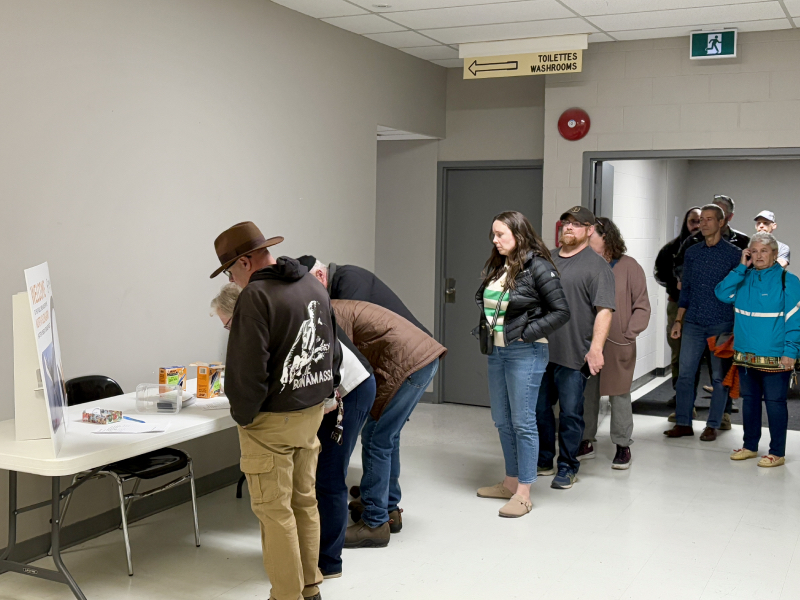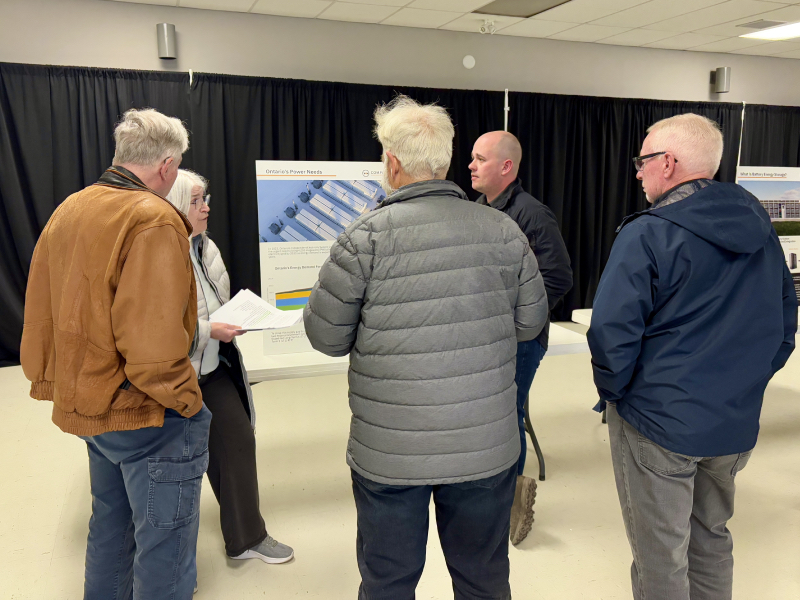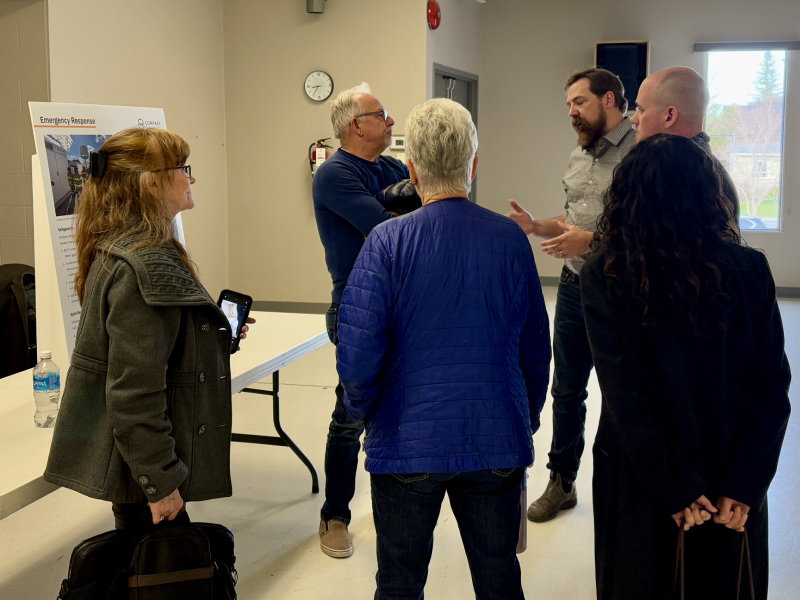
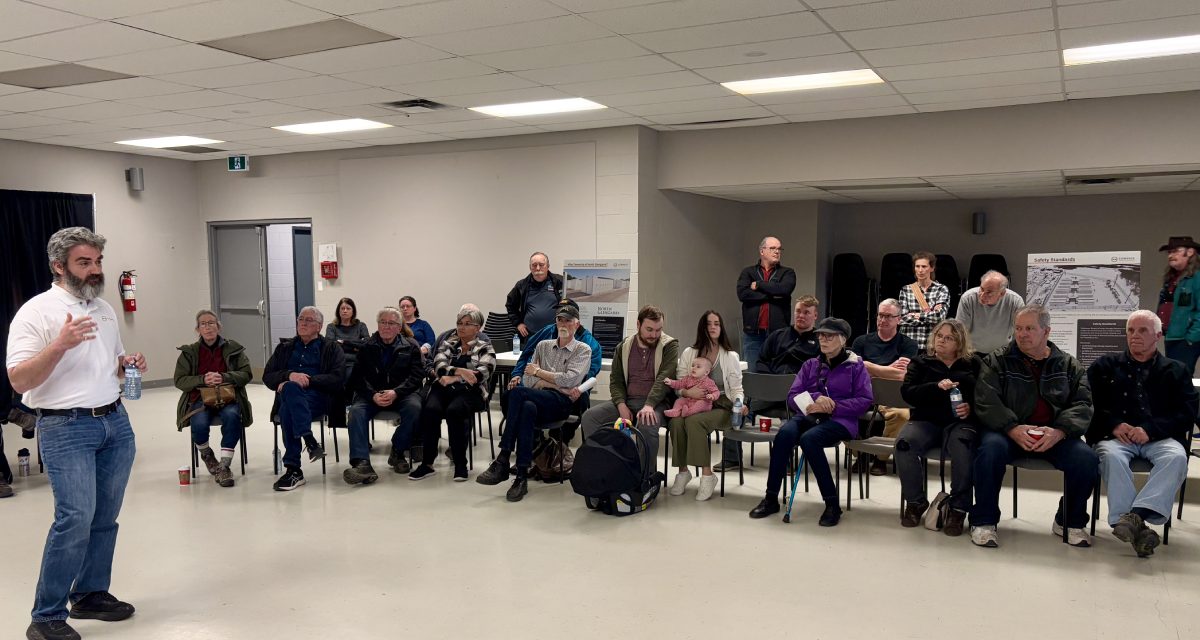
A public information session on the proposed North Glengarry Battery Energy Storage System (BESS) took place on Wednesday, April 30, at the Glengarry Sports Palace in Alexandria. Compass Greenfield Development (CGD) representatives were on hand to answer questions and clarify how the BESS project would impact residents.
CGD is planning to build the BESS installation on Skye Road in North Glengarry near the boundary with The Nation Municipality.
The session was originally planned as a drop-in format, allowing individuals to browse infographic placards at their own pace and speak with CGD staff. However, organizers shifted to a roundtable discussion where questions were addressed one at a time in front of all attendees.
To accommodate residents’ wishes, CGD President Jonathan Cheszes and his team reconfigured the room and asked that questions be posed in an orderly, uninterrupted manner.
Before allowing attendees to pose their questions, the CGD staff presented a brief overview of BESS technology, its uses, how the company will monitor the site after construction, and initial plans for its eventual decommissioning.
Cheszes emphasized the company’s desire for transparency: “We’re here because we know that there’s a lot of community concerns around the project, and we believe there is a lot of misinformation about the project and risks. We’re here because we want to talk with you, answer your questions, and hear your concerns. We are going to be here in the community for a long time; we want to try and be good neighbours.”
The timeline for the North Glengarry BESS began in 2023 with technical assessments and permit reviews. Between 2023 and 2024, CGD consulted with the municipality and sent letters to nearby residents about the proposed battery site.
The project is currently in the engineering, design, and approval phase, which is expected to be completed by the end of 2025. This includes the awarding of the contract by IESO and securing final permits. Construction is scheduled to begin in 2026, with the site being operational by the end of 2027.
The site is planned to operate until around 2047, when it will be decommissioned.
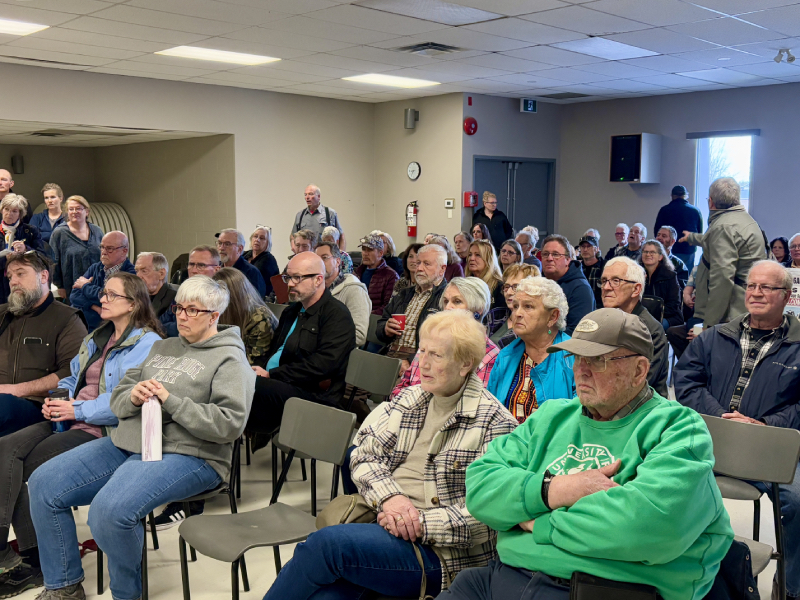
When the floor opened to questions, citizens raised concerns about the project’s purpose, effects on agriculture, cybersecurity, the possibility of third-party ownership, and emergency response planning.
Cheszes and his team had to intervene a few times to pause the discussion to manage the room and ensure each question was heard and addressed.
Some attendees referred to concerns based on personal research or raised overlapping questions, leading to moments of repetition and tension.
One resident yelled, “Now you’re over here! Now you’re just trying to build a plant near St-Isidore which nobody knew about! We don’t want that battery around here! Leave us alone, we don’t want to be poisoned!”
Local farmers emotionally voiced concerns about a potentially catastrophic event with the BESS site that could affect their livelihoods and farms, though they did not offer supporting evidence to back the claim.
CGD staff responded, “In terms of what we have to protect, there’s a hierarchy. We always focus on human life first. I don’t want to disregard the value of livestock, but they are replaceable. Humans are not.”
“It took me over 30 years to build up my herd. That’s replaceable?” one longtime local farmer posed.
“We’re not talking about the whole herd of cows dying. Have you bought 20 cows, or did you just look at a check?” another resident argued.
One resident summarized a broader distrust of CGD’s corporate motives stating, “It’s just a bunch of fat cats getting fat! That’s it.”
Growing Electrical Demand for Ontario
CGD staff explained that the North Glengarry BESS would be used to offset peak demand periods on the provincial electrical grid and that it would not necessarily be used for local needs, but rather, the needs of Ottawa or bigger cities which are expanding in Ontario.
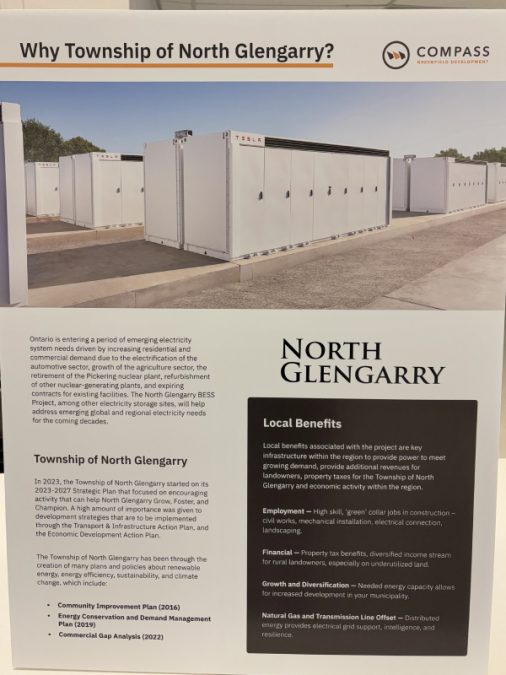
The site on Skye Road was also selected because of its proximity to Highway 417 and the Hydro-One St-Isidore Transformer Station.
CGD explained that BESS stations help improve grid reliability during peak demand—particularly in growing urban areas like Ottawa—where new power plants cannot be built quickly enough.
Agricultural Concerns and Potential Developments
One concerned farmer asked how a fire or malfunction could affect nearby livestock, questioning the speed of emergency response and coverage for losses: “Who’s going to help me with 400 cows if smoke gets into the barn? My insurance won’t pay—who will?”
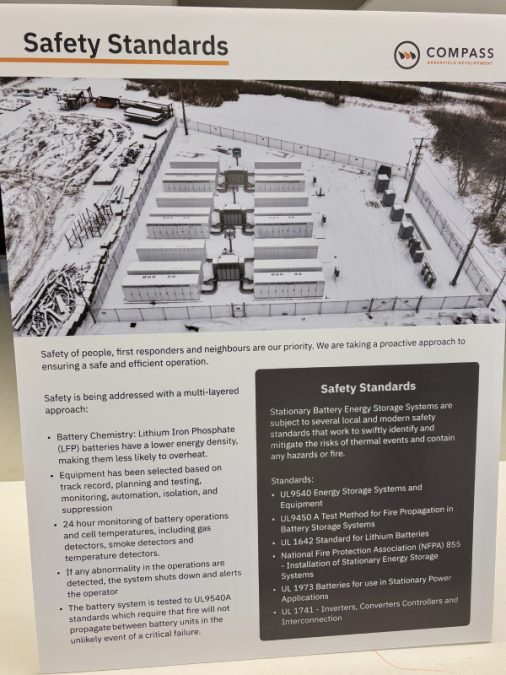
CGD staff replied, “Thermal events, where the battery fails, are extremely rare. I don’t have a percentage. The Tesla batteries we receive are sent with enough stored energy to maintain their HVAC cooling systems for six months to prevent overheating the cells, though the batteries only heat up when the BESS is charging or discharging.”
Cheszes then stated that the North Glengarry BESS project is the only one planned, with no additional BESS or electricity-generation initiatives being researched by CGD currently in the area.
Cybersecurity and Third-Party Buyouts
Tech Blogger Larissa Douglas asked if current BESS technology met cybersecurity standards for preventing remote hacking by external parties or other national security threats to the electrical grid by foreign entities.
CGD staff stated that all BESS projects are approved by and fall under the oversight of the Ontario Independent Electricity System Operator (IESO) while also following the security standards of the industry.
Another citizen questioned what would happen if a third party came along and bought out the company or the BESS site location; “What guarantees do we have that, three months after it starts working, some third party buys you guys out, and all your happy faces are no longer responsible for it?”
Cheszes responded, “I’m not good at the speculation game. But we have no intention to sell the projects.”
Emergency Response and Insurance
A couple of residents shared the same concerns surrounding emergency response in the event of a BESS failure.
“We haven’t conducted any training as of yet, since the systems aren’t on site. What we do and are committed to doing for volunteer firefighters is on-site, in-person training. They will not be pouring water into the battery while it burns; these systems are designed to burn into themselves as water is not an effective solution to combat this type of fire,” CGD staff said.
In addition, CGD staff said that no incidents have occurred with this specific type of BESS technology, although they acknowledged that older systems had issues globally in the past.
While explaining the automatic shut-down procedures and the remote location that operates the remote monitoring of BESS operations, a resident interjected, “And your remote location to shut it down is in a location, where? In the province of Ontario? Or is it in Portugal, in Pakistan? Somewhere that doesn’t give a crap about us?”
CGD staff responded that the remote monitoring station was based in Toronto. This prompted renewed overlap in discussion among the crowd.
One attendee shouted from the crowd, “That’s even worse!”
Insurance coverage was also a lively topic during the session, with concerned citizens asking what coverage CGD holds for such projects.
CGD staff said that they were covered under Intact Insurance and would be willing to discuss additional insurance obligations to ease the minds of locals, though assured attendees they are meeting all the provincial requirements.
For those seeking more information, answers to many concerns raised by citizens during the meeting are now available in the FAQ section on the project’s website: https://northglengarryenergystorage.com, where residents can also subscribe for project updates.
Photos by Philip Oddi: