


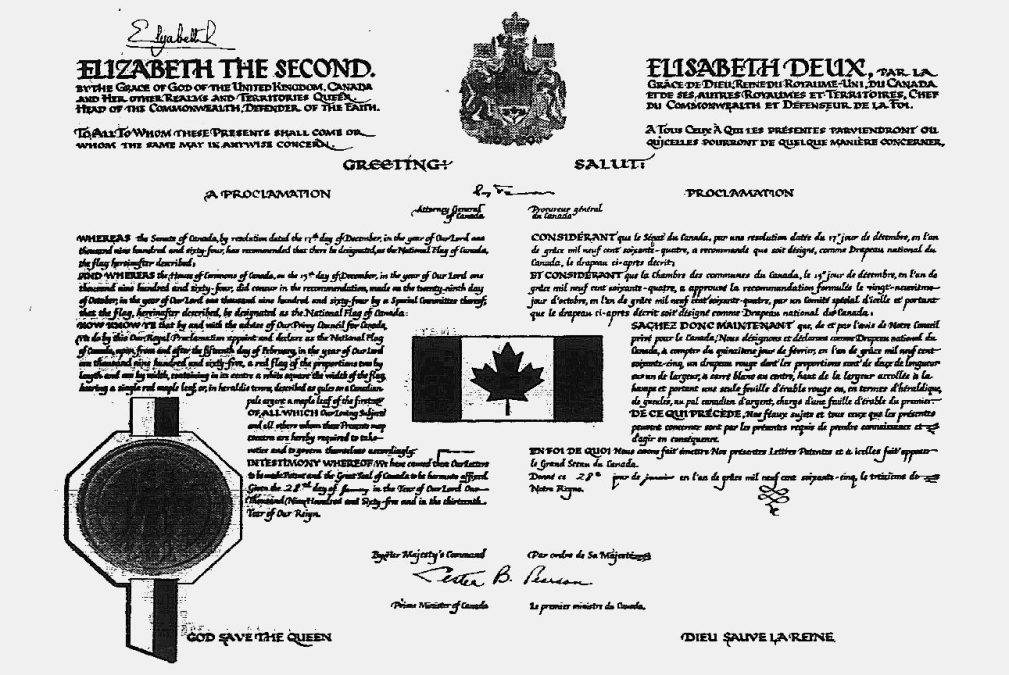
Our red maple leaf flag is a ubiquitous symbol of Canada, across the country, and around the world. Saturday, February 15, 2025 is the 60th anniversary of the flag. On February 15, 1965 the flag was officially proclaimed as the National Flag of Canada and was raised on Parliament Hill in Ottawa for the first time.
The French were first to colonize what became Canada, so the pre-revolutionary flag of France was the flag of New France. After British colonization, the royal union flag, better known as the Union Jack, was widely used as Canada’s flag, even after Confederation in 1867. Beginning in the 1890s, the first version of the Red Ensign appeared as an unofficial national flag. It is red with a small Union Jack in the top left, with a shield in the bottom right that usually contained symbols shown on various provincial coats of arms. In 1921, the shield was changed to be the shield from the Canadian Coat of Arms.
Early efforts to adopt a distinct national flag for Canada were unsuccessful in 1921 and 1946. Politics and cultural sensitivities were significant on the issue. After World War Two, an increasing number of Canadians were also from many ethnic backgrounds. These cultural facts and other symbolism were all part of the debate, and ultimate decision on a national flag in the 1960s.
In 1963, Prime Minister Lester B. Pearson promised to have a new national flag for Canada in time for the Centennial celebrations in 1967. Pearson first proposed a twig of three red maple leaves on a white background with blue bars on each side to symbolize the east and west coasts. The design was submitted to Members of Parliament (MP’s) in 1964 but was widely rejected. Instead, a parliamentary committee was created and given six weeks to submit a recommendation for a national flag. The Great Flag Debate is what followed. The committee was divided between those who wished to retain the symbols that tied Canada to its colonial history, and those who wanted Canada to adopt its own symbols for the future.
The committee received dozens of designs featuring a wide variety of Canadian symbols and images. One of the more well-received concepts was proposed by George Stanley, Dean of Arts at the Royal Military College (RMC) in Kingston. Inspired by RMC’s own flag, Stanley recommended a concept featuring a single, stylized red maple leaf on a white background with two red borders.
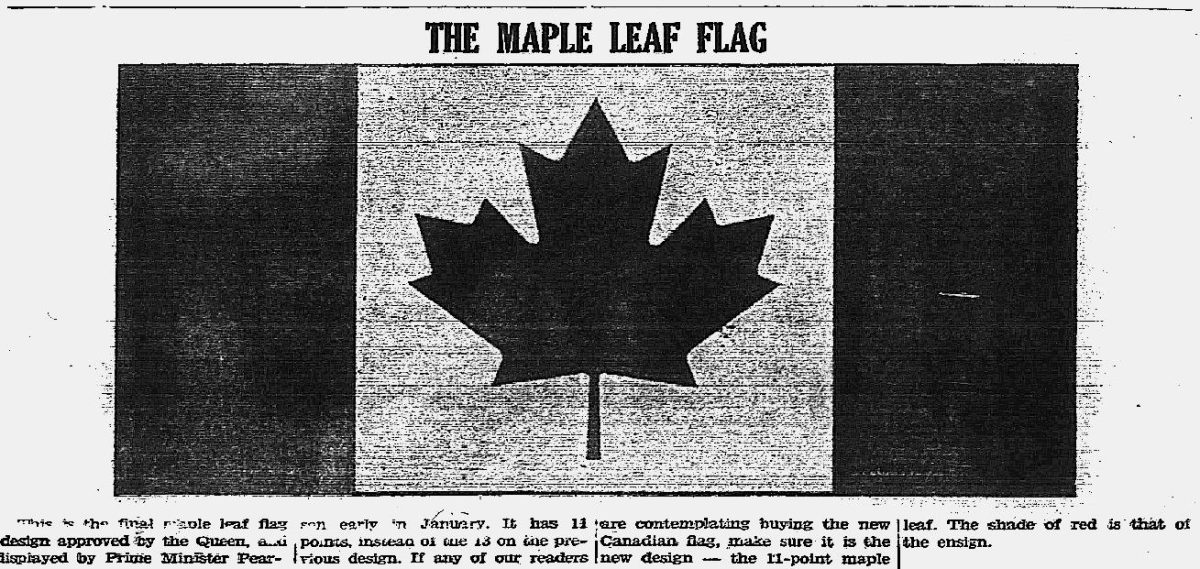
On October 22, 1964, the committee voted in favour of Stanley’s single-leaf concept. Two months later the House of Commons approved, followed shortly after by the Senate. The debate was long, with significant disagreement about the symbols on the proposed flag. Flag committee member and Leeds MP John Matheson, is often credited with achieving consensus within the committee and helping to end the Great Flag Debate in Parliament.
Originally, there were 13 points on the maple leaf. They were reduced to 11 points during the final design process.
The red maple leaf flag is the only flag many contemporary Canadians have ever known. There is history and politics behind every national symbol, but 60 years later, our flag has endured as a symbol of a strong, independent, and proud Canada.
In 1996, February 15 was officially proclaimed as National Flag of Canada Day.
Notre drapeau a 60
Notre drapeau rouge à feuilles d’érable est un symbole omniprésent au Canada, dans tout le pays et dans le monde entier. Le samedi 15 février 2025 marque le 60e anniversaire du drapeau. Le 15 février 1965, le drapeau a été officiellement proclamé drapeau national du Canada et a été hissé pour la première fois sur la colline du Parlement à Ottawa.
Les Français ont été les premiers à coloniser ce qui est devenu le Canada, de sorte que le drapeau français prérévolutionnaire était le drapeau de la Nouvelle-France. Après la colonisation britannique, le drapeau de l’Union royale, mieux connu sous le nom d’Union Jack, a été largement utilisé comme drapeau du Canada, même après la Confédération de 1867. À partir des années 1890, la première version du Red Ensign est apparue comme drapeau national non officiel. Il est rouge, avec un petit Union Jack en haut à gauche, et un écu en bas à droite, qui contient généralement les symboles figurant sur les armoiries des différentes provinces. En 1921, l’écu a été remplacé par l’écu des armoiries canadiennes.
Les premières tentatives d’adoption d’un drapeau national distinct pour le Canada ont échoué en 1921 et en 1946. La politique et les sensibilités culturelles ont joué un rôle important dans ce dossier. Après la Seconde Guerre mondiale, les Canadiens étaient de plus en plus nombreux à être d’origines ethniques diverses. Ces faits culturels et d’autres symboles ont tous fait partie du débat et de la décision finale sur un drapeau national dans les années 1960.
En 1963, le Premier ministre Lester B. Pearson a promis d’élaborer un nouveau drapeau national pour le Canada à temps pour les célébrations du centenaire en 1967.Pearson propose d’abord un rameau de trois feuilles d’érable rouges sur fond blanc avec des barres bleues de chaque côté pour symboliser les côtes est et ouest. Le projet est soumis aux députés en 1964, mais il est largement rejeté. Au lieu de cela, une commission parlementaire a été créée et a disposé de six semaines pour soumettre une recommandation pour un drapeau national. Il s’ensuivit le grand débat sur le drapeau. La commission est divisée entre ceux qui souhaitent conserver les symboles qui lient le Canada à son histoire coloniale et ceux qui veulent que le Canada adopte ses propres symboles pour l’avenir.
La commission a reçu des dizaines de projets présentant une grande variété de symboles et d’images du Canada. L’un des concepts les mieux accueillis a été proposé par George Stanley, doyen des arts du Collège militaire royal (CMR) de Kingston. Inspiré par le drapeau du CMR, Stanley recommande un concept comportant une seule feuille d’érable rouge stylisée sur un fond blanc avec deux bordures rouges.
Le 22 octobre 1964, le comité vote en faveur du concept de feuille unique de Stanley. Deux mois plus tard, la Chambre des communes l’approuve, suivie peu après par le Sénat. Le débat fut long, avec un désaccord important sur les symboles du drapeau proposé. John Matheson, membre du comité du drapeau et député de Leeds, est souvent crédité d’être parvenu à un consensus au sein du comité et d’avoir contribué à mettre fin au grand débat sur le drapeau au Parlement.
À l’origine, la feuille d’érable comportait 13 points. Ils ont été ramenés à 11 points lors de la conception finale.
Le drapeau rouge à feuilles d’érable est le seul drapeau que de nombreux Canadiens contemporains aient jamais connu. L’histoire et la politique se cachent derrière chaque symbole national, mais 60 ans plus tard, notre drapeau est resté le symbole d’un Canada fort, indépendant et fier.
En 1996, le 15 février a été officiellement proclamé Journée du drapeau national du Canada.