
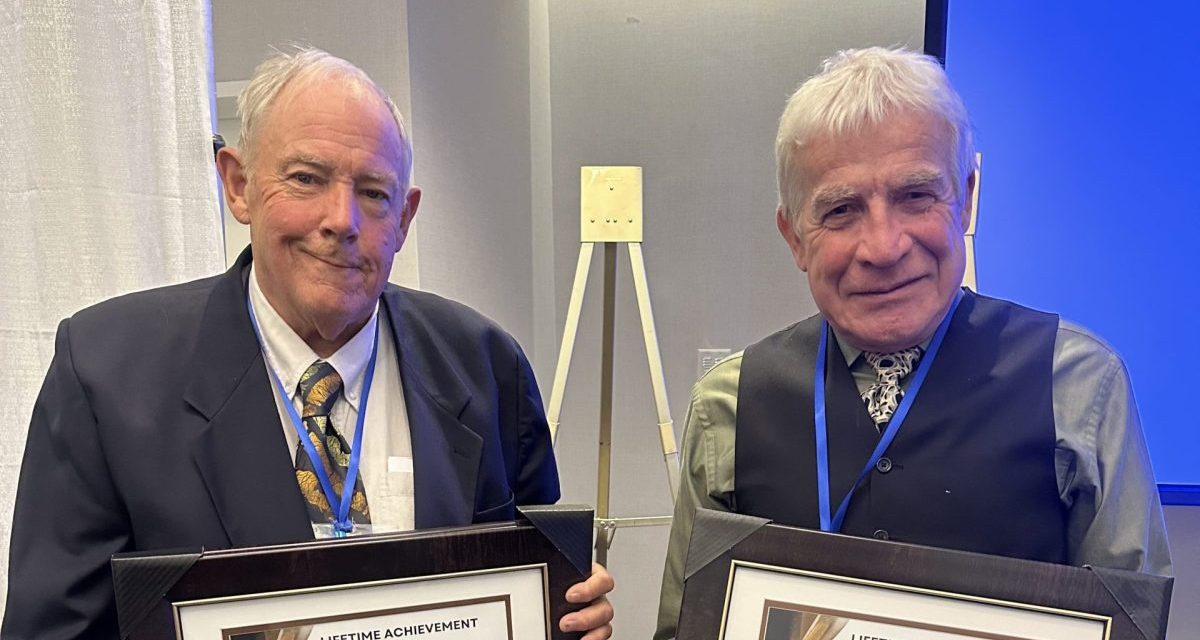
A Vankleek Hill journalist has been awarded a Lifetime Achievement Award from the Canadian Farm Writers’ Federation (CFWF). Robert Irwin, along with longtime colleague Don Stoneman of Bancroft were presented with the awards at the CFWF annual conference in Halifax in October.
The pair have had careers, achievements and contributions to Canadian agricultural journalism that have been intertwined since they met as colleagues working at Farm & Country magazine in the late 1980s. When that publication folded in 1999, a group of its employees quickly regrouped, producing the first edition of Better Farming magazine only four months later.
Like many journalists, Irwin, whose agricultural background is in pig farming, ended up in the profession through a series of events in life.
“I don’t have a journalism degree. For a number of years, I travelled to journalism courses organized by the Canadian Association of Journalists in cities from St John’s to Vancouver,” he added.
Irwin and Stoneman developed a reputation for leading a team of strong, investigative journalists that covered stories across the spectrum including farm animal welfare, stray voltage and its effects on livestock, the Ontario government’s decision to end the Slots at Racetrack program, the role of women in farming, neonicotinoids, sewage spills and bypasses from urban sources and more. They also covered farmer mental health issues years before it was given a place of prominence in mainstream farm discussions. Among the magazine’s best-known pieces was a series on Lyme disease that won both national and international awards.
In 2007, Irwin and Stoneman broke the story that later became known as the ‘Pigeon King’ scheme with coverage containing more than 50 stories as the issue was first publicized, charges laid and throughout the court case.
Pigeon King was a company that swindled more than 1,000 investors in a Ponzi scheme involving pigeon breeding for agricultural purposes. In years since, it has been used as the basis for both a play and a feature on CBC’s Farm Crime series.
Irwin said there is nothing unique about his journalistic methods, but he does appreciate the right conditions and topics being in place to tell a good story.
“There was nothing unique about my approach. I was fortunate to have had mentors like legendary Farm & Country publisher John Phillips. I also worked with an amazing team that was driven by a passion for excellence. Most importantly we had an editorial budget that allowed us to dig deep on stories that other reporters would have had to skim over,” he said.
Irwin appreciates telling the stories of topics and issues that can influence public discourse.
“I’ve found that the most satisfying stories involve issues that have been hidden, misunderstood, or misrepresented. Sometimes after you publish, public opinion shifts, or you eventually see new legislation enacted. It’s hard to describe the satisfaction that comes from feeling like you’ve made a difference,” he said.
Agriculture and journalism are both in states of significant change, largely due to consolidations in both industries, and the influence of rapidly evolving technologies. Irwin said these factors will affect the future of agricultural journalism.
“Ag publishing remains profitable. As farms get bigger and more automated however, the number of readers in that market declines. At the same time farm suppliers are being acquired by competitors so they buy fewer pages of advertising. Search-engine and social-media advertising are also siphoning ad revenue from print publications,” Irwin said.
There are also potential consequences from artificial intelligence (AI). But Irwin does not believe it means the end of journalists.
“AI makes almost every aspect of the reporting and publishing process more efficient so its use will increase. I don’t think reporters can be completely eliminated though. Most importantly AI can’t seem to function ethically. It also lacks empathy, intuition, context and good judgment,” Irwin said.
Irwin and Stoneman’s nomination was submitted by members of the Eastern Canada Farm Writers’ Association with letters of support submitted by other agricultural journalists and communications professionals from across the country.