
By Carol Willems-Martin
This story is the history of the Willems family, as sourced by John, the late Harry, Anna and Theo. This is their recollection of their journey, and their experiences of surviving in the Nazi-occupied Netherlands during World War Two, and then emigrating to Canada to begin a new life.
Johanna Spearings met and married Cornelius Willems in 1935 and began their family immediately. The Willems family were farmers living in the village of Cromvoirt, located in the township of Vught, in the province of North Brabant in The Netherlands. The family spent their days cultivating their land and cattle on the nearby polders, attending the Catholic church faithfully and were enrolled in Catholic school. They remember vividly playing football, with friends and classmates, as this was a fond pastime for the kids growing up, from their earliest memory. War came from their neighbouring country of Germany in 1939 and life as they knew it, would never be the same.
They were a hard-working family as John, Harry and Theo recall that they had the job of milking the cows early in the morning. They biked the cans of milk to the diary daily. As they did so, they passed the concentration camp and saw with their young eyes, all the horrors of the S.S. guarded Concentration camp formerly known as Herzonenbusch Concentration Camp (a.k.a. Vught concentration camp). It was located just three kilometres south of the city of Hertogenbosch and east of their village. This camp was opened in 1943 and was S.S. guarded, so life was exceptionally hostile and crude, housing 31,000 prisoners mostly, Dutch Jews and those accused of hiding Jews along with other victims of the German regime. This was also home to Corrie Ten Boom and her family of Haarlem, The Netherlands, when they were discovered hiding Jewish people from Nazi arrest. In her renowned book entitled, “The Hiding Place”, Ten Boom chronicles the terror she experienced while there, including the exterminations that were ongoing along with the starvation and hangings of the prisoners.
Our grandfather fought as a reserve member of the Dutch Army, to protect Holland from German invasion. He was never able to share these stories with us as they were too difficult to speak of. Nazi occupation of their community was most difficult with food shortages and danger all around. A safe and secure life gave way to terror on any given day or night including the sounds of aircraft bombers, rogue incoming V1 and V2 rockets, air raids and being held at gunpoint to surrender whatever the soldiers wanted, mostly food and supplies. On one occasion, German Soldiers commandeered their home, and the family was forced to seek refuge in a nearby field where our grandfather created a makeshift underground burrow to keep the family safe for six weeks in the cold. The Nazis plundered their home of all their food sources leaving nothing behind, including the family’s horse, that our grandfather needed for transportation and working the fields. The soldiers left him their horse that was suffering from shell shock and couldn’t be handled safely. Animals too, suffered greatly in the chaos and dangers of war.
On another occasion, German soldiers used dynamite to blow up the church across the street from where they lived. Their home was consequently destroyed by the falling steeple, so they had to find a new home. Theo recalls living in a cottage located near Lake Izerman, with memories of gathering up cones and brush from the nearby dunes to stay warm as there was no heat source available.
Harry recalls the time when the only food available was an animal that had been killed in crossfire. Our grandmother decided to send her eldest sons, instead of her husband, to gather as much of the animal as they could carry back so the family could eat.
Our family offered comfort and aid to the allied forces when they were without their troops. They did so to ensure that Nazis would not imprison them. Harry also recalls the time when the Nazis came to their school looking for information about who was hiding Jews in the community. The fear of their presence was terrorizing. He recalls the threats of being shot, vividly. Theo recalls being chased by a German tank through a ditch and down the road. He was rescued by a woman he never knew or met again. Theo remembers gathering up and turning in live ammunition to British soldiers who would pay him with chocolate bars. A real treat when food was scarce. Learning their English language was also difficult as it was foreign to them. He heard their conversations that often included the word “foggy” and later he learned that the word had nothing to do with the weather but rather a swear word the British were especially fond of using. Well as they say, when you learn a new language, you always learn the bad words first.
Jobs were not plentiful, so our grandfather would put John out to work at the age of eight at the concentration camp. He was responsible for moving and dumping wheelbarrows of dirt just outside the camp walls, that had been loaded by prisoners. His recollections were difficult for him to recall and said without blinking, “I just got through it and never looked back, there is nothing good to be found there.” He remembers that things were so very desperate, and Harry and Theo echo those words, remembering the faces of the children pressed against the barbed wire, when he passed the camp on their bicycles. They were skin and bone. Harry said and vividly recalls seeing them, and they resembled, in his words, “like clothing hung on a clothesline.”
On October 26, 1944, allied forces came to town and liberated their community along with the Vught Concentration camp. My family remembers this day well as soldiers handed out fresh oranges and chocolate bars to everyone celebrating their arrival with the promise of freedom at last.
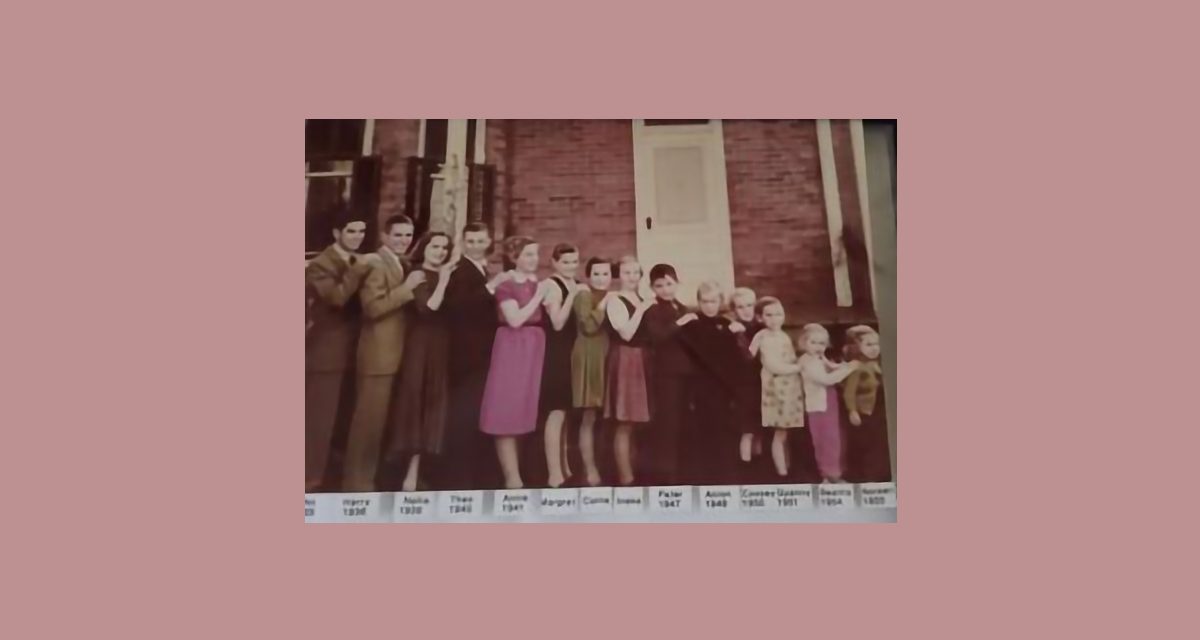
Postwar, our family immigrated to Canada on April 1, 1952. They had the choice of immigrating to Australia or Canada and our grandparents chose Canada. They left Rotterdam, Holland on March 25, 1952, aboard the SS Waterman and crossed the Atlantic Ocean, arriving in Halifax, Nova Scotia on April 1. They would have made the voyage sooner, but our grandmother was pregnant at the time, with Gyanny, delaying their trip by another year. They crossed the sea with 12 children in tow, including John, Harry, Nellie, Theo, Anna, Margaret, Corrie, Ineke, Peter, Anton, Koosey and baby Gyanny. Their ages ranged from one to 17. The voyage was spent with men and boys on one floor of the ship and the women and girls on another. The high seas and rough waters made the journey difficult at best. John, Harry and Theo recall spending most of the time being very seasick with the pitching of the ship in very high seas. With reluctant hearts, they endured the hardship and unforgiving swells of the rolling sea to get to Canada and begin again.
They made the remainder of their voyage by steam train to St. Eugène. John and Theo described the train as barren with no seating and a pot-bellied stove in the centre of the railcar to warm themselves. They had to use whatever means possible to stay warm for the several days it took with no water or food to be had. The Harry LeRoy family of Barb Road would step up and provide a home for our family. Home became a simple brick house, cold in the winter without the amenities they had known, but it was a place to start over and begin life anew. The family was given daily rations of milk and firewood to subsist with. To make their new life a success, all children had to undertake menial labour and bring home every cent they earned, to their father. It took a lot of eggs and bread to feed this family of 12, soon to expand with the arrival of Beatrix, Noreen and Roy, who were born after their arrival in Canada.
The dream of owning a farm was realized in 1955, when our grandfather purchased a 150-acre farm formerly owned by William Mullin, located on Barb Road. He purchased the farm for approximately $15,000 to $18,000 and the funds used were hard earned, thanks to the contributions of all his children.
Our grandmother passed away while birthing her 16th child on October 31, 1958, just six years after arriving in Canada. Her heart longed to be back in her homeland and as Theo shared, if there wasn’t a sea between her and The Netherlands, she would have walked all the way back home.
With the death of their mother, Anna was given the challenge of helping to look after the family. That meant a lot of laundry, meals to cook and children to care for. An overwhelming task for any teenager, all while grieving the loss of her mother. She recalls the sadness in their home. Our grandfather remained a widow for 11 years and re-married Gabrielle Massey in 1969, also a widow with her two sons, Michael and Romeo, in 1969.
Never looking back but staying the course, has been our family’s unspoken truth. Great grandchildren have come and are having children of their own. Life continues and we flourish because one man and one woman decided to risk everything and start again. We celebrate their courage, their strength and faithful fortitude, for giving us all a wonderful place to call home, Canada. This is why we remember and celebrate Remembrance Day.
PS; This was written with deep and profound respect for those who carved the way and found the courage to tell this story. Thank you for sharing it and entrusting us to carry your story forward to a new day so that your journey will never be lost and always remembered.