
By Shawn MacWha
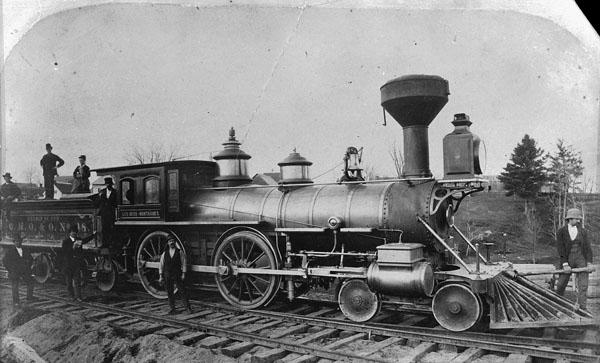
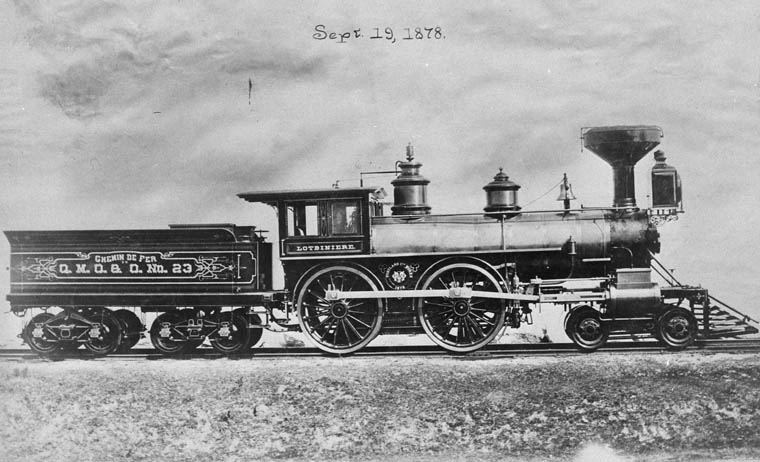
During the latter years of the Nineteenth Century the Government of Québec funded the construction of a number of “colonization railroads” to open up new parts of the province to settlement and economic development. The Québec, Montréal, Ottawa and Occidental Railway (QMO&O) was one such undertaking and in December, 1885 it was granted a charter to build a line from Québec City to Ottawa along the north shores of the Ottawa and St. Lawrence Rivers. By connecting the largest cities in the region with smaller towns and villages along the province’s two greatest rivers it was hoped that the railway would spark new industries to stem the tide of young Quebecers who were leaving their homes to find jobs in the bustling factories of New England.
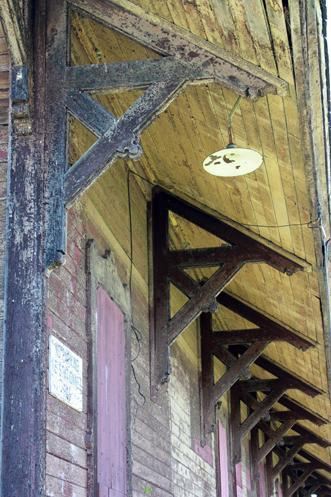
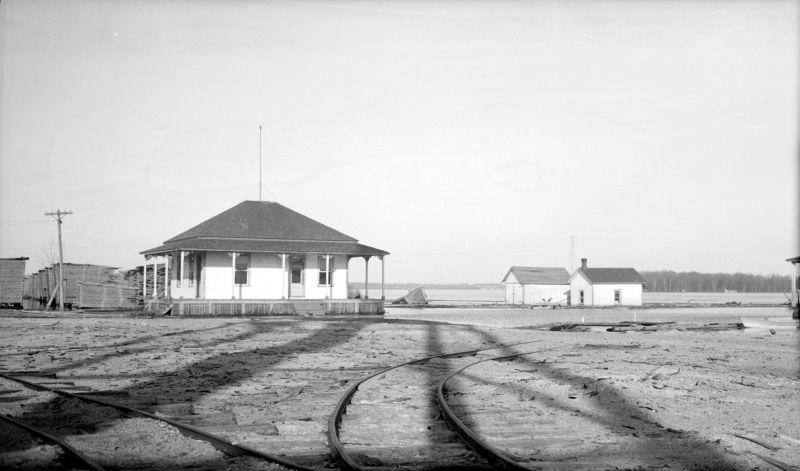
Construction of the railway began in the first weeks of 1876 and the 200-kilometre-long section of track between Montréal and Alymer was finished in the spring of 1877 thanks to the efforts of almost 600 workers. Stations strung out along this line included ones in Ste. Therèse, Ste. Scholastique, Lachute, Staynerville, Calumet, Fassett, Thurso, Masson, and Hull as well as a number of smaller towns along the way. Like the station in Calumet the majority of these buildings were single story wooden structures that featured a ticket office, a small restaurant, indoor and outdoor waiting areas and a warehouse for freight. Goods and passengers waiting outside were protected by large overhanging eaves and the station master had a small office which projected out from the main part of the building to allow him to see up and down the tracks for approaching trains. Starting in 1878 the stations also had telegraph offices operated by the Dominion Telegraph Company offering towns along the railway with an instant connection to the outside world.
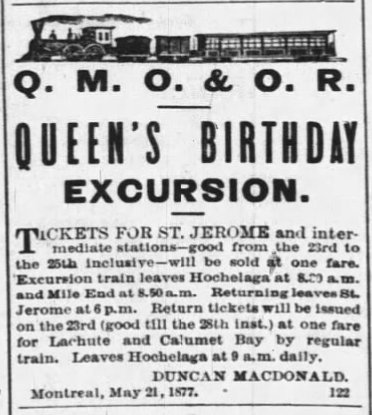
Almost immediately upon its completion, Calumet station became the centre of activity for the surrounding region. In May, 1877 a new steamer service was established which allowed travellers in Ottawa to board the steamship Geneva and sail down the river to connect with the train at Calumet. From there passengers could then proceed directly to Montréal, making the voyage from the nation’s capital in an unprecedented seven hours. For those visitors who wanted to stay in Calumet to enjoy the local fishing, boating, and country pursuits the Calumet House Hotel offered fine accommodations at reasonable rates only a few minutes away from the railway station. Other travellers preferred to cross the river by ferry and take a stagecoach to the larger resorts in Caledonia Springs. There patrons stayed at places such as the Grand Hotel where they could bathe in the town’s famous mineral waters and engage in recreational activities such as bowling, lawn tennis, croquet, and horseback riding. Evenings featured dances, parties and even an orchestra. Around the turn of the last century tourists from all over Canada and the United States, and even as far away as Europe, came to take the waters in this idyllic little Eastern Ontario town.
While the QMO&O sold its tracks between Montréal and Alymer to the Canadian Pacific Railway (CPR) in 1882 the railway remained the primary means of transport along the north shore of the Ottawa River until the coming of reliable roads in the 1920s. Along its route three different resource railways came down from the Laurentians to join the main line and add important freight revenues to the CPR: the Thurso and Nation Valley Railway, the Salmon River and Northern Railway, and the Dominion Timbers Railway. Passengers too used the railway to move between Montréal, Hull and the towns and villages in between. During the 1920s, for example, there were up to four trains a day between Calumet and Montréal, and two that ran westwards to Hull. However, with the decline of passenger traffic in the latter years of the Twentieth Century service, dropped to only one regular train per day in the 1970s, plus a Sunday service to, but not from, Montréal. Passenger service along the line was stopped completely in the fall of 1981, with the last train stopping in Calumet on November 14.
That is not to say that there were not calls for a resumption in service. In 1985, for example, this newspaper reported on the efforts of Lachute resident Arthur Goldup to have passenger service reinstated along the line from Calumet to Montréal. While this unfortunately never occurred and Montréal’s EXO network has yet to make the obvious connection to Lachute there have nonetheless been on-going efforts to at least save the station. As early as 1990 the CPR offered to sell the building to the village of Calumet, which wanted to convert it into a library, for only one dollar. However, the $120,000 price tag for the land upon which it sat derailed (sorry) the plan to transfer the station to the municipality and CPR ended up keeping the station.
Several years later the CPR finally succeeded in getting rid of the station, as well as its “north shore line,” on November 1, 1997 when it sold it to the Québec Gatineau Railway (QGRY), a subsidiary of Gennesse &Wyoming Inc. While freight trains have continued to roll by Calumet since that time, the days of people stopping here to enjoy the local countryside, or head off on other adventures, are sadly now over.
Fortunately there are still efforts afoot to save the station, which is now almost 150 years old. As James Morgan reported in The Review earlier this year (“Calumet railway station preservation efforts continue,” February 17, 2023) https://thereview.ca/2023/02/17/calumet-railway-station-preservation-effort/ the Grenville-sur-la-Rouge council recently agreed to work with the QGRY to put a temporary cover over the station and cooperate on its eventual preservation and restoration. Given how much of Canada’s industrial history has been lost to decay or the wrecking ball one can only hope that these efforts will be successful and that this station can once again find a place in the life of the community.
Calumet and the railway