

Written by:
Michelle Landriault
The deaths of children in combat service is a particularly heavy loss for a family to suffer. Imagine how such tragic events can affect, even break, the normal course of family life. Think of the courage needed to move ahead in life, to make every day count, to remember.
The Milner Family of Pleasant Corners Road, Vankleek Hill is one of several Canadian families who painfully lost multiple sons in World War II. Thomas and Margaret (McDonnell) Milner saw four of their sons enlist. One son, Collin, was returned home from military service after his three brothers were Killed in Action. For survivors, this is not an easy thing to do, nor is it easy to live with.
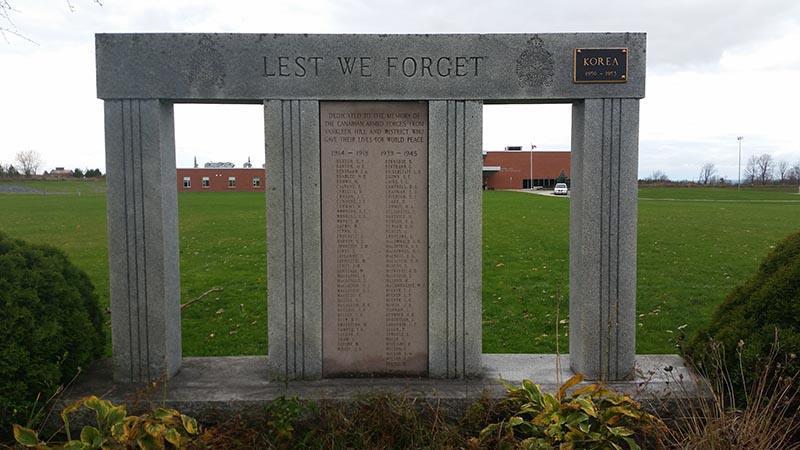
The names of the three brothers can be found on the modest family tombstone in St. Gregoire Catholic Cemetery. Their names also appear on the Vankleek Hill War Memorial located at Vankleek Hill Collegiate Institute. However, their military story was not so visible.
Guy Benedict Milner, Evan Milner, Joseph Emmett Milner
The courageous WWII history of these three brothers was unexpectedly brought to life several years ago by Michael Berrie, Aviation Researcher & Archivist, Oxford, England. He came across the air combat history of the Milner boys while researching a project based on a Lancaster bomber exhibit. Not long after, Berrie purchased a Lancaster flight log that surprisingly showed up on e-Bay. That rare flight log reported on an RCAF crew that included Guy Milner.
The discovery that Guy Milner came from Vankleek Hill, brought Michael Berrie to connect with the Vankleek Hill & District Historical Society. Here, with editing & additions, is the Milner research provided by Michael Berrie for which we are grateful.
Three Milner Boys, Royal Canadian Air Force 1943-1944
Michael Berrie begins: I was researching the wartime crash of Lancaster Bomber ED916 over Holland in June, 1943. Killed in the crash was a member of the RCAF, Guy Benedict Milner. Further research led me to Vankleek Hill, Ontario as his birthplace.
Then I discovered that he was one of three brothers from the same family who were all killed in the combined service of the Royal Canadian Air Force and the Royal Air Force during WW II. The three Milner boys died in combat over a period of seven months: June 1943; September 1943; January 1944. They are:
Guy Benedict Milner, 22, Mid-Upper Gunner, Lancaster ED916, 103 Squadron Royal Air Force, lost over Holland 13th June 1943. Killed by German Luftwaffe night fighter ace Werner Rapp over Holland while returning from a raid on Bochum, Germany. It is important to highlight that Guy Milner had chosen to stay for a second tour of duty. This fatal flight was to have been his final flight in completing his second tour.
Joseph Emmet Milner, Warrant Officer Class 1 Pilot, Sterling EE912, 15 Squadron RCAF, on an operation, Stirling aircraft EE 912, to Berlin. Shot down near Trostow, Germany during operations over Berlin, Sept 1st 1943 – all seven crew lost. Buried in the Berlin 1939-1945 War Cemetery established in 1945 as a central burial ground for aircrew and prisoners of war who were interred in the Berlin area and in East Germany. Of the wartime burials, about 80% are aircrew, killed in action over Germany, the remainder are prisoners of war. This is all the information available at this time.
Evan Milner, Air Gunner, 419 Squadron RCAF, lost on a raid on Berlin, Jan 29th 1944. Canadian Military Archivist Glenn Wright reports that Evan Milner is buried at Zuhlen, Germany. He is commemorated on the Runnymede War Memorial, Surrey, England. This is a memorial to 20,000 air crew who died with no known individual grave.
As Archivist Michael Berrie says, he was fortunate to come across the flight log for the Lancaster ED916 flight in which Guy Milner was Mid-upper Gunner. For this reason, there is more detail here about Guy Milner than about his two brothers. Certainly, the confusion, alarm, and quick decisiveness required in these dire circumstances would hold true for the other two fatal flights.
1943 Flight Log Book Lancaster ED916 purchased on E-bay
Michael Berrie: About 20 years ago, I planned to build a mock-up of a Lancaster Radio Section based on a collection of Lancaster aircraft parts I had brought together. As the project got bigger, I dealt with quite a few military dealers. Soon, bomb aimer and navigator equipment arrived and were placed into storage until needed for the project.
Eventually during this process, a dealer contacted me and said that he had a flight log book for sale belonging to the wartime wireless radio operator George Backhurst of the Lancaster ED916. The dealer asked a high price, but I purchased it. It was a magnificent thing to see and I carefully put it away for further research. Eventually, the Lancaster Radio Section project was completed in the museum at Royal Air Force Welford where I am archivist.
I began to seriously read the purchased flight log book. I discovered that the Lancaster ED916 crew had completed many raids that included flying over the Alps twice to both La Spezia in Northern Italy and to Berlin, as well as twice over the U-boat pens at St. Nazare, France.
Guy Milner – Deadly Air Combat
According to the log book, on the night of June 13, 1943 the crew of Lancaster ED916 from RAF 103 Squadron took off from RAF Elsham Wolds in North Lincolnshire for a bombing mission to Bochum, Germany. This was to be the crew’s 20th bombing mission.
Guy Milner had already completed his first tour of duty, and he could have then gone on a training roll. Instead, he chose to sign-on for a 2nd tour.
It should have been a relatively simple mission. The crew was a Commonwealth crew with two Canadian members: Guy Milner was in the Mid Upper Gunner position and the other Canadian, Sgt. Barry Godden of Nova Scotia, was in the Rear Gunner position.
The crew completed the mission and was returning to England over Holland, when suddenly a German night fighter operating out of Twente airfield in Holland jumped them from the port side and slightly below. The 30mm cannon shots from the Luftwaffe night fighter passed through the mid turret killing Guy Milner instantly, and ruptured the port wing tanks. Sgt. Godden was hit by splinters in the leg.
The pilot took evasive action and corkscrewed the aircraft, but it became un-flyable. The pilot ordered the crew to bail out. According to the pilot’s statement in 1946, he jumped from the aircraft only after the crew had all exited safely. Less than 10 seconds after he bailed out, the aircraft exploded in mid-air. The Dutch police later found the body of crew member Sgt. Francis Jay from Croyden, England dead in his parachute, but the cause of his fatality was unknown. Possibly the chute was damaged, or he sustained injuries as he bailed out.
The rest of the surviving crew were taken Prisoners of War, and only liberated in 1945 from various POW camps in Germany. It was then that the full story of the Luftwaffe night fighter attack was finally put together by the Royal Air Force from the independent post war reports of the surviving crew members.
I was able to track down the German claim report of Luftwaffe night fighter Oblt Werner Rapp who staked his claim of this Lancaster over Hover Geen, Holland. Rapp’s eventual fate is unknown to me at this time, but he survived WW II with 18 enemy aircraft destroyed. By all accounts, he was an above average fighter pilot.
Flying with Rapp that night was his electronics officer whose log book I was able to trace, and it conclusively verified the claim position and times of the fatal air attack on Lancaster ED916. Rapp and his air crew were coming around for a second attack when the Lancaster aircraft exploded.
Guy Milner’s mother Margaret: three years of contradictory information
It seems that there was a lot of confusion about whether or not Guy Milner had died; as well as a lot of doubt on the part of the RCAF. There is evidence that the RAF placed all the wives and mothers of missing, or captured crew members in contact with each other in the hopes of sharing information amongst themselves should anyone hear from an imprisoned husband, or son.
As a result, Guy Milner’s mother, Margaret, received a letter from the navigator’s wife, Mrs. Hemmingway. That letter told Mrs. Milner that Navigator Rowland Hemmingway was in a POW camp and that all the crew members of Lancaster ED916 were safe. This caused some grief and confusion. However, the RCAF believed him to be dead and had sent a letter to that effect telling Mrs. Milner that her son Guy was missing, presumed dead.
The farm of Thomas and Margaret (McDonnell) Milner is on the north side of Pleasant Corners Road. Their neighbor, the late Jack Mooney, recalled as a young man in his 20s on a summer day in 1943 seeing the taxi from Vankleek Hill slowly going up the long Milner farm driveway to deliver to the parents the official telegram reporting Guy’s death. “That’s how it was done,” Jack said. “A telegram would arrive in Vankleek Hill, and a taxi driver would deliver the news to the family.” It was to be the first of three taxi arrivals to take place within a seven month period.

Milner Farm, Pleasant Corners Road
In the same time period as the arrival of the telegram, a letter was received by the father of Canadian Rear Gunner Barry Godden which was published in a local paper in Nova Scotia. The letter stated that two of the crew were killed – Francis Jay and Guy Milner. At the time, the RCAF could not be sure what the truth was because both letters – Hemingway and Godden – had come via “enemy sources.”
In fairness to the Germans, though it may seem strange, they did go to some effort to do the decent thing and informed the RCAF of the death of Guy Milner via the Red Cross in Geneva.
The Germans forwarded a copy of their official death entry and information that they had compiled. I have a copy of this. Given that a captured airman was only required to give name rank and serial number, and would not divulge any other crew names because they still may be evading capture, providing this death information was a difficult task for the Germans who could just as easily have left well enough alone.
From the German information, we learn that the Lancaster wireless radio operator, George Backhurst, suffered a back injury in the bail out and was attended by a Dutch physician. Under normal circumstances, there was a good chance the physician was a member of the Dutch Resistance who would help guide Backhurst safely to an escape line. However, the back injury was severe enough that it required hospital treatment as the only safe option.
It was while in hospital that the Germans interviewed George Backhurst and showed him the dog tags of Guy Milner RCAF. They informed him that the body had been found in the burnt-out wreckage of a Lancaster. Backhurst recognized the name from the dog tags. Later, Backhurst and Godden met up at a German POW camp, and the information about Guy Milner’s death was exchanged. Godden then sent his letter home with the information about the deaths of Jay and Milner. Yet still the RCAF was not certain.
Because Pilot Guy King believed himself to be the last to exit the failing aircraft, he also believed that all the Lancaster crew got out and safely landed. He later reported this in his 1946 RAF statement. King may well have passed on his belief in the crew’s survival to Navigator Hemmingway. As they were in different POW camps from the other remaining Lancaster ED916 crew members, King and Hemmingway genuinely believed it true. As a result, it was Hemmingway who, in good faith, wrote to his wife about the Lancaster ED916 crew’s survival.
The RCAF was then in a position of having no conclusive proof, and of having conflicting statements from various sources. Guy’s mother, Margaret Milner was genuinely excited with the news from Mrs. Hemmingway that all the crew was safe. An internal RCAF letter reveals that the RCAF, though confused, leaned toward believing that Guy Milner was dead.
However, it was not until 1946 that the RCAF finally received details of Guy Milner’s burial place. This information arrived after receiving a statement from returning Warrant Officer Godden stating that Guy Milner was dead. In 1946, the RCAF sent a letter to Thomas and Margaret Milner which finally gave them details of the grave location for their son Guy.
Milner Family descendants report they have a letter written to their grandmother Margaret Milner in 1948. The writer was in the plane that went down with rear gunner Guy Milner. The letter tells how the gunner and the pilot saved the lives of the crew – while a German fighter was attacking the plane – the gunner kept shooting as the pilot flew. The crew was able to parachute out. The fellow who wrote the letter was the gunner trainer and this was Guy’s last training run.
Lancaster ED916 Crew Members
In 2002, Canadian Rear Gunner crew member Sgt. Barry Godden passed away in Glace Bay, Nova Scotia. The Lancaster navigator Rowland Hemmingway died in 2000 in a Blackpool, England hospital. His war medals were put up for sale on E-bay. I found his name 15 minutes before the end of the E-bay bidding and was able to buy them. In time, the medals will be passed on to the 103 Squadron Association Museum at Elsham Wold.
The Lancaster ED916 Pilot Guy King remained with the RAF to become Squadron Leader. He retired in 1955 and became an airline pilot. He died in Marlow, England in 2000.
Wireless Operator George Backhurst whose log book I purchased was born in 1911 and emigrated to Australia. I have not found his death certificate; however, because I have his log book, I must presume he has died. I have found no trace of the Bomb Aimer Sidney King as there are some 123 death certificates on file with that name.
The bodies of Sgt. Francis Jay and Mid-Upper Gunner Guy Milner are buried side-by-side at Westerbrok Cemetery in Holland. 103 Squadron Association Museum provides details of the fatal flight & a photo of the grave stones at Westerbrok Cemetery, Holland for the two lost crew members: Francis Jay and Guy Milner.
Evan Milner: commemorated on Runnymede War Memorial
Michael Berrie: I have some background information on Evan Milner and I have a service history. Sadly, there is still no photograph. Evan started off as a farmer, likely with his father on Pleasant Corners Road; but after two years he joined the Sullivan Mining Company as a diamond driller and later as a drill operator. When war broke out, Evan enlisted in the RCAF as a cadet, and trained as a Wireless Operator and Air Gunner before being commissioned. After arrival in England, he joined 16 Operational Training Unit (RAF Upper Heyford). He was posted to 12 Squadron, and then to 103 Squadron as a Gunnery Leader.
My contacts in the RAF inform me that Milner had already done a tour with 12 squadron before being transferred to 103 Squadron and as Gunnery Leader was responsible for briefings. This flight would have completed a second full tour.
Evan Milner died on an air raid over Berlin January 29, 1944. The will of Evan Milner left all his possessions to his mother Margaret, and the RAF listed all his personal items at Elsham Wold in great detail. Right down to the fact that his lighter did not work. He is commemorated on the Runnymede War Memorial, Surrey, England. This is a memorial to 20,000 air crew who died with no known individual grave.
You have to have deep sympathy for Mrs. Milner who, while clinging to hope that her son Guy is alive, had her hopes raised and dashed three times.
Guy Milner, 1st Tour of Duty
Here is information collected from No.12 RAF Squadron concerning Guy Milner’s 1st tour before joining 103 Squadron. Listed are details of the bombing targets and dates . This information is not in his official records. At this point in his 1st Tour, Guy Milner could have gone on to a training roll. Instead, he signed up for a second tour which was fatal.
P/O Guy Benedict Milner was posted to 12 Squadron, RAF Binbrook during the summer of 1942. In September 1942, 12 Squadron transferred to RAF Wickenby with a view to converting to Lancaster aircraft. However, they retained a few Wellington aircrafts and continued flying sorties against the enemy.

Crest for RAF Squadron 103: “Touch me not” – a swan was chosen for the power of its flight strength and its impressive ability to defend, in juxtaposition to its beauty. RAF 103 Squadron was based at RAF Elsham Wolds, England where it was a busy flight squadron. Of the 248 bombers lost in WWII operations out of Elsham Wolds, 198 were from 103 Squadron. Of the types of bombers lost, 208 were Lancasters.
The personnel transferred was the following crew:
P/O D. C. Hagerman, Pilot
P/O B. H. Chant, Nav.
Sgt. T. M. Markins, W/OP
Sgt. C. L. Neale, Bomb Aimer
P/O G. B. Milner RCAF, RG
In Wellington aircraft, they flew the following raids:
30/09/42 to the Kattegat (mining) in Z8501
6/10/43 to Kiel in Z8437
13/10/42 again mining in Z8407
17/11/42 again mining in Z8407
During December 1942, the conversion to Lancaster aircraft took precedence. The original crew was joined by Sgt. P. V. Knight, Flight Engineer and Sgt. M. Evans, MUG. They flew Lancaster bombers on the following raids:
09/01/43 to Essen in W4373 PH-F
11/01/43 to Essen in W4373 PH-F
21/01/43 to Essen in W4373 PH-F
23/01/43 to Dusseldorf in W4373 PH-F
02/02/43 to Cologne W4373 PH-F
04/02/43 to Turin in W4373 PH-F
13/02/43 to Lorient in W4373 PH-F
14/02/43 to Milan in W4373 PH-F
16/02/43 to Lorient in W4373 PH-F
18/02/43 to Wilhelmshaven in W4373 PH-F
05/03/43 to Essen in W4373 PH-F
08/03/43 to Nuremburg in W4373 PH-F
09/03/43 to Munich in W4373 PH-F
12/03/43 to Essen in W4858 PH-A
26/03/43 to Duisburg in W4373 PH-F
29/03/43 to Berlin in W4881 PH-C this was the completion of their tour.
